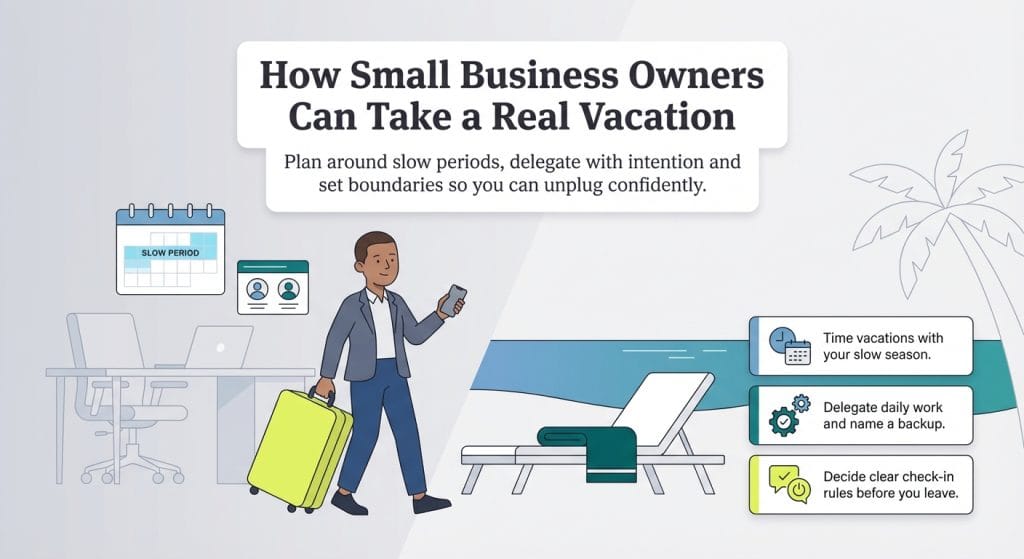
Running your own company comes with plenty of freedom, including the ability to set your schedule and adjust it as life demands. But that flexibility has a flipside: Taking real time off can feel almost impossible when you’re the one holding everything together.
Even so, giving yourself space to step away matters. Time off helps you reset, clear your head and return with the kind of energy and perspective that’s hard to access when you’re always “on.” The challenge, of course, is figuring out how to take that break without worrying about what’s happening back home. Here’s how to plan a worry-free vacation as a small business owner so you can recharge and support your company’s long-term success.
How to take a vacation as a small business owner
Taking time away isn’t just a nice break: It directly supports your performance as a leader. A 2025 review that looked at 32 different studies found that vacations can have a meaningful and lasting impact on overall well-being. And in separate research, even a single week off was linked to better sleep and lower stress levels. Those improvements can help you come back with clearer thinking and more confident business decision-making — two essentials for running a healthy company.
Follow these tips to ensure your business is taken care of without sacrificing your necessary R&R.
- When possible, plan vacations around slow periods
- Set vacation boundaries for yourself
- Delegate your work
- Prepare employees for any foreseeable issues
- Let important clients know you'll be on vacation
- Establish a second-in-command for urgent matters
- Enjoy yourself
1. When possible, plan vacations around slow periods.
Most small business owners have a good sense of when their operations naturally slow down. Those quieter stretches are often the best times to step away, though they don’t always line up with ideal travel windows. If your downtime hits during hurricane season in the Caribbean or when winter storms are rolling through the Northeast, you may want to look at destinations with more reliable weather or consider a shoulder-season trip that matches your schedule better.
Family schedules can add another wrinkle. School breaks often overlap with peak travel times and some of the busiest periods for many businesses. When that happens, look for alternatives such as long weekends, partial-week trips or destinations closer to home. You can also plan ahead for peak-season coverage so you’re not locked into traveling only when work slows down.
The
best time to take a vacation depends on your business cycle. Try to schedule trips during slower stretches when possible. If your slow season isn't ideal for travel, look for nearby destinations or shorter trips that still give you a real break.
2. Set vacation boundaries for yourself.
Once you decide the best time to take your trip, you’ll want to set some work-life boundaries and establish a few rules for yourself while you’re away.
- Determine if you can unplug: Start by deciding how connected you want to be. Do you plan to fully unplug for the week, or do you prefer limited check-ins? Some small business owners have more flexibility here, depending on the managers or support staff they have in place.
- Choose your accessibility level: If completely disconnecting isn’t possible, choose the level of contact that feels sustainable. Maybe a single daily check-in on Slack is enough. Maybe you only want to be looped in on true emergencies. Or perhaps it’s more realistic to set aside an hour every other day, similar to office hours. Whatever you decide, communicate those expectations before you leave so your team knows exactly when and how you’ll be available.
- Set your boundaries: Once you know how available you want to be, decide what rules will help you stick to that plan. For some people, a single short check-in works. Others feel more at ease looking at messages twice a day. What matters is having a boundary you can maintain. According to the American Psychological Association’s 2025 Work in America Survey, workers who let work spill into their personal time reported higher stress, while those with more control over their hours and environment reported better mental health and lower stress overall.
3. Delegate your work.
Building a capable, trustworthy team is ultimately what gives you the freedom to step away. When you know day-to-day operations are covered, you gain the flexibility to travel when it works best for you, not just when business is slow. As DeAnna Spoerl, co-owner and director of client services at Bear Icebox Communications, put it, “You must plan ahead — not only for your relaxing trip but also for any work that needs to be done when you’re away.”
Here are some tips for covering your responsibilities ahead of time:
- Plan early: Start your delegation plan as early as you can. Map out the tasks you typically handle and decide who will take over each responsibility. Is there one person who can manage your daily operations, or does it make more sense to divide tasks among several people to avoid overloading anyone?
- Train your team: Once you’ve identified the right people, set aside time to walk them through each process, especially if they’re new to the role. “Delegating tasks [takes] a lot more than just telling people what to do,” Spoerl explained. “There’s explaining the ‘whys’ behind certain strategic moves or how to handle difficult client situations.”
- Evaluate your responsibilities: Review your workload, prioritize tasks and determine what truly needs attention while you’re away. Some responsibilities can be paused until you return, and clearing that non-urgent work off your plate can make a big difference. As Spoerl noted, “Some businesses are a bit harder to fully disconnect from. However, if you can at least know that nothing major is pending during your precious time off, that’s a step toward chillaxing.”
4. Prepare employees for any foreseeable issues.
As you plan your vacation, take time to think through any issues that could realistically arise while you’re away. Even if something is unlikely, it’s better to flag it for your team than have them caught off guard without guidance.
Decide whether potential issues should be shared broadly with all department leads or handled by one trusted manager. Either way, the goal is the same: empower your staff to address problems while you’re out. Even when you trust employees to handle situations as they come up, formally outlining how to escalate concerns and when they should involve you creates clarity for everyone.
According to an
Adobe report on entrepreneurial work-life balance, 82 percent of small business owners lose sleep over work concerns. Setting clear expectations before you leave can keep those worries from following you on vacation.
5. Let important clients know you’ll be on vacation.
If your business keeps you in regular contact with clients or partners, give them advance notice that you’ll be away. A quick heads-up gives you both time to address any loose ends before you leave and reassures them that they’re still a priority to your business.
Do the following when you connect with clients:
- Review any active projects or outstanding issues and decide together what can be wrapped up beforehand and what can wait until you return.
- Clarify who their main point of contact will be while you’re out, especially if clients are accustomed to working directly with you.
- Introduce the team member who will be covering for you and confirm how and when that person can be reached.
- Reassure them that they’ll be supported during your absence.
A little preparation goes a long way in maintaining trust and keeping work moving smoothly while you’re away.
6. Establish a second-in-command for urgent matters.
To give yourself the best possible break, choose someone on your team to serve as your second-in-command while you’re away. A trusted point person who can act on your behalf and handle the decisions you’d normally make dramatically increases your chances of actually disconnecting.
“When we go out of town, we do our best to let our team know specific days we will absolutely be disconnected,” said Spoerl. “We also have a roster of senior account advisors who would be entirely capable of stepping in to help the team out if needed.”
Your backup should be someone with the following characteristics and abilities:
- You trust them implicitly.
- They can make sound decisions.
- They know when to push back or say no.
- They should feel comfortable acting as your gatekeeper, protecting your time off and filtering out anything that doesn’t require your attention.
Once you’ve designated that person, communicate the plan to the rest of the team so everyone knows who to turn to during your absence. This not only helps keep your vacation uninterrupted but also reinforces an employee-centric company culture where time off is respected and everyone feels supported. As Spoerl put it, “If any one of us says, ‘I need time off for X,’ our trust system allows us to freely take the time we need, knowing that our team members have our backs.”
Delegation is an essential
business skill that directly supports your ability to step away. Owners who delegate well are far more likely to take uninterrupted time off.
7. Enjoy yourself.
As a business owner, you care deeply about the company you’ve built and the team you’ve supported. But caring for yourself is just as essential to your long-term success, and you deserve time off.
Many entrepreneurs put in long hours to keep their businesses running smoothly. In fact, the Adobe report on small business owners (cited earlier) found that about one in five puts in more than 50 hours a week, with many logging 60 hours or more. Without enough time to rest and recharge, that kind of pace can quickly lead to burnout.
And of course, all the preparation that goes into taking a vacation can feel like work in its own right. Planning, packing, arranging pet care, and putting mail on hold can all add up. Your business requires the same kind of forethought. “Planning ahead could look like scheduling emails, tying up loose ends or prepping your second-in-command to be able to handle any pressing issues that may come up,” Spoerl said. “Vacation needs to feel like a true getaway — calm, quiet, release of muscle tension and peace. But you won’t be feeling any of that if you haven’t prepared for your duty to be handled.”
Lining up coverage before you leave makes it far easier to switch out of work mode. With the groundwork done, you can actually relax and enjoy the time away you’ve earned.