Business.com aims to help business owners make informed decisions to support and grow their companies. We research and recommend products and services suitable for various business types, investing thousands of hours each year in this process.
As a business, we need to generate revenue to sustain our content. We have financial relationships with some companies we cover, earning commissions when readers purchase from our partners or share information about their needs. These relationships do not dictate our advice and recommendations. Our editorial team independently evaluates and recommends products and services based on their research and expertise. Learn more about our process and partners here.
Economic uncertainty has left many employers facing the need to reduce their workforce. But layoffs aren’t the only option. Learn more about offering voluntary severance.


When economic uncertainty impacts businesses, many commonly turn to workforce reductions as an option to save money and bolster cash flow. For example, more than 271 tech companies made layoffs in 2025, resulting in more than 124,201 employees being laid off, according to Layoffs.fyi.
However, layoffs aren’t business owners’ only option when it comes to reducing their workforce. One alternative is to offer voluntary severance — paying your employees to quit. It could offer a better way to save on labor costs without impacting the morale of the employees who remain on the team.
Voluntary severance is a mutually agreed-upon arrangement where an employee chooses to resign in exchange for a financial package and other benefits. Companies typically introduce these programs when they need to downsize or reduce costs without making layoffs.
Unlike involuntary measures such as layoffs or other kinds of employee termination, voluntary severance puts the decision in the employee’s hands. Workers can accept or decline the offer, and in many cases, the terms of the severance contract can be discussed and negotiated between the employer and the employee.
Each company will offer different benefits under a voluntary severance agreement, said Lindsay Witcher, global managing director for Randstad RiseSmart. Typically, a voluntary agreement will offer salary and health care coverage continuity for the employee over a set period of time and sometimes an additional amount of money to help the employee transition.
Involuntary layoffs can be incredibly emotionally distressing for employees, Witcher said, “for obvious reasons.”
“You have a family to support, you have yourself to support, you have obligations, you have all these things,” Witcher said. “Especially when the job market is like it is, it is just so very, very difficult for people. So, when it’s done to you, it’s a shock.”
While opting to take a voluntary separation agreement can also bring up fears of the unknown, Witcher said, it can allow for more of a sense of control and a runway for employees to plan their next move. “When we choose something, the outcomes are always better than when something is chosen for us,” Witcher said.
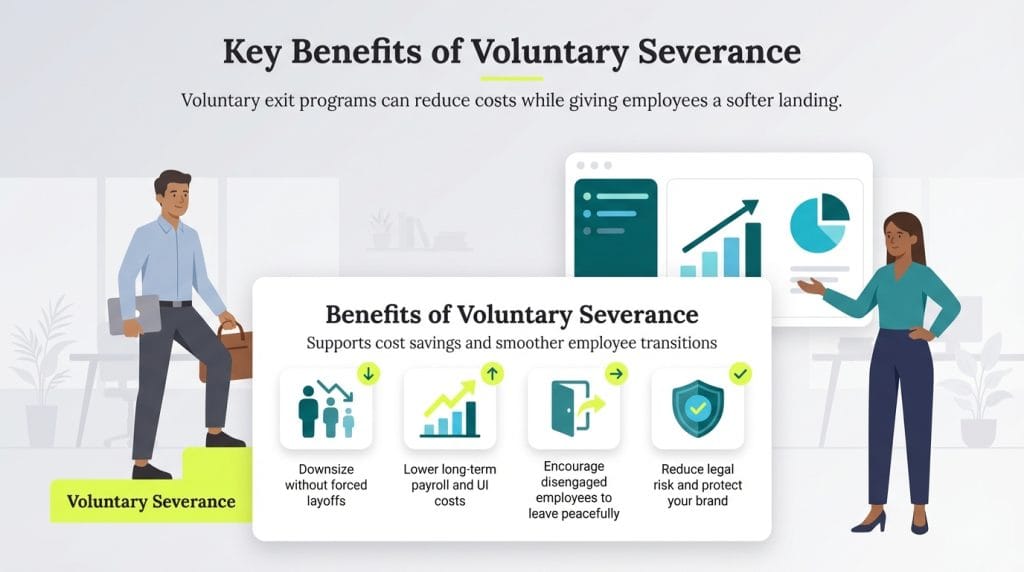
Implementing a voluntary severance program can create advantages for both the organization and its workforce. For employees, it provides a financial safety net to pursue new career paths, transition into early retirement or leave a role that no longer fits their goals. For employers, the benefits often extend beyond immediate payroll reduction.
Voluntary severance allows employers to downsize their organization without having to lay off employees. This is typically the primary reason a company will offer voluntary severance and it often comes as a result of needing to cut costs, such as salary and benefits or increase efficiencies. We tend to see voluntary severance programs pop up when organizations are faced with economic uncertainty and need to protect themselves.
Offering employees the option to partake in a voluntary severance program can benefit your organization monetarily in the long run. Not only do you reduce the amount of money you’re spending on employee wages and benefits, but you also prevent your organization from having to manage costly unemployment insurance (UI) claims. Having a large number of UI claims against your business can result in higher state tax rates and penalties.
Voluntary severance incentives effectively place the separation decision in your employees’ hands. Given the option to leave with a financial cushion, disengaged or underperforming team members may self-select out of the organization. This type of incentive can be just the push they need to leave the company peacefully.
Rather than managing lengthy disciplinary processes or writing performance improvement plans, you provide a graceful exit route. Resolving poor fit through a voluntary option saves management time and preserves company resources, allowing you to focus on retaining top talent. [Related article: How to Handle a Bad Hire]
Securing a voluntary severance agreement can significantly reduce a company’s exposure to potential litigation. The voluntary nature of the exit creates a mutual understanding: employees are less inclined to file lawsuits or grievances against a former employer when they have chosen to leave on good terms with fair compensation.
While voluntary severance agreements aren’t completely without risk, “it’s significantly less likely that employees are going to say, ‘I was discriminated against,’ because they voluntarily took the package or took the program,” said Trina Ricketts, shareholder at employment law firm Ogletree Deakins and co-chair of the firm’s Reduction in Force and WARN National Practice Group.
A business owner can also choose to include a section in the severance agreement that restricts the employee from pursuing legal claims against the employer. “A really important element of any severance agreement is going to be a release of claims, that the employee is releasing the employer from any future claims,” said Alex Berke, an employment attorney with Berke-Weiss Law.
Offering a voluntary exit option helps protect your brand reputation by minimizing the animosity often generated by forced layoffs. A respectful, voluntary separation process positions the company as an empathetic employer, which is critical for maintaining trust with remaining employees, clients and future candidates.
Since the decision to leave the organization is ultimately up to the employee, this kind of exit can build goodwill with that worker and reduce the possibility of them speaking poorly about your company to others. “If the person leaves having a good experience, they will remain a brand advocate,” Witcher said.
Involuntary workforce reductions, especially large ones, can often garner negative media attention, said Ricketts. So, too, can legal claims of employment discrimination. “Ultimately a person is being accused of something, even though it’s the company who is being sued,” Ricketts said. “So [discrimination claims] are very, very personal and can be distractions to the business.”
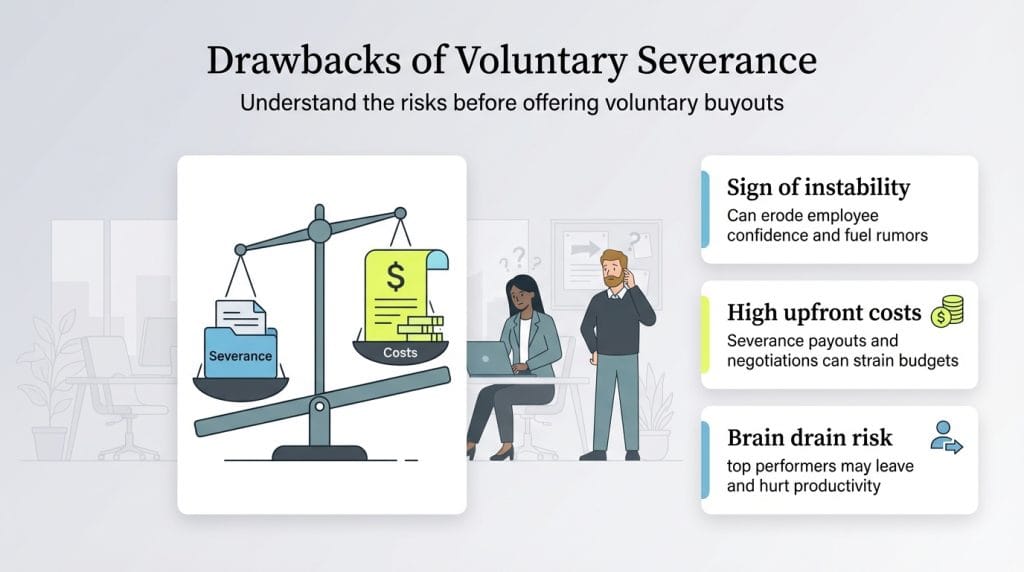
While voluntary severance programs offer distinct advantages, they are not without risk. If you’re thinking about offering voluntary severance, consider the following drawbacks first:
Berke recommended prioritizing effective communication during any elimination process, balancing clarity around the budgetary reasons for the eliminations while quelling employee concern about being on a “sinking ship.”
“No matter what process the employer chooses to go through, they do want to be really thoughtful about their communication strategy to employees,” Berke said.
“I think a lot of companies are very hesitant to do voluntary separation because they’re worried that the people they actually need and want to stay in the business will opt into the voluntary severance,” Witcher said.
However, employers can structure their voluntary severance program to reflect specific eligibility criteria and in a way that allows for the employer to decline someone’s request to participate, Ricketts said. “You don’t have to accept everyone into the program, but there’s always a morale issue if somebody is declined as well,” Ricketts said.
“One concern could also be that you offer a pretty good package to start with and people don’t necessarily take it or not enough people take it,” Berke said. Typically, subsequent packages will be less fulsome, Berke said.
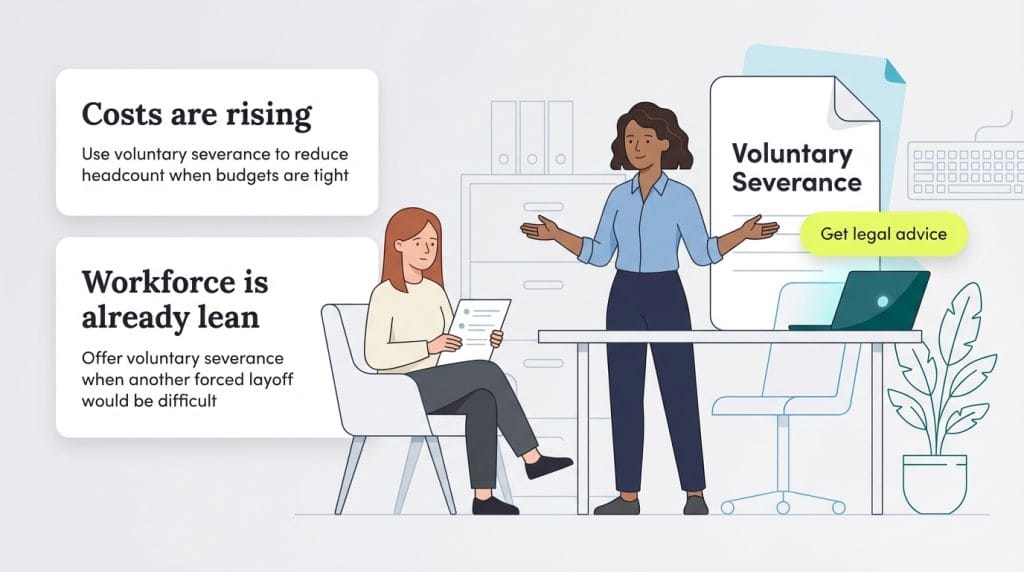
Voluntary severance programs are usually offered when companies are facing economic uncertainty or hardships. If you know you will have to reduce your workforce to cut costs or increase efficiencies, providing voluntary severance can be a good way to do that if the pros outweigh the cons for your business.
Voluntary severance can also be a good option if you’ve already made drastic cuts to your staff and need to reduce your workforce further. Initial layoffs are often made based on employee performance and another round of employee reductions can be difficult to make when your workforce is already lean. Voluntary severance puts the choice of separation in the hands of employees, reducing your burden.
The specific voluntary severance program and terms you offer should depend on your particular business. It’s always a good idea to speak with an experienced HR professional or legal counsel when determining if voluntary severance is the right option for your organization.
“I think it’s really important to talk [to a lawyer] about the details of your situation because even one hour talking to counsel might save a lot of headaches,” Berke said. “If an employee gets a lawyer and brings a claim against the company, whether it’s real or not, you have to pay a lawyer to respond.”
Erin Donaghue contributed to the reporting and writing in this article. Source interviews were conducted for a previous version of this article.