Business.com aims to help business owners make informed decisions to support and grow their companies. We research and recommend products and services suitable for various business types, investing thousands of hours each year in this process.
As a business, we need to generate revenue to sustain our content. We have financial relationships with some companies we cover, earning commissions when readers purchase from our partners or share information about their needs. These relationships do not dictate our advice and recommendations. Our editorial team independently evaluates and recommends products and services based on their research and expertise. Learn more about our process and partners here.
A SIP trunk is the digital version of an analog phone line. With SIP trunking, businesses can upgrade to a unified digital phone system.

Session initiation protocol (SIP) trunking allows any organization to upgrade its offline PBX to an internet-powered business phone system. Business leaders are using this technology to harness VoIP’s capabilities for streamlining communication systems, enhancing call reliability and reducing operational costs.
This guide covers the basics of SIP trunking, how the technology works and strategies for selecting a provider that offers the services your business needs.
SIP trunking is a technology that allows a business to make local or long-distance calls over the internet without using traditional phone lines. A SIP trunk is the digital version of an analog trunk line that lets users make outgoing calls and receive incoming calls.
Businesses often adopt SIP trunking to reduce phone expenses or take advantage of cloud-exclusive features. For example, a digital phone system is much easier to monitor with analytics tools that can track critical information about business phone calls, including frequency, length, audio quality and the number of missed calls. This capability provides the company with important data about how it uses telephone systems in day-to-day work.
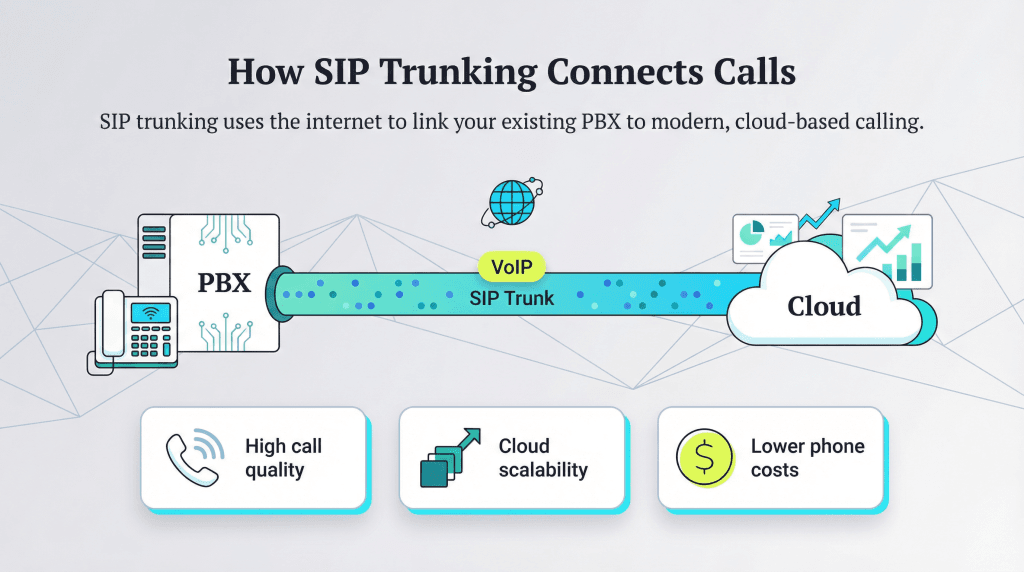
In an analog system, physical trunk lines connect the business’s private branch exchange (PBX) to the public switched telephone network (PSTN).
A PBX functions as a corporate telephone network that enables office phones to communicate internally and with external parties. This system manages the routing of incoming and outgoing calls while providing sophisticated capabilities such as call screening and automated call distribution.
Using SIP trunks, virtual analog trunks allow a SIP provider — typically called an “internet telephony service provider” — to take advantage of a business’s existing PBX hardware. This setup essentially creates a cloud-based PBX rather than directly connecting to the PSTN.
SIP trunking works by using Voice over Internet Protocol (VoIP), which digitizes a caller’s voice and transmits the communication over an IP network, usually the internet.
The technology supports a business’s phone systems, bringing the cloud’s scalability, cost benefits and analytics features to its landline. Transitioning from analog connections can improve call quality. Plus, businesses can continue to use their existing PBX hardware to make phone calls.
Businesses sometimes use the term “SIP trunking” interchangeably with “VoIP.” While the two are closely related, they are different. Also, investing in VoIP doesn’t necessarily mean investing in SIP.
SIP is a signaling protocol that facilitates VoIP calls. But, VoIP can operate independently of SIP by using alternative signaling protocols like H.323 and MGCP. These protocols also manage how VoIP establishes and disconnects calls over the internet. Although H.323, MGCP and SIP have different operational mechanisms, they share the same goal: enabling VoIP to connect and disconnect phone calls over the internet.
VoIP can function using digital phones (IP phones) and analog phones. It can use a separator box or similar device — an “analog telephone adapter” — to convert an analog signal to a digital signal that can be sent over the internet.
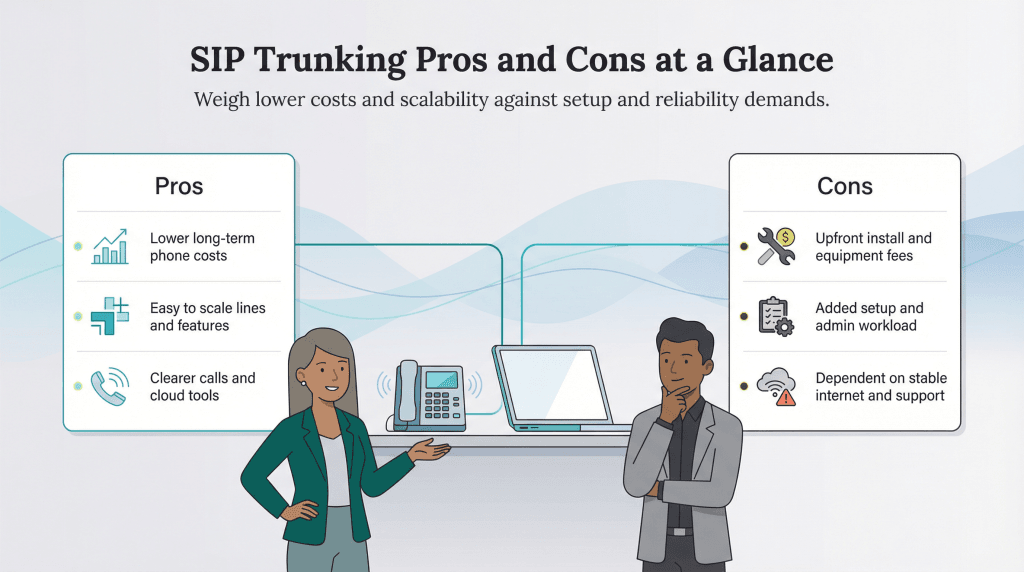
SIP trunking can be a worthwhile investment for businesses that want to digitize their phone lines, but the technology isn’t perfect. Consider these pros and cons when deciding whether to invest in a SIP trunk upgrade.
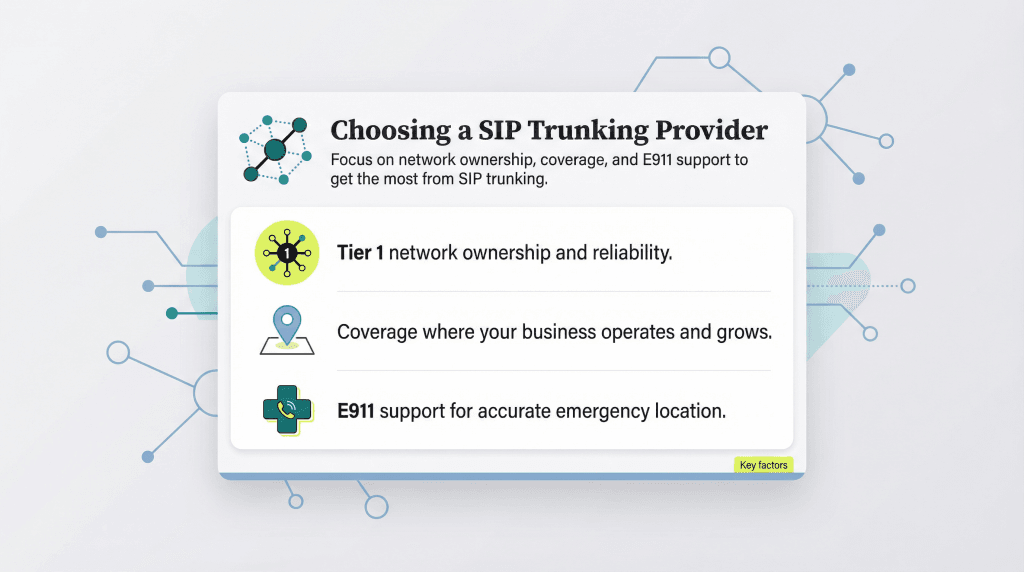
Your SIP trunking provider selection will significantly impact the value your organization derives from this technology. Research providers before investing in a SIP trunk upgrade to ensure your choice offers the services and resources you need.
When you’re choosing a business phone system with SIP trunking, look for a provider that offers these key benefits:
The provider’s network infrastructure represents their primary competitive advantage. Leading SIP providers offer a high-quality and reliable network they fully control.
The majority of SIP providers operate as intermediaries — Tier 2 or Tier 3 resellers — purchasing services from network operators or other distributors. In contrast, Tier 1 providers maintain complete ownership of their network. When customers submit issues or support requests to Tier 2 or 3 providers, these companies must open their own ticket with the company from which it resells services.
Tier 1 providers alone can deliver complete accountability to their clients. Network ownership empowers them to provide greater operational transparency and accelerated issue resolution.
You must ensure a provider can service the geographic areas where you operate. For example, a small business with exclusively local customers may not need extensive coverage from its provider. However, an e-commerce business with a significant portion of its client base overseas would need a company that can handle frequent international calls.
Analog phone system owners don’t have to think too much about 911 service; the number is always available when needed. Digital phone systems can be more complicated because there’s no tie to a physical location.
A good SIP provider should offer enhanced 911 (E911) to ensure your phone system can automatically provide the caller’s location to emergency dispatchers. E911 capabilities mean emergency services will know where to send first responders.
The SIP trunking sector has experienced consistent expansion in recent years, with the global market projected to reach $43.7 billion by 2031, according to Transparency Market Research. Consider these leading SIP trunking solutions for your business:
RingEx is an excellent, practical, easy-to-use option for most companies with a range of features. The service is designed from the ground up to make collaboration effortless. Features like instant messaging, document sharing and conference calling provide a single, centralized communications system for a business.
As our RingEx review explains, this service’s pricing begins at $20 per user monthly with annual commitments (month-to-month plans start at $30). Their 14-day trial period can help you decide if it’s right for you..
Vonage is a unified communications system with numerous business features, including a unique Microsoft Teams integration. The service integrates with Teams by default, allowing employees to access the phone system directly from the Teams platform.
As we detail in our Vonage review, monthly plans start at $13.99 per month, per line for its mobile plan when billed annually (month-to-month pricing begins at $19.99).
8×8 is a unified communications system built for ease of use. Features like mobile and desktop apps, video chatting, and conferencing provide a centralized communication system for businesses that want to switch to SIP trunking.
Our 8×8 review explains why this platform excels for small businesses requiring cost-effective solutions with scalability and personalization options. Note that 8×8 provides customized pricing through their sales team rather than published rates.
SIP trunking is a powerful option for businesses interested in upgrading to a unified digital communication system. It allows you to leverage legacy PBX technology without relying on analog phone lines. This upgrade will mean cost savings for most businesses and access to cloud-exclusive communications management features.
Kimberlee Leonard contributed to the reporting and writing in this article.