Business.com aims to help business owners make informed decisions to support and grow their companies. We research and recommend products and services suitable for various business types, investing thousands of hours each year in this process.
As a business, we need to generate revenue to sustain our content. We have financial relationships with some companies we cover, earning commissions when readers purchase from our partners or share information about their needs. These relationships do not dictate our advice and recommendations. Our editorial team independently evaluates and recommends products and services based on their research and expertise. Learn more about our process and partners here.
Your registered agent determines whether you find out you are being sued and whose address the public sees.


This article is sponsored by Northwest Registered Agent
When you form an LLC or a corporation, you fill out a document that asks for a name and an address. It feels like a formality but the moment your state accepts that filing, the information on it becomes part of the permanent public record. That means it’s searchable by anyone and, in many states, available for purchase in bulk.
One field on that form asks you to name a registered agent. Most new business owners either list themselves without much thought or accept whatever service their formation provider bundles in. But this choice determines whether you reliably find out if your business is sued and whose address the public sees when they look you up.
Here is what a registered agent actually does, why every state requires you to have one and how the decision shapes both your compliance exposure and your personal privacy.
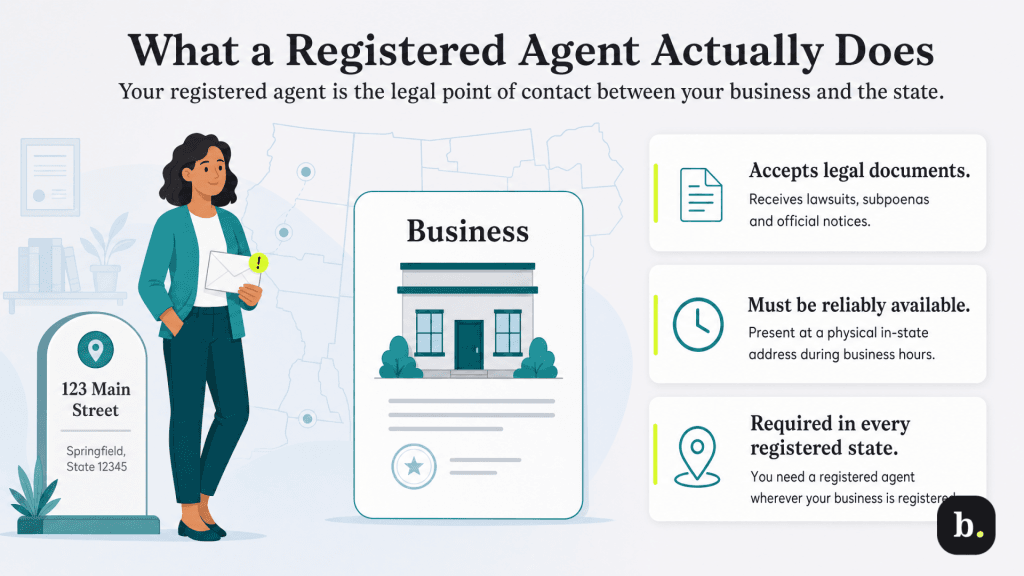
A registered agent is a person or company you designate to accept service of process and official government correspondence on behalf of your business. Service of process is the formal delivery of legal documents, such as a summons, a subpoena or a complaint. When someone sues your company, those papers go to your registered agent—not to you personally or whoever happens to be staffing your front desk.
The role is narrow but consequential. Your agent is the legal point of contact between your business and the outside world, and the address you list is where the state and the courts will look for you.
State statutes generally impose four requirements on who can serve:
One point that trips up owners expanding across state lines: you need a registered agent in every state where your business is registered, not only the state where you formed it.
The terminology varies, which makes the requirement look more complicated than it is. Arizona and Ohio use “statutory agent.” Kansas, Maryland, Massachusetts, Michigan and Rhode Island use “resident agent.” California, Louisiana, New York and West Virginia use “agent for service of process.” Pennsylvania uses “registered office provider.” These are all names for the same job.
The registered agent requirement exists to protect a basic principle of due process: a lawsuit cannot move forward unless the defendant has been properly notified. That is straightforward when the defendant is a person. It is harder when the defendant is a business entity, which is a legal construct with no single human attached to it. The registered agent solves the problem by giving every registered business a known, fixed, publicly listed point of contact.
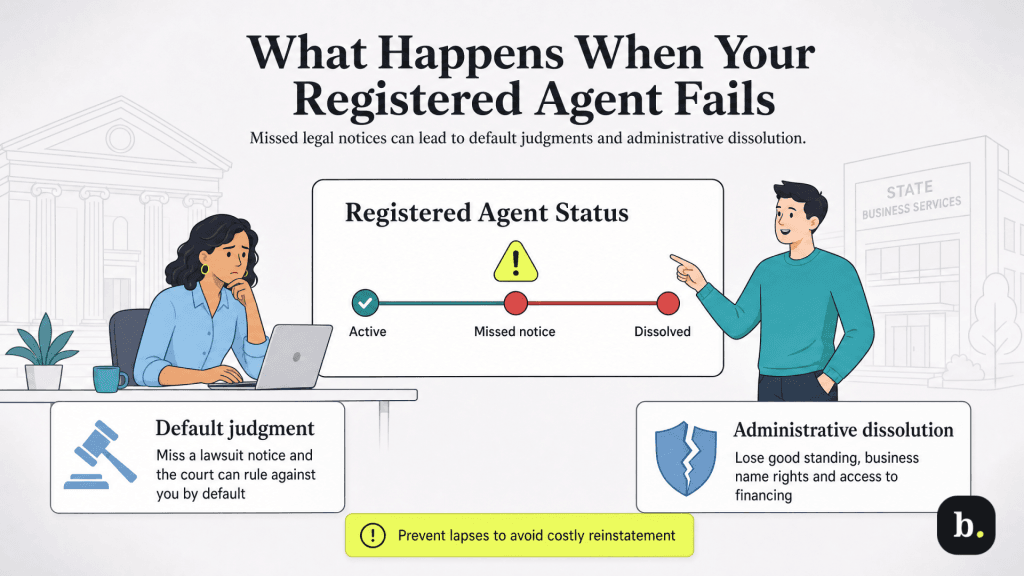
What most owners do not realize is what happens when that point of contact fails. States do not simply pause the lawsuit. They substitute themselves.
Under Florida law, if service cannot be made on a LLC’s registered agent — because the company does not have one or because the agent cannot be served with reasonable diligence — the plaintiff may serve the Florida Secretary of State as the company’s agent instead. Texas and most other states have parallel provisions.
Once that happens, service is legally complete. Your deadline to respond begins running. Whether the notice ever reached you is a separate question from whether you were served, and courts treat them separately.
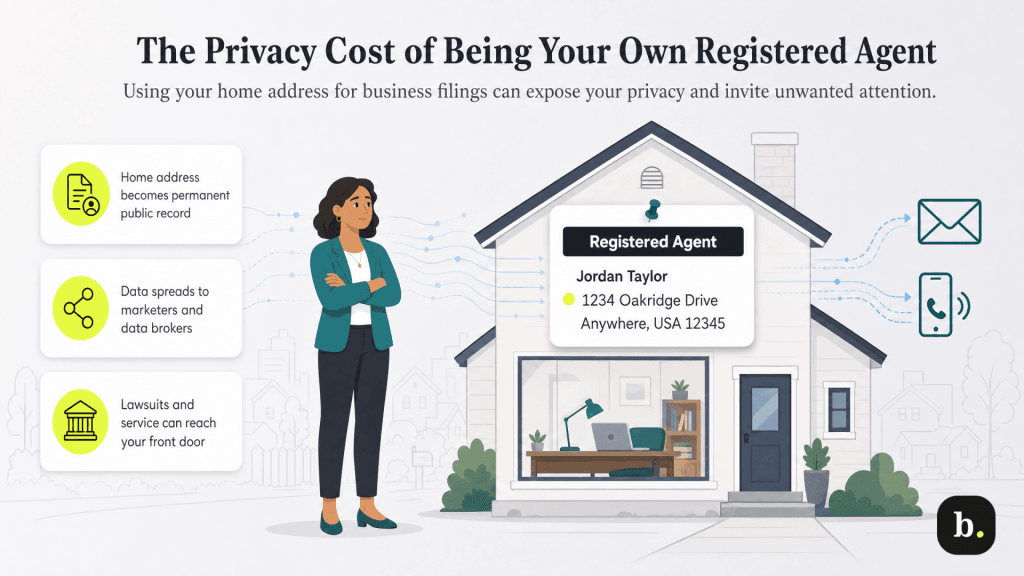
Every state permits you to act as your own registered agent, and for some businesses that works fine. The question is not whether you are allowed to. It is what you give up by doing it.
Whatever address you list becomes part of the public record, permanently and in association with your name. For a business to run out of a spare bedroom, that means publishing your home address. There is no practical way to claw it back later. Amended filings do not erase the originals, and copies of the record propagate well beyond the state’s own website.
That propagation is not hypothetical. States actively license their business filing databases for commercial use. Minnesota, for example, charges commercial users $710 for a bulk business data order. Indiana collects enhanced-access fees for commercial bulk data ranging from $35 for a single monthly upload of new business filings to $9,500 for a comprehensive annual subscription. Kentucky, South Dakota and Nevada operate comparable programs.
None of this is improper. Business registration records are public by design, and open access serves real purposes, including letting the public identify who is behind a company. But it does mean your filing is not a static entry sitting on a government site waiting for someone to search your name. It is a data feed, refreshed regularly, flowing to marketing firms, data brokers and the operators who send official-looking compliance solicitations to newly formed businesses.
The downstream effects range from irritating to genuinely concerning: a sharp increase in junk mail and cold calls, deceptive mailers designed to look like state correspondence, and, for some owners, a home address that is trivially available to a disgruntled customer, a former employee or anyone else motivated to find it.
There is also a practical constraint that doubles as a privacy problem. Serving as your own agent means being physically present at the listed address during business hours. If that address is your home, then being served with a lawsuit happens at your home, potentially in front of your family.
[Looking for more ways to protect your business? Check out our selections for the best business insurance providers.]
This is a real decision with legitimate answers on both sides, and it depends less on the size of your business than on the shape of it.
Acting as your own registered agent is workable when you operate in a single state, you have a commercial address you are comfortable publishing, you are reliably at that address during business hours and you do not expect to move. Plenty of storefront businesses fit that description.
It becomes a poor fit when any of the following apply:
Cost is rarely the deciding factor. Commercial registered agent service runs an annual fee that is modest when measured against the cost of a single missed lawsuit or an unplanned reinstatement.
If you do hire a service, these are the criteria worth comparing:
[Related article: Sole Proprietors and Business Licenses]
Registered agent services do not treat privacy the same way. Some handle it as an optional add-on you have to find, select and sometimes pay extra for. The stronger approach makes protection the standing configuration rather than something you opt into.
In practical terms, a privacy-focused provider does the following:
Northwest Registered Agent, for example, built its service around this principle and calls it Privacy by Default. According to the company, it uses its own address on client documents wherever possible, leaves optional fields blank, files on behalf of clients so the state receives the company’s information rather than the client’s, scans documents in house with its own employees, and does not sell client data. Northwest describes the protection as automatic, with no separate opt-in and no premium tier attached to it. The company also states that it requires a warrant before releasing client information to law enforcement or government agencies.
The broader point applies whichever provider you choose. Read the privacy policy before you sign up, and ask a simple question: is privacy the default setting here, or a feature I have to go find and switch on?
