Business.com aims to help business owners make informed decisions to support and grow their companies. We research and recommend products and services suitable for various business types, investing thousands of hours each year in this process.
As a business, we need to generate revenue to sustain our content. We have financial relationships with some companies we cover, earning commissions when readers purchase from our partners or share information about their needs. These relationships do not dictate our advice and recommendations. Our editorial team independently evaluates and recommends products and services based on their research and expertise. Learn more about our process and partners here.
Google published official guidance on optimizing for AI answers in 2026, and much of what GEO vendors sell is on its list of things to ignore.


A homeowner looking for a plumber used to get 10 blue links. Increasingly, they ask an AI assistant instead and get two or three business names. That shift has produced a new acronym: generative engine optimization, or GEO. Along with it, a fast-growing industry has cropped up, selling services to help your business turn up in those answers.
But not all of those services may have the impact they claim. In May 2026, Google published its first official documentation on optimizing for AI search features, and a good deal of what GEO vendors recommend appears on Google’s list of tactics you can safely skip. Here is what GEO actually is, how AI answers get assembled and which parts of the playbook have evidence behind them.
Generative engine optimization is the practice of structuring your content and online presence so AI systems retrieve, cite and recommend your business when someone asks a relevant question. Rather than competing for a position on a results page, you are competing to be one of the handful of sources an assistant draws on while it writes an answer.
The term came out of academic research rather than the marketing industry. In 2024, researchers from Princeton University, Georgia Tech and IIT Delhi presented a paper at the ACM SIGKDD conference that coined generative engine optimization and introduced GEO-bench, a benchmark of roughly 10,000 queries for testing whether changes to a webpage affect how often AI systems cite it. Its strongest methods include adding citations, quotations and statistics; these tactics improved visibility in AI engine responses by as much as 40 percent, according to the research.
You will see answer engine optimization (AEO), large language model optimization (LLMO), artificial intelligence optimization (AIO) and plain “AI SEO” used to describe the same work. It’s all virtually synonymous. Google’s documentation treats AEO and GEO as two names for one thing.
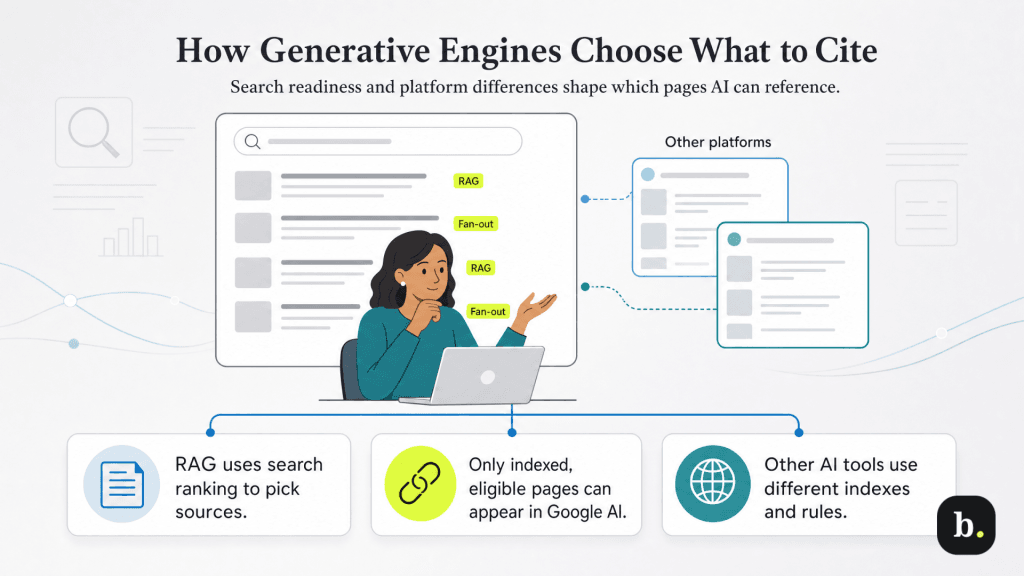
Google’s guide to generative AI features describes two mechanisms AI engines use to cite content.
For Google, if your page is not indexed or not eligible to appear in Google Search, it cannot appear in Google’s AI features either. Google additionally requires that a site be included in Search generative AI features in Search Console to be eligible. There is no separate AI index to get into. The AI is reading from the SERP, which means crawlability, page speed and a site that works on a phone are still just as important as they’ve always been for SEO.
Other platforms work differently. ChatGPT, Claude, Perplexity and Copilot draw on their own indexes and partner search providers, cite sources at different rates and often disagree about which sources are authoritative for the same question. Appearing in one is no guarantee of appearing in the others, which is a reason to treat Google’s guidance as necessary but not sufficient.
Google’s answer is no. Its documentation states that, from Google Search’s perspective, optimizing for generative AI search is optimizing for the search experience, and therefore still SEO. The company points readers weighing third-party GEO services toward its separate guidance on third-party SEO advice.
However, Google only speaks for AI Overviews and AI Mode. It does not speak for ChatGPT, which sends the large majority of measurable AI referral traffic, or for the other large language models. Those systems make their own retrieval and citation decisions.
The useful synthesis is that strong SEO fundamentals are important for every platform, and they account for most of the available work. Platform-specific tuning is a smaller and far more speculative layer that changes platform by platform.
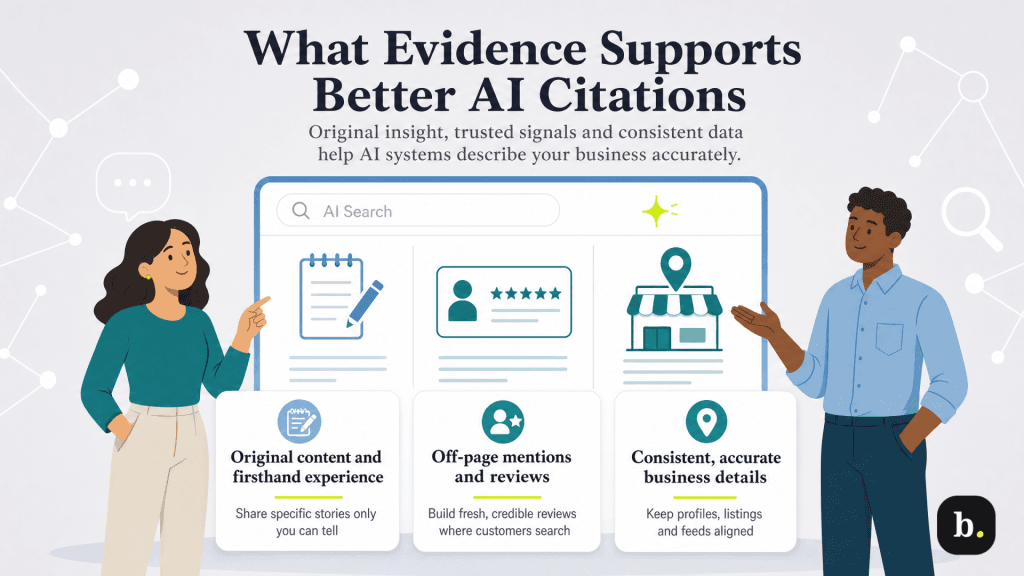
The following three areas seem to be important across the board when it comes to earning AI citations. All three also support strong SEO and should be part of your strategy regardless of your focus on AI citations.
Creating content people find unique, compelling and useful will likely influence your visibility in generative AI search more than anything else in its guide. It draws a line between commodity and non-commodity content using its own examples. An article like “7 Tips for First-Time Homebuyers” is common knowledge that could have come from anyone, while a piece on why a specific buyer waived an inspection and what the sewer line turned out to look like reflects experience no one else has. AI systems sample many sources, so the one with an actual point of view stands out. Google’s companion guidance on people-first content spells out the standard.
This is the most accessible advantage most small business owners have. You know what a job costs in your market, what goes wrong on site and what customers consistently misunderstand when they call. None of that can be synthesized from other people’s pages.
Much of what an AI system says about a business comes from somewhere other than that business’s own website. This includes directories, review platforms, forums and video. Reviews carry particular weight, and recency matters more than it used to. BrightLocal’s 2026 Local Consumer Review Survey of 1,002 U.S. adults found that 74 percent of consumers look for reviews written within the previous three months and 92 percent care about star ratings. The same survey found use of AI tools for local business recommendations rose from 6 percent to 45 percent in a year, making AI the third most common source of recommendations behind Google and Facebook.
Community platforms are part of this picture too, since discussion threads frequently turn up as cited sources. Our guide to Reddit marketing covers how to participate without tipping into spam.
AI systems assemble a picture of your business from many places at once. A conflicting address, an outdated service description or a homepage that never quite says what you do gives them less to work with, and a vague description is easy for an assistant to skip in favor of a competitor it can describe confidently.
Google specifically recommends keeping a Google Business Profile current. And, for retailers, Google suggests supplying Merchant Center feeds, so local and product details are visible to AI responses and ordinary search results alike.
Google’s documentation includes a mythbusting section naming tactics that do not help in Google Search. Independent testing has since backed up most of it. Keep in mind that these items apply to Google specifically, and that other LLMs like ChatGPT or Claude likely have their own approaches.
Google also warns against seeking inauthentic mentions across the web, noting that its spam systems and its generative AI features both rely on the same core quality signals.
Start with the free option. In June 2026, Google added a Generative AI performance report to Search Console, which shows how your content is performing in generative AI features across Search and Discover. Google also cautions against third-party tools that promise ranking success or claim to use internal Google metrics, since no outside tool has that level of access.
Beyond Google, measurement gets harder. Ahrefs measured AI chatbots sending 0.28 percent of total traffic across 74,752 websites in March 2026, against roughly 28 percent from Google. However, AI referrals are growing quickly.
Referral data also undercounts influence. Someone who hears your business named in an AI answer and then searches for you by name two days later arrives as branded search traffic, and the AI recommendation gets no credit. For that reason, we recommend tracking brand mentions separately from clicks, which is what dedicated platforms in this category do—see our HubSpot AEO review for an example of how that monitoring works in practice.
Work in this order. The early steps cost nothing and provide the biggest benefits.
For businesses rebuilding from scratch, several platforms now bundle AI visibility settings into the build process. Our picks for the best AI website builders cover which ones include useful SEO tooling. And if AI discovery is only one gap among several, our guide to building an online presence puts it in context.
