The Great Resignation of 2022 is over. Employees are far less eager to YOLO out of their jobs now, but businesses face a new challenge: the Great Detachment. According to a recent Gallup poll, only 1 in 3 Gen Z and millennial employees feel engaged at work. The other two-thirds may be going through the motions of productivity theater.
What’s the solution for workplace malaise?
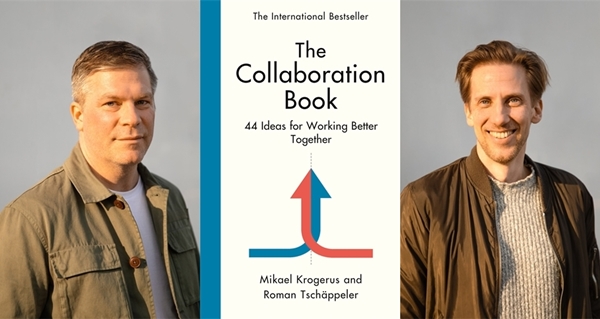
Mikael Krogerus and Roman Tschäppeler, co-authors of international bestseller The Collaboration Book, have some ideas (44 of them, to be exact). In a joint interview with b., they made the case for small wins from small teams and why detachment, like collaboration, is a two-way street.
b.: What made you say, “We need to put this book into the world”?
Krogerus and Tschäppeler: We wanted to look deeper into the mechanics of collaboration. Our best days at work aren’t necessarily the days that are “successful,” rather the days that aren’t exhausting. What seems to drain us most is bad teamwork, and what lifts us up most is good teamwork.
One concept that stuck with us is Karl Weick’s idea of small wins. Most people say you should “think big” and “believe in the vision,” but every project has a valley where we get tired and lose sight of the goal. And in that valley, you can’t force it, but you can celebrate the small stuff. Every mountaineer knows this: Many small steps are less impressive than a few big ones — but they are less exhausting and take us further.
b: Employee disengagement has an estimated global cost of $8 trillion. Can better collaboration make a difference?
Krogerus and Tschäppeler: A lot of people — not only Gen Z — feel disengaged in their workplace. There are many structural reasons why this is the case, and we don’t know of an easy cure.
As an employer, one of the most important things to do is to create trust. When we talk about trust, what we usually mean is, “Can I trust this person?” We rarely think of things like, “Can this person trust me?” Or, “Can my employees trust this company?” Some experts suggest that burnout and quiet quitting are not only caused by massive workload, but by interpersonal problems — bad leadership, bad collaboration.
b.: Please tell us about the Two Pizza Rule.
Krogerus and Tschäppeler: Apparently, Jeff Bezos came up with it after founding Amazon: A team should be small enough that it can be fed by two pizzas. In smaller groups — five to seven — people can’t hide, so everyone takes a greater share of the responsibility. And small groups make it easier to turn strangers into friends, since everyone has to interact at some point.
b.: As Swiss and Finnish authors, what can American workers learn from your countries’ ethos?
Krogerus and Tschäppeler: There is a Swiss rule of thumb: Promise 80, deliver 80. Don’t oversell ideas; deliver what you promise. Finland works in a similar way. There’s a saying: “Less talk, more hockey.”
The Collaboration Book is available now.