Building a company from the ground up is a difficult process. Forging a new market can especially be a stretch.
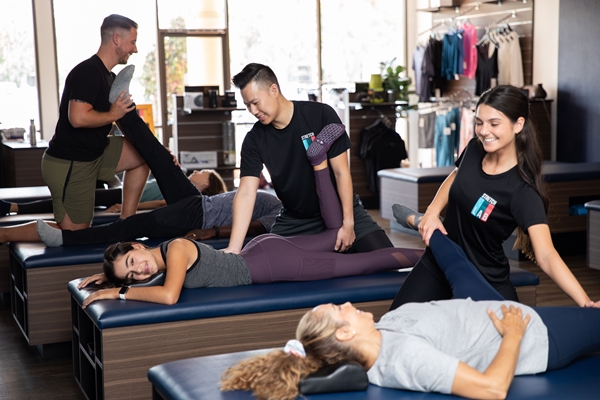
StretchLab, which has grown to 900-plus global locations since opening in Los Angeles in 2015, specializes in “assisted stretching.” Unlike yoga studios, StretchLab appointments are all one-on-one; unlike physical therapy clinics, it’s for general nonprescription wellness.
StretchLab president Verdine Baker told b. how its franchise model and use of digital advertising helped to grow the company.
b: What got you interested in working with StretchLab?
Baker: I played soccer in high school and in college, and certainly had been stretched by athletic trainers and professionals. So it was just kind of that initial intrigue of, “Oh yeah, I’m familiar with this.” Also knowing that there’s not a whole lot of independent stretching studios around … the world.
b: How did your background at Crunch Fitness serve you in this role?
Baker: A lot of the skill sets and … systems that I’ve learned or implemented “big box,” I’ve brought over to that boutique fitness setting. Not all of them work [for both], right? But a lot of the community-building tools, building a member base, building engagement — those things translate across whether you need 5,000 members or you need 300 people. …
What’s unique for us as a brand — and, really, as a vertical — is that it is something that’s new. … [It] needs to be an education process that comes along with our branding and marketing message. … You have to have people achieving real results … to validate it.
b: Why do you think the franchise model works for StretchLab?
Baker: It’s that nice in-between. The true entrepreneur … get[s] to make all the rules, but you also assume all the liabilities, right? On the other side of the spectrum, as an employee, you don’t have any liabilities but you don’t get to make any other rules or dictate your environment.
Franchising, in general, meets that world in-between where you … bring that entrepreneurial mindset — because you have to execute, you have to do what you need to do as a business owner — but you’re not spawning everything from yourself. You have systems and processes.
b: To what degree does location determine a franchise’s success?
Baker: It’s a factor, but I don’t think it’s the only determinant factor. We have studios not in the most prime locations that outperform studios that are in the most prime locations. … We welcome other health and wellness modalities that could be our neighbors for some cross-pollination and partnerships — and also [for] the eyeballs that are getting into our studios. We find that most of our members are also doing something else.
b: If a franchisee needs to prioritize physical advertising versus digital advertising, how important is each for getting discovered?
Baker: We have to do both. Our franchisees are required to spend on [their own] digital advertising in addition to the digital advertising that we do on the national level. However, digital advertising only works as good as your organic efforts are going to be. … We’re looking at total leads, and then we’re looking at their mix between digital and organic. That helps us guide our support to those studios and how to improve on those different channels.
This interview has been edited for length. Read the full Q&A at business.com.