Many employees receive equity as part of their compensation, often in the form of stock options. This is particularly prevalent among senior C-suite executives and employees at early-stage companies. Use our calculator to estimate the value of your stock options under different scenarios to better understand your potential financial upside.
Key terms when using the stock options calculator
Current stock price
The stock price refers to the current market value of a single share of the company. When the stock price is above the strike price of your options, you are “in the money” — meaning your options have intrinsic value.
Stock appreciation
This is the assumed annual rate at which the company’s shares may grow in value. Keep in mind that this is a hypothetical projection, not a guarantee.
Number of options
This is the number of stock options awarded to you by your employer.
Strike price
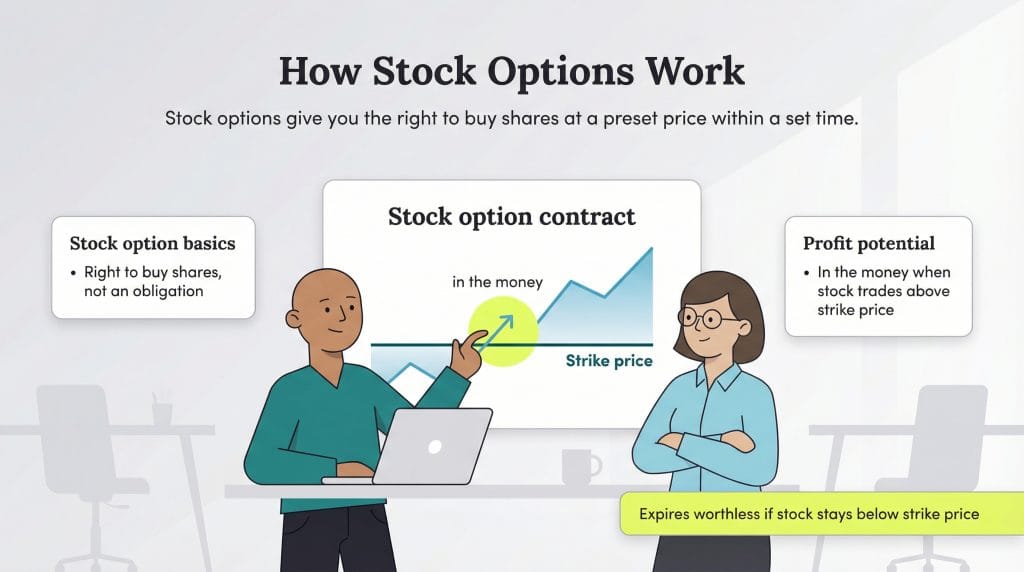
The strike price is the predetermined price at which the company’s stock can be purchased under your stock option or stock purchase agreement. When the stock price goes above the strike price, the options are considered “in the money” and hold value. If the stock price remains below the strike price when the options expire, the options are “out of the money” and become worthless.
Number of years
This refers to the time period you expect to hold the options. At the end of this period, the options will either expire worthless or can be exercised and sold for a profit, which you can estimate using a stock options profit calculator.
What are stock options?
Stock options represent the right (but not the obligation) to purchase stock in a company. In the public markets, a standard stock option contract represents 100 shares of the underlying stock. These contracts last for a finite period of time, ranging from weeks to years. For certain industries and roles, stock options are a common form of employee compensation.
If the company’s stock price is above the option’s strike price at exercise or expiration, it is considered “in the money.” This means the option holder can purchase the stock at a below-market rate. Option holders may earn a significant profit if the stock price rises well above the strike price. However, if the option expires when the stock price is below the strike price, the option holder earns nothing.
If you're planning on
selling your business, stock options can play a key role in the deal. Buyers often evaluate how many employee options are outstanding and at what strike price, since this affects the
business valuation and future ownership structure.
What factors affect stock prices?
Several economic, market and company-specific factors can influence stock prices, especially in the short term, which is why they can be unpredictable. For instance, general economic conditions, managerial turnover and geopolitical events can all move stock prices quickly.
Interest rate changes by the Federal Reserve also play a significant role: Rate increases can slow growth and reduce investor confidence, while rate cuts often boost spending and market optimism. In October 2025, for example, the Federal Reserve cut its benchmark federal funds rate by a quarter point, a move markets interpreted as bullish and that helped push U.S. equities higher.
Over the long term, however, a company’s stock price will generally reflect its underlying performance. Businesses that achieve profitable growth tend to see their stock price appreciate, while those that fail to generate a satisfactory return for shareholders will likely see their stock value decline.
In addition to stock price growth, some companies also reward shareholders through dividends. A stock's
dividend yield — the annual dividends paid relative to its share price — can increase total returns even if the stock price doesn't rise quickly.
Tax implications of stock options
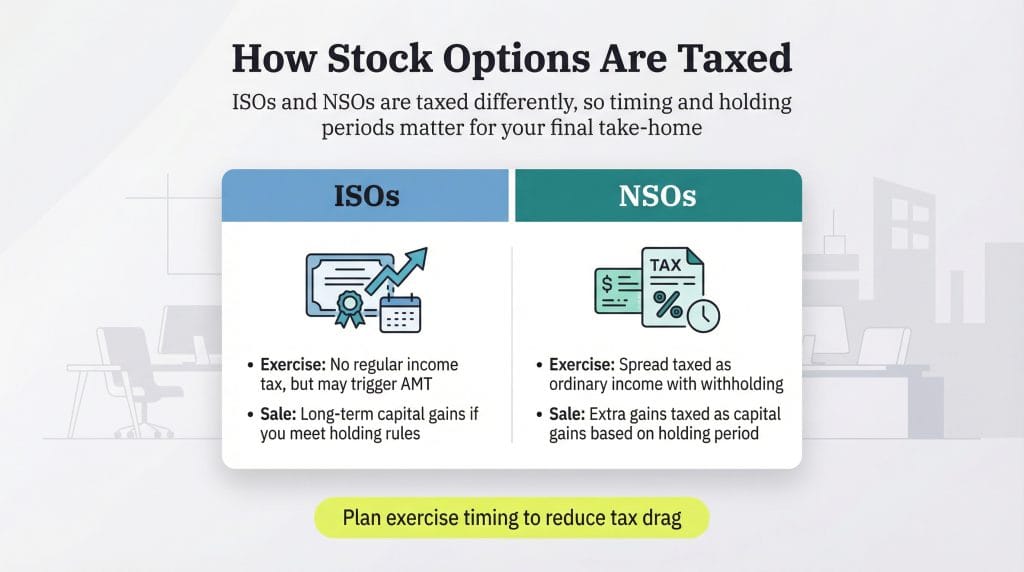
Understanding how your stock options are taxed is key to maximizing what you keep. Employee stock options generally fall into two categories — incentive stock options (ISOs) and non-qualified stock options (NSOs) — and each is taxed differently.
- ISOs: With ISOs, you typically won’t owe regular income tax when you exercise your options, but the spread between the strike price and the stock’s fair market value may trigger the alternative minimum tax (AMT). If you hold the shares for at least one year after exercising and two years after the grant date, any gains are usually taxed as long-term capital gains, which for high earners can be taxed at up to 20 percent at the federal level and is often lower than ordinary income tax rates.
- NSOs: NSOs are treated differently. The “spread” at exercise — the difference between the strike price and the fair market value — is taxed as ordinary income, and your employer will withhold taxes as if it were part of your paycheck. Any gains after you exercise are taxed as capital gains, and the rate depends on how long you hold the shares before selling.
Because taxes can take a meaningful bite out of your earnings, it’s smart to consider your exercise timing and holding strategy carefully. The right approach can make a significant difference in your net proceeds.
When should you sell your stock options?
Ideally, you want to exercise and sell your stock options when the company’s share price rises above the strike price so you can lock in a profit. Most stock option grants follow a vesting schedule, meaning you can’t exercise your options until a certain portion has vested. According to the National Center for Employee Ownership (NCEO), many stock option grants follow a four-year vesting schedule, often with a one-year cliff — meaning 25 percent of your options vest after the first year, with the remainder vesting gradually (usually monthly or quarterly) after that.
However, you don’t want to wait until your stock options expire, or you’ll forfeit their value. Keeping an eye on your vesting schedule, the company’s performance and your personal financial goals can help you decide the right time to exercise and sell.
You don't have to exercise all your options at once. Many employees exercise gradually over time to spread out taxes and reduce the risk of selling at a single price. A common approach is "sell to cover," where you sell just enough shares to cover the exercise cost and taxes, then keep the rest invested for potential growth.
Common mistakes to avoid with stock options
Stock options can be a great wealth-building tool, but there are a few easy-to-miss missteps that can cost you money. Here are some of the most common mistakes employees make and how to avoid them:
- Waiting too long to exercise vested options: If you leave a company, you typically only have 90 days to exercise your vested options, or you’ll lose them. Many people don’t realize this until it’s too late, so keep an eye on vesting dates and any post-termination deadlines.
- Putting all your eggs in one basket: It’s tempting to hang on to every share if you believe your company will keep growing, but holding too much of one stock can be risky. Selling a portion over time or diversifying into other investments can help protect your overall wealth.
- Not preparing for the cost to exercise: Exercising options isn’t just about clicking a button; you’ll need cash to buy the shares and cover the taxes. Run the numbers ahead of time so you’re not caught off guard. Some employees use a “cashless exercise” or a stock option loan to help cover costs, but each comes with pros and cons, so it’s smart to talk with a financial advisor or business lawyer first.