Business.com aims to help business owners make informed decisions to support and grow their companies. We research and recommend products and services suitable for various business types, investing thousands of hours each year in this process.
As a business, we need to generate revenue to sustain our content. We have financial relationships with some companies we cover, earning commissions when readers purchase from our partners or share information about their needs. These relationships do not dictate our advice and recommendations. Our editorial team independently evaluates and recommends products and services based on their research and expertise. Learn more about our process and partners here.


Determining investment returns over time can be challenging and typically involves many complicated mathematical formulas. However, our calculator makes it easy to compute investment returns by plugging in a handful of numbers. You can use this investment returns calculator to project the future value of a retirement portfolio or a particular investment over time.
This represents the period over which an investment is expected to grow.
The compound annual growth rate refers to how much, on average, the investment is expected to grow each year in percentage terms. For example, from 2014 through 2024, the S&P 500 delivered an annualized return of 12.8 percent.
This is the total capital invested on day one of the time period in question.
Any additional contributions you intend to make are added to this box. These can be annual, quarterly, monthly, biweekly or weekly amounts.
This refers to how often you intend to make additional contributions (see “additional investment” above).
The inflation rate refers to how much, on average, the prices of goods and services are expected to increase during the specified period. According to the Federal Reserve, the long-term inflation target remains at 2 percent annually, though actual inflation reached 3.4 percent in 2023 and 2.9 percent in 2024.
Investment returns in the U.S. can be subjected to taxes, both at the state and federal levels. Capital gains taxes usually apply when you sell an investment or receive a dividend. For 2024, long-term capital gains tax rates range from 0 percent to 20 percent depending on your income level, with most taxpayers paying 15 percent. Short-term capital gains are taxed as ordinary income, which can reach up to 37 percent for high earners. Business owners can leverage investment vehicles like a Roth individual retirement account to protect investments from taxes.
By checking this box, you assume that you will increase your investment contributions with inflation.
With compound interest, your returns are added back to your initial capital. Subsequently, you earn returns on both your initial capital and any interest that accumulates. Over time, the total capital grows exponentially as you earn interest on interest.
With simple interest, returns are not added back to the initial capital. Instead, you only generate returns based on the initial capital. Over time, the total capital grows at a fixed, linear rate.
This is the total amount of money you put in over time, including the initial investment and additional contributions.
This is the total value of the investment at the end of the specified time period. If you check the “show value after inflation” box, the calculator reveals the value of the investment in today’s dollars.
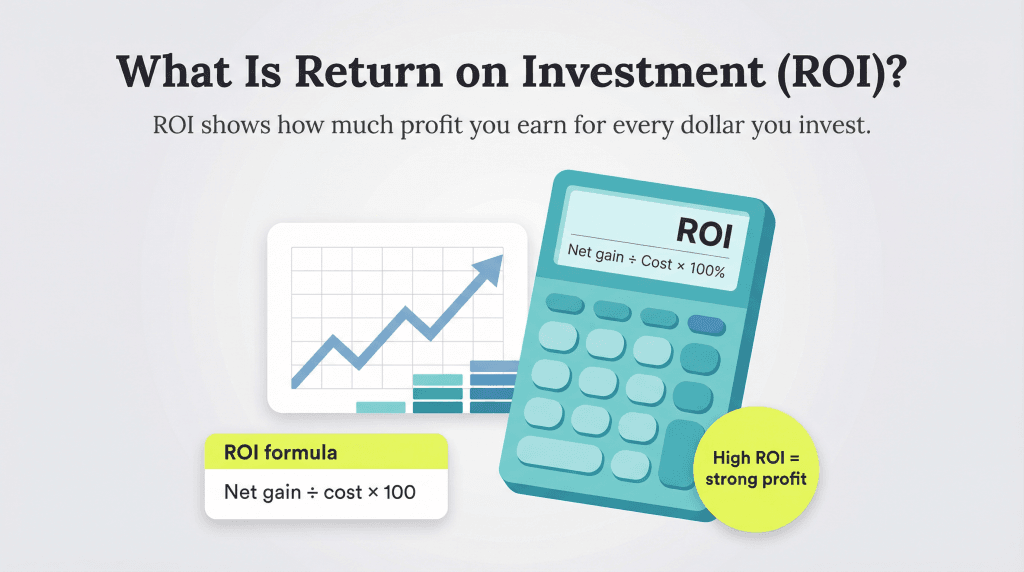
ROI is a metric that measures an investment’s profitability. Typically, ROI is presented as a percentage. ROI is calculated by taking the net gain of the investment and dividing it by the cost of the investment, then multiplying the result by 100. For business owners, understanding ROI helps evaluate whether capital investments, marketing campaigns or operational improvements deliver sufficient returns to justify their costs. A high ROI means that the investment generates a lot of profit compared to its cost.
Several key variables influence your investment returns, and understanding each helps you make more informed financial decisions for your business:
Investment timeline: Longer investment periods typically allow for greater compound growth and help smooth out market volatility. Business owners planning for retirement or long-term capital projects benefit from extended investment horizons.
Rate of return: Different asset classes offer varying return potential. While stocks historically provide higher returns, they also carry greater risk. Bonds offer more stability but lower growth potential.
Tax efficiency: Strategic tax planning can significantly impact net returns. Consider tax-advantaged accounts like 401(k)s, IRAs and Health Savings Accounts (HSAs) to minimize tax drag on investment growth.
Inflation impact: With inflation averaging 2.9 percent in 2024, maintaining purchasing power requires investments that outpace rising costs. Real returns (returns after inflation) provide a more accurate picture of wealth growth.
You can maximize ROI by diversifying across asset classes, maintaining consistent investment contributions through dollar-cost averaging, minimizing investment fees and expenses, staying invested for the long run and minimizing taxes through strategic account selection.
