Business.com aims to help business owners make informed decisions to support and grow their companies. We research and recommend products and services suitable for various business types, investing thousands of hours each year in this process.
As a business, we need to generate revenue to sustain our content. We have financial relationships with some companies we cover, earning commissions when readers purchase from our partners or share information about their needs. These relationships do not dictate our advice and recommendations. Our editorial team independently evaluates and recommends products and services based on their research and expertise. Learn more about our process and partners here.
Technology shouldn't hinder communication. Here's how to use it to support clearer, more meaningful interactions.


Technology has fundamentally changed how we communicate at work. Instead of writing letters to people in different time zones, we can log in to Zoom or Google Meet and chat with them as though we were in the same room. With the rise of remote and hybrid work, some team members may know their co-workers only through email threads and video calls.
On the surface, the capabilities technology brings to the workplace are overwhelmingly positive, offering convenience, collaborative power and connectivity. But that doesn’t mean technology should weaken interpersonal communication. The difference comes down to how intentionally these tools are used to support real connection, not replace it.
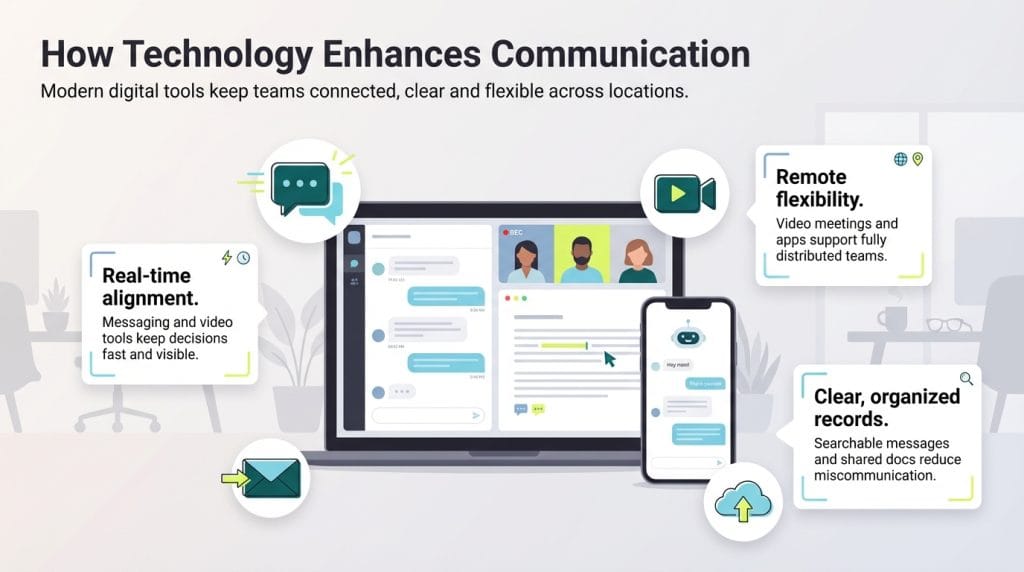
Modern software solutions offer clear benefits for workplace communication, especially for distributed teams. Here are some of the upsides of relying on technology to stay connected.
Internal communication apps that integrate with your business systems make it easy to reach someone immediately. If an issue comes up, a quick message is often enough to get a fast answer from a co-worker, especially on platforms like Slack, Microsoft Teams, Google Chat or Wrike. [Read related article: How to Use Slack for Workplace Communication.]
“[At leading organizations], quick team alignments are handled through instant messaging, complex problem-solving through video calls with collaborative whiteboarding, [and] creative collaboration through hybrid sessions combining in-person and remote participants,” said Harmeet Bhatia, technical account manager at Amazon Web Services.
Cloud-based communication tools also help teams stay accessible regardless of location, making it easier to coordinate work across time zones.
In the modern business landscape, flexibility is a competitive advantage. Video conferencing platforms such as Zoom and Google Meet allow employees to work from almost anywhere without losing face-to-face interaction with co-workers and managers. While remote work has drawbacks, including challenges around culture and connection, the ability to operate with more mobility and flexibility is a real advantage for many businesses.
Miscommunication is more likely when messages are passed from person to person, much like the classic “telephone game,” where details get distorted along the way. In the past, clients often had to go through receptionists or assistants to reach a business owner. If a message was misunderstood, important context could be lost, sometimes leading to frustrating customer experiences.
With digital messaging, people receive the exact words you intended and can refer back to them as needed. Searchable message histories in tools like Slack or Microsoft Teams also help ensure instructions and decisions don’t disappear once a conversation ends.
Dmytro Zaichenko, marketing lead at Coupler.io, emphasized that digital messaging supports clearer, more structured communication. “You have time to include all the details and polish your messages, which makes discussions and negotiations more meaningful and organized,” Zaichenko said.
Technology can support communication with both employees and customers. Many businesses now use AI-driven chatbots to handle initial customer questions on websites or social media, providing faster responses outside of normal business hours. Others have built their own digital communication tools so customers can ask questions, leave feedback and share suggestions. This kind of direct communication helps customers feel heard while giving businesses clearer insight into their needs.
Internally, collaboration platforms let teams co-author documents in real time using tools like Google Workspace or Microsoft 365. Teams can then review and share that work in virtual meetings or in person using interactive displays. Even when everyone isn’t in the same room, communication doesn’t have to rely on words alone.
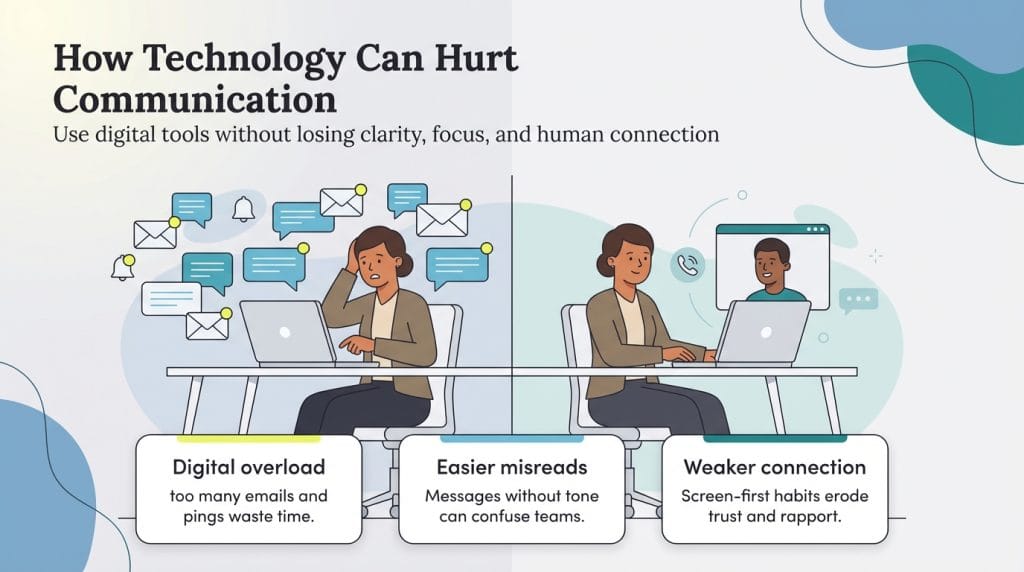
There are downsides to relying too heavily on digital communication. “Detrimental effects [of digital communication tools] mostly come from people overusing technology or neglecting basic communication ethics,” Zaichenko said. “These [tools] diminish the essence of human communication. People forget that they reach people, and they selfishly focus on what [they] can get ASAP.”
Business owners need to navigate these pitfalls carefully so technology supports the team rather than distracting it.
While digital tools promise efficiency, they can also create “digital debt” — the accumulation of emails, chats and notifications that demand constant attention. Chat platforms and email make it easy to start conversations from virtually anywhere, at any time.
Because these tools feel fast, it’s tempting to rely on email or messaging apps instead of having real-time conversations. But technology isn’t always the most productive option.
For example, sending a company-wide email may seem like the quickest way to share an update. In practice, it often triggers a wave of follow-up questions, leaving managers to spend more time responding than they would have spent addressing the issue in a short meeting.
To work more efficiently, teams need to be intentional about how they communicate. Overreliance on asynchronous tools can lead to long back-and-forth threads that could have been resolved in a five-minute call.
Emails, texts and chats are useful for quick communication from almost anywhere, but digital messages are also easier to misinterpret. Some people simply communicate more clearly face-to-face than they do on a screen.
If someone sends a terse reply, are they brushing you off because they dislike your idea or just trying to move through tasks quickly? Effective communication relies on eye contact, body language and tone of voice as much as it does on words. When communication is filtered through a screen, much of that context is lost, which can make collaboration less clear than it would be in person.
“In business, technology lets us move fast, but it can also lead to miscommunication,” cautioned Scott Cohen, CEO of the email marketing platform InboxArmy. “Quick messages on Slack or Microsoft Teams make things efficient, but they can create confusion or a lack of depth in discussions that would benefit from in-person chats.”
When communication is unclear, employees often fill in the gaps with assumptions rather than understanding. Being mindful of tone and wording matters, especially in short, written exchanges, because brief messages can have outsized consequences.
Technology makes it easy to stay connected with people around the world, but it can also change how we interact with the people right in front of us. Instead of meeting a friend for coffee, we might opt for a quick check-in over text. Communication becomes more compressed, with speed often taking priority over depth.
The same dynamic shows up at work. When most interactions happen through a screen, colleagues can start to feel more like usernames or email addresses than people. Over time, that distance can make it harder to build strong working relationships.
A lack of personal rapport can slowly erode trust. Without meaningful connection, teams may struggle with workplace collaboration, engagement and loyalty. In environments with little face-to-face interaction, employees are also more likely to feel isolated and less empathetic toward one another.
Mobile devices can pull attention away from important tasks. Constant notifications fragment focus, making sustained, deep work harder. The risk is obvious in some contexts; drivers, for example, are easily distracted when they try to talk or text on their phones.
The same issue shows up in the workplace. Messaging tools are often used for both personal and professional communication, which makes it harder to draw boundaries. When employees bounce between multiple apps, including Slack, email, LinkedIn and business texting, the mental load adds up, increasing the likelihood of mistakes and slowing productivity.
With so many tools in play, it’s easy for workplace communication to tip into overload. “Technological evolution has also introduced the challenge of … workers [needing to] navigate multiple communication channels, leading to cognitive burden and potential productivity losses that organizations must actively manage,” Bhatia said.
The good news is that this downside is largely preventable. To help prevent employee burnout and overwhelm, Bhatia advises setting clear expectations around response times, defining “do not disturb” periods and establishing guidelines for which platforms to use in different situations.
“The key to success lies in balancing technological efficiency with authentic human connection, ensuring that digital tools enhance, rather than replace, meaningful workplace interactions,” Bhatia explained.
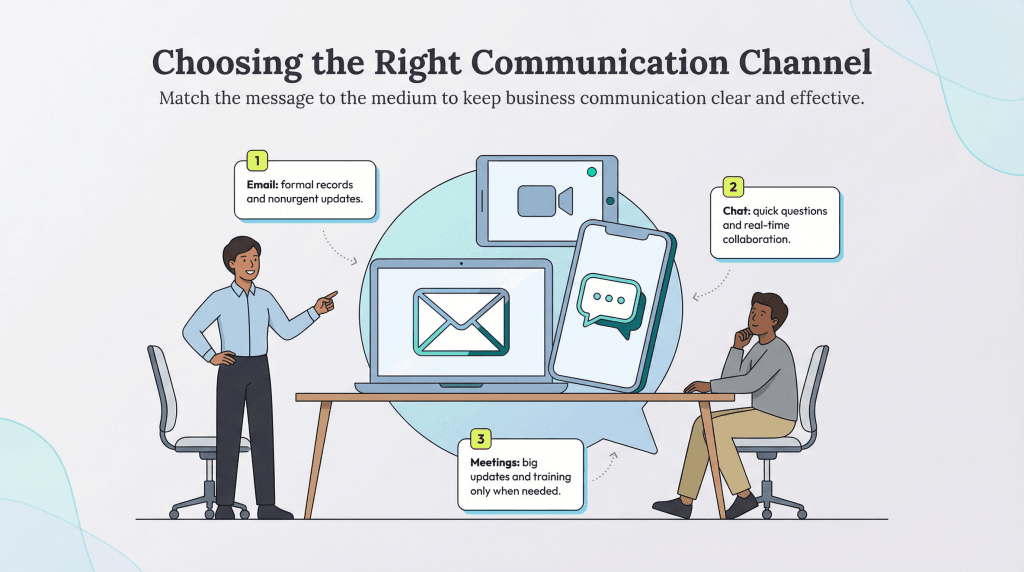
Whether technology enhances or hurts communication largely depends on how it’s used. The key is choosing the right channel for the situation rather than defaulting to whatever tool is most convenient. Here are a few ways to be more intentional about technology-driven communication.
Most businesses use a mix of communication tools. The challenge is making sure each one is used for the right purpose.
When sending digital communications to employees, focus on the information that truly matters. In a high-volume digital environment, brevity and clarity go a long way. Anticipate where confusion might arise and address it upfront to reduce unnecessary follow-up messages.
No matter the channel, employee feedback is essential. Establish a consistent way for employees to share input and make it clear they can reach out through the method they’re most comfortable with (including anonymous employee feedback options). Businesses should also provide straightforward ways for customer feedback to be submitted.
When you use multiple communication platforms, timing matters as much as the message itself, particularly for global companies with geodiversity challenges. Be mindful of colleagues’ availability, deadlines and time zones. Respect focus-time blocks and schedule nonurgent messages to send during working hours whenever possible to help prevent burnout.
Face-to-face conversations play an important role in building morale and strengthening company culture. Even if your team relies heavily on digital tools, look for opportunities to connect in person. For remote teams, that might mean annual retreats or informal virtual “coffee breaks” where work takes a back seat.
Your communication approach should reflect what your organization stands for. If your mission emphasizes business transparency, collaboration or respect, consider how your communication systems and expectations support those values over time. Involve your team in shaping that approach so it feels authentic and workable.
“At InboxArmy, we emphasize transparency and directness,” Cohen explained. “That means balancing digital tools with face-to-face check-ins whenever possible, even if that’s just an occasional video call. Ask your team what works for them, and make it a living conversation.”
Technology enables fast, convenient communication, but it can’t replace every in-person interaction. Digital tools work best when you’re intentional about when and how you use them. By setting clear communication norms and keeping human connection at the center, businesses can help improve employee engagement by making technology a support system for their teams, not another source of friction.
Max Freedman and Aisha Babangida contributed to this article. Source interviews were conducted for a previous version of this article.