Business.com aims to help business owners make informed decisions to support and grow their companies. We research and recommend products and services suitable for various business types, investing thousands of hours each year in this process.
As a business, we need to generate revenue to sustain our content. We have financial relationships with some companies we cover, earning commissions when readers purchase from our partners or share information about their needs. These relationships do not dictate our advice and recommendations. Our editorial team independently evaluates and recommends products and services based on their research and expertise. Learn more about our process and partners here.
If you're considering outsourcing your HR, be aware of specific challenges and know what to look for in your partner.


Human resources (HR) outsourcing brings numerous benefits, including helping busy entrepreneurs save money, time and resources while allowing them to focus on long-term goals and business growth. However, potential drawbacks can arise if you shut down or forego an in-house HR department and rely solely on an outside vendor to handle your company’s HR duties. We’ll explain some of the most pressing challenges outsourcing HR can bring and the steps you can take to overcome them.
HR outsourcing is the process of hiring a third-party service to handle some or all of a business’s human resources tasks, such as running payroll, dealing with employee benefits and recruiting employees.
Typically, businesses outsource HR functions to save time and ensure experts handle essential tasks. Even companies with internal HR departments may outsource specific functions to enhance HR compliance and access specialized expertise.
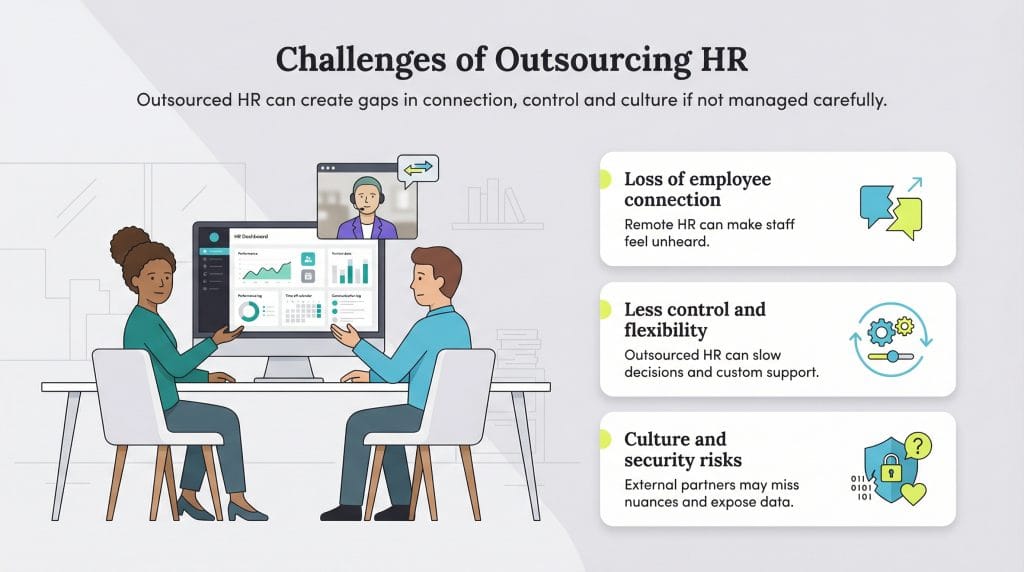
While having experts handle your HR headaches sounds appealing, some potential challenges remain. Before handing over your HR tasks to an HR outsourcing (HRO) provider or professional employer organization (PEO), take time to understand what could go wrong and how to address those issues before they become bigger problems.
The word “human” is part of “human resources” for a reason. HR representatives help employees feel like they have a voice and bring value to the company — a critical function. Transferring these duties to computer software or an off-site third party can make your team members feel disconnected from their employers. As an employer, you also risk not fully understanding your staff’s needs and frustrations.
“Employees can feel disconnected from HR when it’s outsourced, leading to a lack of trust and engagement,” explained Lisa Rigoli, a leadership coach and CEO of Element of Change. “The challenge is ensuring employees feel heard, supported and valued even when HR functions are external.”
According to Rigoli, one of the biggest hurdles when outsourcing HR is ensuring external providers truly understand the organization’s nuances.
“That includes its culture, leadership dynamics and the unspoken expectations that impact employee engagement,” Rigoli explained.
Outside providers may understand your employee handbook and disciplinary policies, but if they don’t truly get the subtleties of your company culture and organizational goals, you risk lower employee engagement and productivity.
According to Adam Calli, founder and principal consultant at Arc Human Capital, business owners may feel a loss of control when they hand over critical functions like payroll, benefits administration and employee relations to an outsourced HR service. They may feel uneasy about giving outsiders access to sensitive information or trusting them to uphold the company’s standards.
“They may be unwilling to let go of tasks or to share openly with HR,” Calli cautioned.
In small businesses especially, HR reps and managers can help employees out in a pinch — whether it’s paying out unused vacation days in an emergency or letting them dip into next year’s leave early, for example. When HR is automated or outsourced, these types of accommodations for loyal workers can be difficult, if not impossible.
In situations where an error has been made, such as a payroll discrepancy or incorrect vacation day counts, going through a third-party HR service can result in delays before the issue is corrected. Typically, this is due to additional layers of communication and approval required with third-party providers. As a result, employees can be left feeling angry or frustrated.
Additionally, the hiring process may take longer with an outside recruiter, and employee onboarding and training might feel less customized and personal than if you used your own in-house HR department.
HR outsourcing can expose your employee data to serious security risks if your third-party partner’s systems aren’t up to par. Many service providers rely on cloud-based software to manage HR functions, which can leave sensitive employee information vulnerable to cyberattacks and data breaches. The last thing you want is for your employees’ personal banking or medical information to be compromised, putting you at risk of violating Health Insurance Portability and Accountability Act laws.
These risks can carry serious financial consequences. According to IBM’s 2025 Cost of a Data Breach Report, the average cost of a data breach has hit a staggering $4.4 million globally.
One of the biggest concerns for many small businesses considering outsourced HR is the cost, since prices can vary greatly. It might seem tempting to simply hire an internal HR professional to handle all your HR needs, but that can be expensive too — and one person may not be able to cover all the functions HR entails.
The advantage of HR outsourcing is that you can choose which functions to outsource. This flexibility allows you to start small and gradually add more HR services as your needs grow. For example, you might decide to keep employee benefits management in-house but outsource your HR compliance tasks.
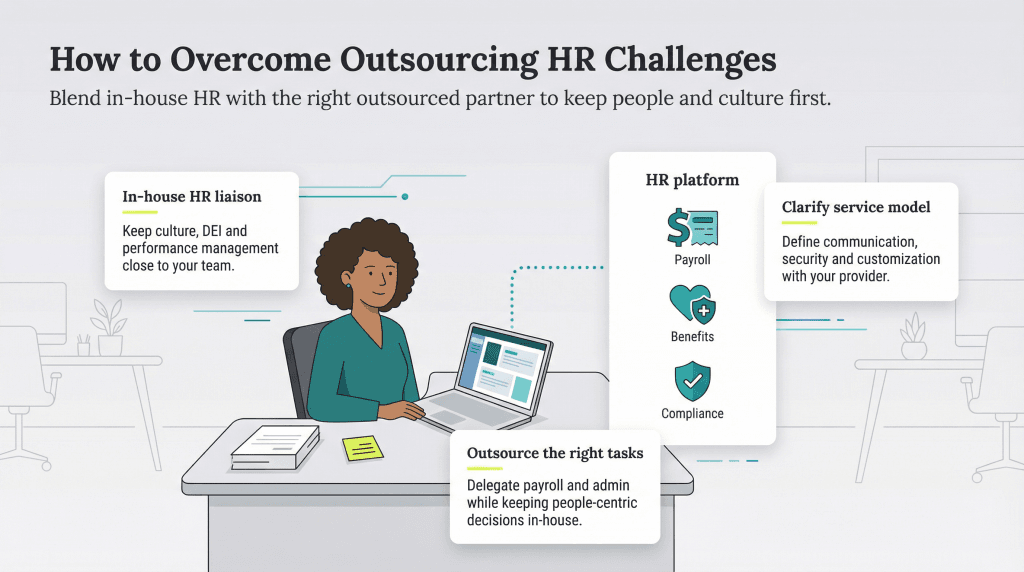
While outsourcing your HR functions can offer real advantages, it also comes with potential limitations. Luckily, a few straightforward strategies can help you address them.
A satisfied, hardworking staff is a business’s biggest competitive advantage. By ensuring employees’ voices are heard, you can create a company culture that values their contributions.
As noted above, one of the biggest challenges of outsourced HR is not having someone on-site to troubleshoot the everyday problems, frustrations and miscommunications that inevitably arise in any work environment.
One practical solution is to hire an internal employee to handle some hand-picked HR functions in-house. They can serve as a liaison between your team and your HR outsourcing provider, making sure all HR activity aligns with your company’s values and culture.
It’s also a good idea to have an internal hire manage employee-centric duties such as company culture, diversity, equity and inclusion and performance management.
Calli pointed out that outsourcing service models vary, so it is crucial to ensure a good understanding of your working relationship’s structure.
“Ask how you will communicate with one another,” Calli suggested. “Having a personal touch and, in this case, a personal contact, makes a huge difference as an HR outsourcing company gets to know your culture and your employees.”
Calli also emphasized the importance of understanding any outsourcing partner’s security protocols. “You should understand the technology setup and determine the security arrangement, such as whose servers [your data] will be housed on and who will have access and control,” Calli advised.
Establishing a clear understanding of how your outsourcing relationship will function — from communication cadence to data ownership — helps set the foundation for stronger collaboration and better outcomes for your employees.
Most HR outsourcing companies provide a platform through which you and your employees can access essential HR information, from time-off requests to benefits management. Before committing to a vendor, ask specifically what can be customized.
Many top-rated HROs and PEOs allow you to build policies within the platform that are as strict or as flexible as your business requires. It’s also worth asking about customizing employee access levels, adjusting reporting features, integrating third-party tools and adapting communication methods to reflect your company culture. The more configurable the platform, the better the experience you can deliver to your team.
Many excellent HR outsourcing services let you pick and choose which functions to hand over, allowing you to maintain a personal touch and deal with specific tasks in-house. Typically, you’ll appoint an in-house manager or HR team member to act as a liaison between your employees and the outsourced HR company.
These are the most common services HR outsourcing companies offer:
While outsourcing any of these services can save your business time and money, it’s often wise to keep people-centric tasks — like hiring, firing and performance reviews — in-house where possible. Maintaining direct involvement in those moments helps preserve trust and company culture. Equally important is creating a feedback loop with your employees: Encouraging them to voice concerns about outsourced services gives you the insight you need to evaluate what’s working and adjust your approach accordingly.
Casey Conway contributed to this article. Source interviews were conducted for a previous version of this article.