Business.com aims to help business owners make informed decisions to support and grow their companies. We research and recommend products and services suitable for various business types, investing thousands of hours each year in this process.
As a business, we need to generate revenue to sustain our content. We have financial relationships with some companies we cover, earning commissions when readers purchase from our partners or share information about their needs. These relationships do not dictate our advice and recommendations. Our editorial team independently evaluates and recommends products and services based on their research and expertise. Learn more about our process and partners here.
Developing accurate customer personas is key to your company's success.

Every successful business has one thing in common: a clear understanding of who it’s trying to reach. Your ideal customer isn’t just anyone who might buy from you; it’s the person who gets the most value from your product or service and sticks with you over time. That’s the customer worth building for, marketing to and investing in. Customer personas help you define exactly who that person is and how to reach them more effectively.
A customer persona (sometimes called a buyer persona) is a clear, research-backed profile of your ideal customer. It’s a semi-fictional snapshot based on real data, patterns and insights that helps you understand who you’re actually trying to reach.
A strong customer persona usually includes details like:
Creating customer personas helps you move beyond generic messaging and speak directly to specific audience segments. Instead of guessing what might resonate, you’re shaping your marketing plan around your ideal customer’s goals, needs and habits, including where and how they prefer to consume content.
One of the biggest advantages of building customer personas is that it changes how you think about your audience. Rather than marketing to abstract groups or assumptions, you’re forced to consider the real people who will actually use your product or service. That shift makes it easier to communicate value in ways that feel relevant, practical and human, which is ultimately what customers care about.
While the terms customer persona and buyer persona are often used interchangeably, they’re not always the same thing. A buyer persona typically focuses on the person responsible for making the purchase decision, while a customer persona looks more broadly at the end user — the person who actually uses and experiences the product or service.
For many small businesses, those roles overlap, which is why the distinction doesn’t always matter. In B2B environments or companies with longer sales cycles, however, separating buyers from users can help sharpen both your messaging and your product strategy.
Customer personas are grounded in research. While the exact process can vary by business, most personas are built by answering a similar set of questions. Below is a breakdown of the core information to consider when developing your customer personas.
Start with the basics: What does your ideal customer do?
The answers depend largely on your business model. For example, if you serve a B2B audience, your personas will likely focus on people responsible for procurement or purchasing decisions.
As you build out this component, include details like education level, professional background, core business skills and where the role sits within the organization. This information helps shape your messaging tone and determine how technical or high-level your language should be.
Next, look at how your customer spends their time.
These questions help uncover your customer’s pressures, priorities and challenges. Not every question will apply to every audience (for instance, some assume traditional employment), so adjust them as needed to fit your market.
Understanding where your audience spends time is critical.
Gathering these insights will help guide your content creation and ad expenditures. Depending on the answers, you may find your digital marketing strategies are better spent on video, long-form articles, LinkedIn posts or email marketing campaigns rather than spreading resources too thin.
Demographics and firmographics provide helpful context for tailoring your messaging.
Demographic details can influence how you frame offers or value propositions, while firmographic data helps identify whether an organization has unmet needs your business can address. This information is especially valuable for B2B companies.
This component focuses on what drives buying decisions.
Research in this area helps you prioritize and personalize messaging. For example, McKinsey and Nielsen research shows that consumer packaged goods featuring ESG-related claims saw 28 percent growth over five years, compared with 20 percent growth for similar products without those claims. So if sustainability or ethics are real strengths for your business, they should show up in your messaging.
Your customers are guided by both professional and personal goals.
Understanding these goals allows you to align your messaging with what truly matters to them. The closer your business goals match theirs, the easier it becomes to communicate value and solve real problems.
For example, assume that your persona, Sheila, is a procurement officer for a small graphic design company. Her goals include maintaining solid communications with suppliers and getting the best prices on raw materials and B2B services. Your messaging should speak directly to those needs.
Values shape how customers perceive brands.
These factors give you insight into how customers think and what they care about, which are details that basic demographic data can’t capture. Understanding values makes it easier to emotionally connect with customers and speak to more than just features and pricing.
Finally, identify what stands in your customer’s way.
Recognizing these pain points allows you to position your product or service as a solution. Returning to the Sheila example, her challenges might include supplier delays, product quality issues or time-consuming manual processes. If your software automates procurement tracking, your messaging should clearly highlight how it saves time and reduces stress.
Building a customer persona doesn’t end once it’s complete. As you learn more about your customers, refine details such as skills, influences, preferred tools and technology. Over time, this makes your personas more accurate and actionable.
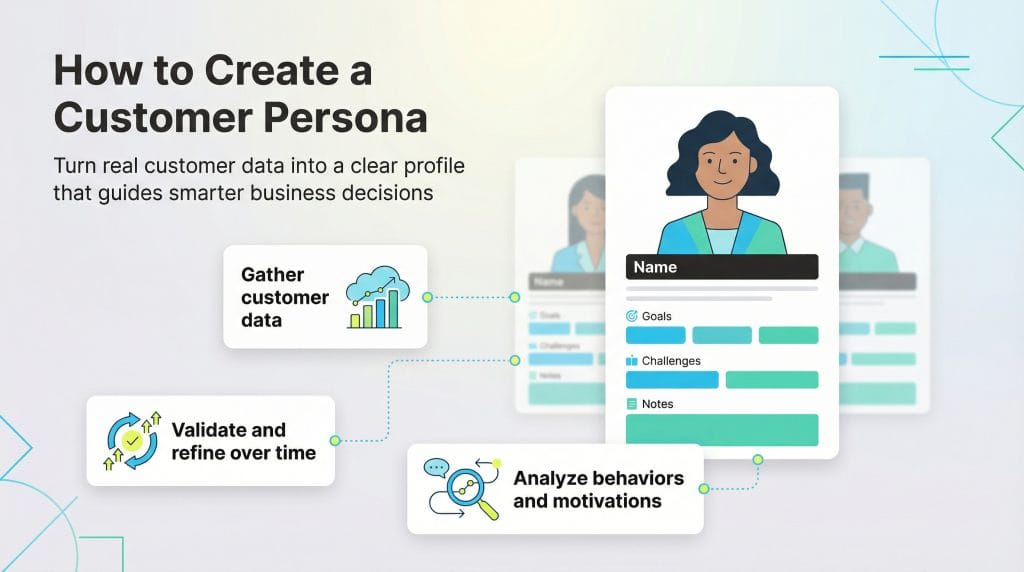
Now that you understand the key components of a customer persona, you can start putting them into practice. You can build customer personas in a few straightforward steps. Done well, this process helps you better understand the customers you want to attract, strengthen your marketing and deliver more relevant, effective customer experiences.
Here’s what to do:
By following these steps, you’ll create a practical tool that supports smarter, more customer-focused decisions. A well-built customer persona acts as a reference point across teams, helping your business connect more effectively with the people it’s built to serve.
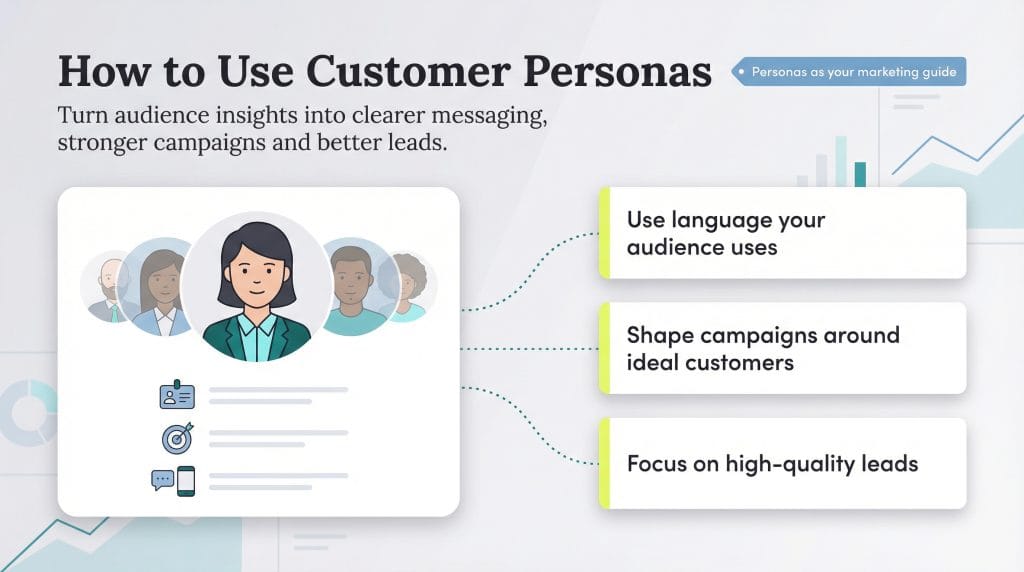
How to use customer personas
Customers expect more personalized experiences, but many businesses struggle to deliver them. In fact, Salesforce research shows that 73 percent of customers feel brands treat them as individuals, but only 49 percent believe their data is used in a way that benefits them. Customer personas help close that gap by taking the guesswork out of personalization.
Here’s how you can use your customer personas to improve your marketing and increase sales for your business.
Tejas Vemparala and Jamie Johnson contributed to this article.