Business.com aims to help business owners make informed decisions to support and grow their companies. We research and recommend products and services suitable for various business types, investing thousands of hours each year in this process.
As a business, we need to generate revenue to sustain our content. We have financial relationships with some companies we cover, earning commissions when readers purchase from our partners or share information about their needs. These relationships do not dictate our advice and recommendations. Our editorial team independently evaluates and recommends products and services based on their research and expertise. Learn more about our process and partners here.
Improve customer retention, build brand trust and boost your ROI by focusing on product quality.


Product quality plays a major role in shaping your brand’s profitability and long-term reputation. Marketing may bring customers through the door, but quality is what keeps them coming back. According to Salsify’s 2025 Consumer Research report, more than two-thirds of shoppers — 69 percent — say they trust brands that offer high product quality.
That said, “quality” isn’t always defined the same way by every customer. What feels premium to one audience may fall short for another. The real challenge is understanding how your target audience evaluates quality and making sure your product delivers on those expectations. Below, we’ll explain what product quality means in practice, why it matters and how you can strengthen it over time.
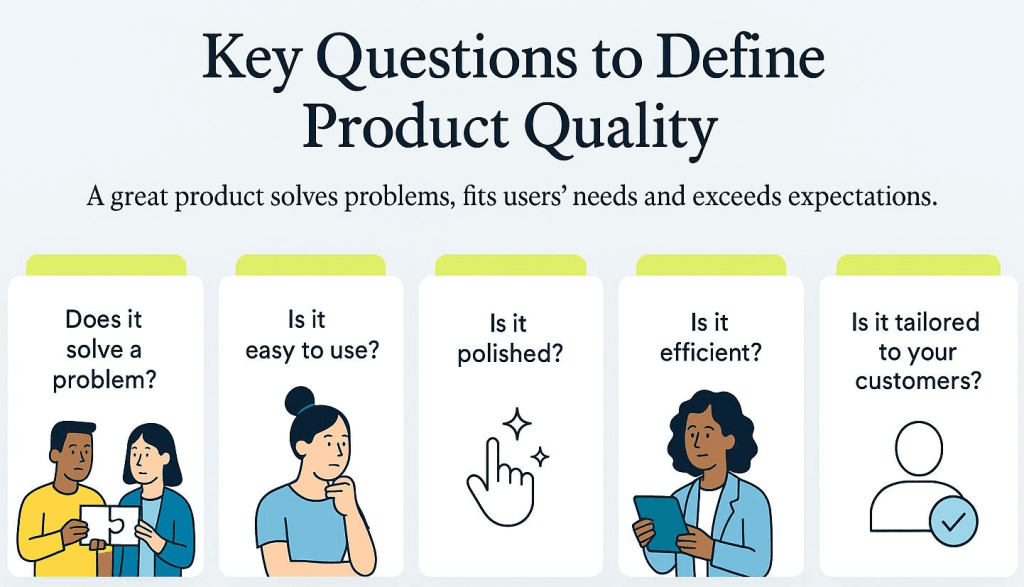
Product quality refers to how well a product meets user expectations. However, what counts as “quality” can vary widely depending on the type of product, according to Jennifer Garrett, senior vice president of product development and design at JEM Global.
“If it’s a simple product with no user interface tech, then it’s definitely in the materials that make the most [impact on] product quality,” Garrett explained. “But if it’s … a smartphone or a tech product, then it’s definitely the user interface.”
When you’re evaluating product quality, start by asking a few practical questions about how your product performs in the real world:
Improving product quality plays a major role in protecting your business’s bottom line and long-term brand reputation. Here are six ways strong product quality can positively impact your business.
Most businesses struggle to grow without earning customer trust. When brands fail to deliver consistent quality, potential buyers quickly lose confidence and look elsewhere. On the other hand, when customers believe in what you offer, they’re more likely to stay loyal and may even be more accepting of changes like price increases.
Reliable performance is often where that trust begins. PwC’s 2025 Customer Experience Survey found that 69 percent of consumers consider dependable product quality a minimum expectation, a reminder that customers rarely praise quality when it’s present but quickly notice when it falls short. And when it is, the consequences can be immediate: The same research found that 52 percent of consumers stopped buying from a brand after a bad product or service experience.
Many buyers check reviews or ask around before making a decision. Online reviews, testimonials, user-generated content and personal referrals often influence purchasing decisions more than traditional advertising. In fact, BrightLocal’s 2026 Local Consumer Review Survey found that 97 percent of consumers read reviews when researching businesses they might buy from.
When a product consistently delivers, customers are more likely to talk about it. Strong experiences turn into positive reviews, recommendations and shares between peers, and those endorsements carry real weight. BrightLocal’s research reinforces this connection, showing that 85 percent of consumers are more likely to use a business after reading positive customer reviews.
“If you design and sell products that last, do their jobs well and are easy to maintain, you’re going to create loyal customers who will happily evangelize for your products,” said Mike Fretto, co-founder and creative director of Neighbor.
Rather than trying to manufacture buzz, focus on creating great customer experiences that people genuinely want to talk about. Paying attention to reviews — and responding thoughtfully to both praise and complaints — shows customers that you stand behind your product, which can encourage more organic recommendations over time.
Investing more time and resources upfront to refine a product can help reduce complaints and costly returns later. In its most recent returns research, the National Retail Federation projected retail returns to reach $849.9 billion in 2025, a sign of how expensive product missteps can become. Focusing on quality early can help businesses avoid adding to those losses.
Some brands spend heavily to get customers to try something new, but what really builds momentum is a strong first experience. When products work the way customers expect, people are more likely to stay satisfied and return for future purchases.
Testing products with real users through pilot groups, beta testing or market research panels can surface problems teams might not notice internally. Direct feedback from early testers gives businesses a chance to refine the experience before launching to a broader audience.
Visual and sensory details can influence how customers judge a product’s quality. The way something looks, feels, sounds, tastes or smells may shape whether it seems premium, sometimes before anyone fully uses it.
For example, wholesale food service packaging supplier MrTakeOutBags places strong emphasis on both design and functionality. Elements like color, print, texture and practical features such as handles can change how customers perceive the product and help differentiate the brand from competitors. Small details often carry more weight than businesses expect, especially when buyers are comparing similar options side by side.
Choosing better materials and paying attention to design details can make a product feel more polished and show customers that quality goes beyond basic functionality.
Quality improvements don’t just affect customer satisfaction; they can change the financial picture behind the scenes. Products with fewer defects typically require less rework, fewer replacements and less time spent managing complaints, all of which can help control operating costs. At the same time, stronger performance and reliable features make it easier to attract repeat business and reach new customers.
After a product gains traction, many businesses shift their focus to efficiency. Instead of cutting corners, they look for smarter ways to streamline production or simplify processes while keeping the experience customers already trust. Small process changes can help control costs without lowering the quality customers already expect.
Consistent product quality can shape how customers think about your brand over time. When people know what to expect, whether it’s reliability, thoughtful design or attention to customer needs, those impressions start to define your reputation and encourage long-term loyalty.
“Product quality becomes an identity of the brand,” Garrett said. “The success of a brand is determined by maintaining that identity and staying true to it.”
Strong quality standards can also reduce risk. Products that perform as expected are less likely to lead to safety issues, complaints or costly disputes, helping businesses protect both their reputation and their bottom line.
“Quality products limit liability,” said Fretto. “A major lawsuit or safety issue with a product could completely destroy a business.”
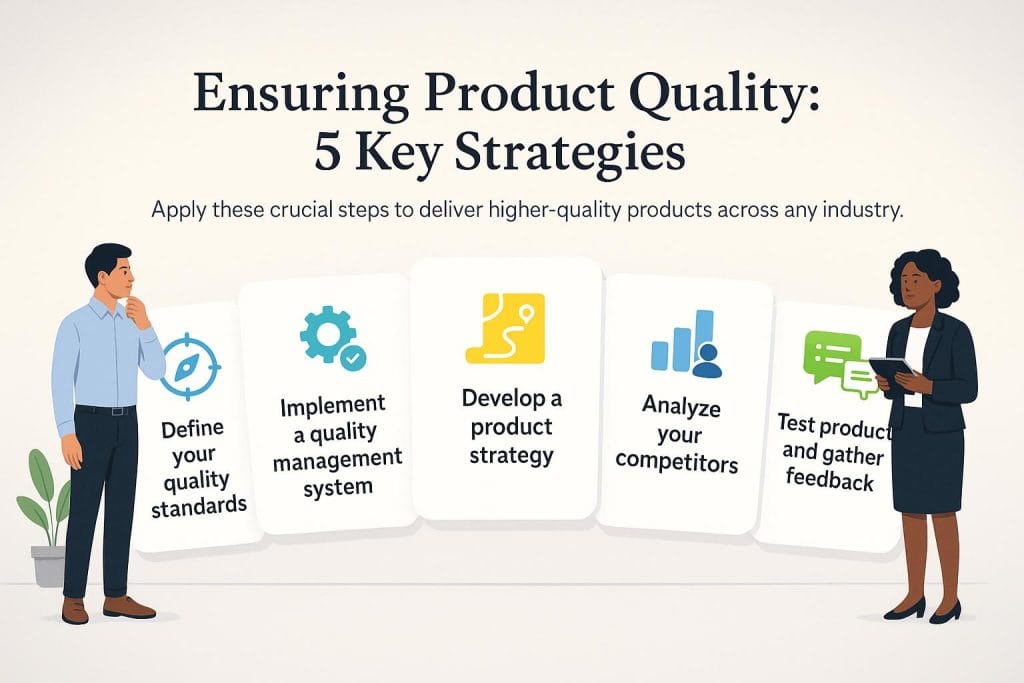
Here are a few practical ways to maintain strong product quality, no matter your industry or target market.
High product quality often starts with getting clear on what matters most to your brand and your customers. “Is [quality] getting the things quickly and cheaply to the customers that want it?” Garrett asked. “[Or,] is it taking your time and making the best product you can… [regardless of] how much money you spend?”
For luxury or premium brands, quality may mean flawless construction and higher-end materials. For more budget-focused brands, it can come down to reliability, durability and delivering strong value within a specific price range.
A quality management system brings structure to how your business plans, builds and delivers products. Rather than being a single tool, it’s an approach that helps teams stay consistent from development through launch. Common principles include keeping customer needs front and center, supporting strong leadership, relying on research and using real data to guide business decision-making.
A product strategy outlines how your product fits into your company’s broader vision and what success looks like over time. It should clarify priorities and define key performance indicators (KPIs) that reflect your goals, whether that means gaining market share, improving customer satisfaction or increasing revenue. Think of it as a guide that helps teams stay focused from early development through launch.
When shaping your strategy, remember that trade-offs are often part of maintaining quality — a concept sometimes referred to as the iron triangle of product development. “I like to say, ‘Good, fast and cheap: Pick two,'” said Garrett.
Looking at what similar brands are doing can offer a useful perspective during product development. Pay attention to where competitors are succeeding, where they fall short and how customers respond to their products. Noticing gaps in their offerings — or areas where your approach already stands out — can help you refine your own strategy.
Instead of trying to copy what works for others, focus on understanding why certain features resonate with customers. Those insights can help you make more informed decisions as you position your product to stand out from the competition in a crowded market.
Testing products before launch gives you a clearer sense of how customers actually use them and where problems might surface. Some teams start with small pilot groups or beta testers to gather candid reactions and spot issues before a broader rollout.
“The more you push your product to see what it can take, the better your chances of spotting issues before the public does,” Fretto advised.
After launch, keep listening to what customers are saying. Survey data, email check-ins and product reviews can show you what’s landing well and where people run into friction. Even critical feedback can reveal how customers actually use your product and what small changes might make it work better for them.
After launch, keep an eye on how your product performs and how it’s produced so quality stays consistent. Some businesses bring in quality assurance specialists to watch for defects along the production line, from packaging durability to core functionality. Their reports can help teams spot patterns and decide what to adjust next.
“The more you can do to learn from the last version of your product, the better you’ll be at creating the next version,” said Fretto.
Miranda Fraraccio and Sean Peek contributed to this article. Source interviews were conducted for a previous version of this article.