Few payment issues frustrate business owners more than a chargeback. One day a sale looks complete, the funds land in your account and everything appears to be running as expected. Then days (or sometimes weeks) later, that money is pulled back after a customer disputes the charge with their bank.
A single chargeback can cost far more than the original sale. Beyond losing the revenue, merchants often pay dispute fees, spend time gathering documentation and, if chargebacks happen too often, risk higher processing costs or even account restrictions. Understanding how chargebacks work — and how to prevent them — is essential for protecting both your revenue and your ability to accept credit card payments.
What is a chargeback?
A chargeback is a forced reversal of a credit or debit card transaction that a cardholder’s bank initiates. Unlike a refund, which a merchant issues voluntarily, a chargeback is imposed after a cardholder disputes a charge. The merchant loses the sale, pays a dispute fee and, in some cases, may be placed in a monitoring program if chargebacks become too frequent.
Chargebacks were originally designed to protect consumers from unauthorized transactions and merchant fraud. Today, they’re used for a much wider range of disputes, including legitimate billing issues, simple misunderstandings and, in some cases, outright abuse of the process.
How the chargeback process works
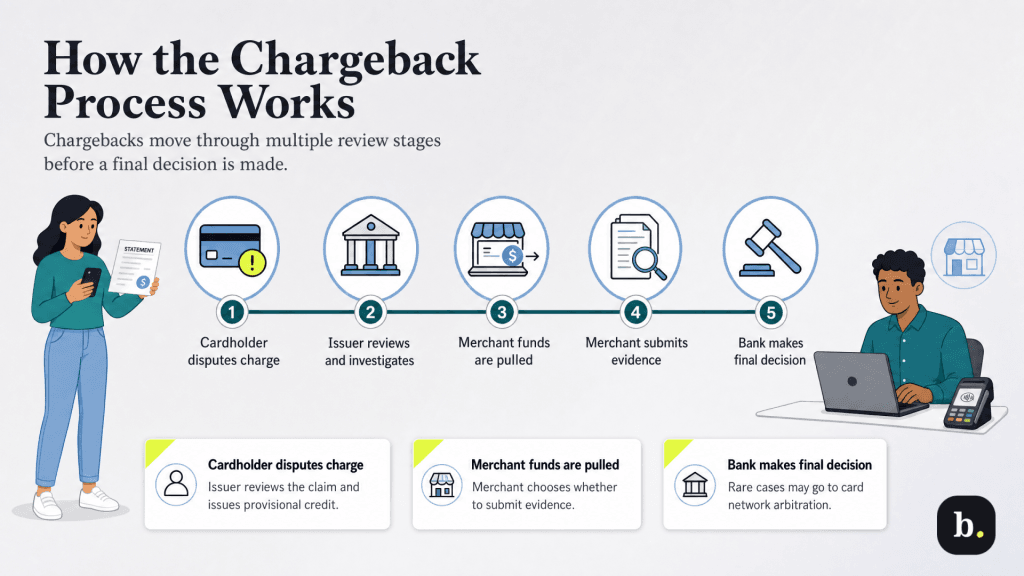
A chargeback rarely happens overnight. Once a customer disputes a charge, the process can stretch over several weeks — and sometimes several months — as banks, payment processors and merchants work through the claim. Here’s a look at the typical chargeback process.
- The cardholder disputes the charge. The process usually starts when a customer contacts their issuing bank to question a charge on their statement. They may claim the transaction was unauthorized, the order never arrived, the item was significantly different from what was advertised or any number of other issues. If the issuing bank believes the claim has enough merit to investigate further, it assigns a reason code and formally initiates the chargeback.
- The cardholder receives a provisional credit. In many cases, the issuing bank temporarily credits the customer for the disputed amount while the investigation moves forward. At the same time, the dispute starts making its way back through the payments chain, first through the card network, then to the acquiring bank or payment processor, and eventually to the merchant.
- The merchant’s funds are pulled back. At this point, the disputed funds are debited from the merchant’s account, usually along with a chargeback fee (which can be steep, depending on the processor). For many business owners, this is when the financial implications get very real.
- The merchant decides whether to fight the chargeback. The merchant can either accept the dispute or challenge it through a process known as representment. If the merchant decides to fight the chargeback, they’ll need to submit compelling evidence showing the transaction was legitimate and that the goods or services were delivered as promised.
- The issuing bank makes a final decision. The evidence works its way back through the same chain for review. If the issuing bank rules in the merchant’s favor, the funds are returned. If the bank sides with the cardholder, the chargeback stands.
- In rare cases, the dispute moves to arbitration. If either side continues to challenge the outcome, the dispute may be escalated to arbitration through the card network. Most chargebacks never make it this far, partly because arbitration can be expensive for everyone involved.
Chargebacks are showing no signs of slowing down.
Mastercard's 2025 global chargeback study found that 59 percent of merchants said their chargeback volume increased by more than 10 percent in the past year.
Common reasons for chargebacks
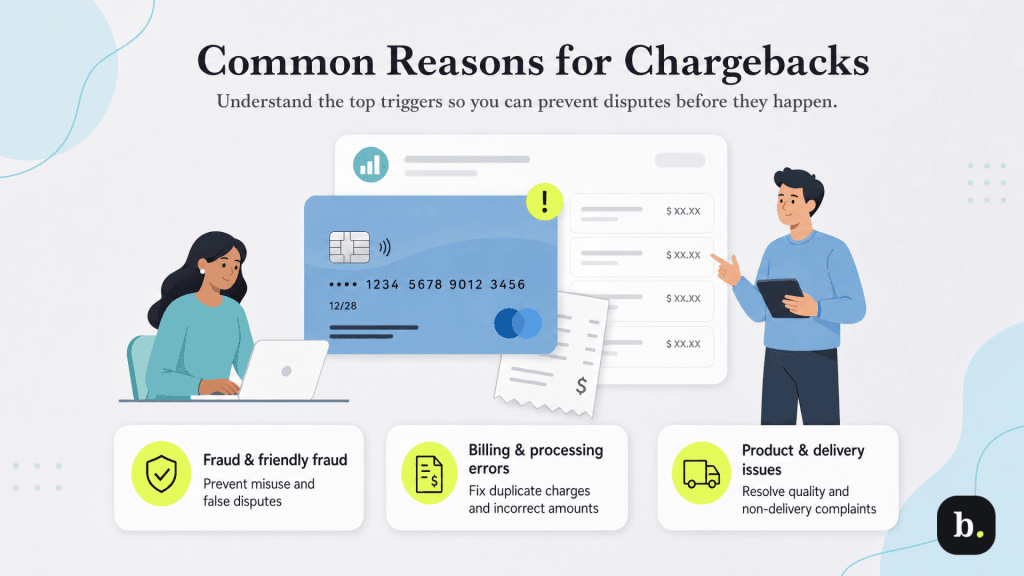
Chargeback reason codes vary by card network, but for most small businesses, the same patterns tend to show up again and again. Some involve true fraud. Others come down to billing confusion, fulfillment issues or customers disputing purchases they actually made. Here’s a look at some of the most typical chargeback causes.
- Fraud: Fraud-related chargebacks happen when someone other than the legitimate cardholder uses stolen card credentials, takes over an account or otherwise gains unauthorized access to a payment method. The real cardholder discovers the charge, reports it to their bank as credit card fraud and disputes the transaction. These chargebacks are especially common in card-not-present environments, such as online stores and e-commerce platforms.
- Friendly fraud: Friendly fraud happens when a customer makes a legitimate purchase, receives the product or service and disputes the charge anyway. Sometimes it’s buyer’s remorse. Sometimes a family member made the purchase and the cardholder doesn’t recognize it. In other cases, it’s an intentional attempt to get something for free. Because the original transaction was legitimate, these disputes can be especially difficult for merchants to spot and prevent.
- Unrecognized charges: Sometimes the purchase itself is legitimate, but the customer doesn’t recognize the charge on their statement and assumes something is wrong. In many cases, this comes down to a billing descriptor issue, when the business name that appears on the statement doesn’t match the name the customer knows. For example, if a customer buys from “Sunrise Bakery” but their statement shows a charge from “SRB Holdings LLC,” they may dispute the charge simply because the transaction looks unfamiliar.
- Customer disputes: The cardholder received the product or service but claims it was defective, not as described or otherwise unsatisfactory. This category can also include orders the customer says never arrived.
- Processing errors: The wrong amount was charged, the customer was billed more than once or a promised credit was never issued. These chargebacks usually stem from legitimate billing or point-of-sale mistakes.
- Authorization issues: The transaction was processed without a valid authorization, or the authorization expired before the transaction was settled. This can happen when batch closing is delayed for too long.
What chargebacks cost your business
Most business owners assume a chargeback costs them the original sale. In reality, that’s usually just the beginning. By the time a dispute is resolved, the true cost may include lost revenue, product losses, processor fees, staff time and, in extreme cases, restrictions on your ability to accept card payments at all.
Here’s where those costs usually show up.
- Transaction amount: The full sale price is debited from your account. If the chargeback involves a physical product that has already shipped, you’re often out both the revenue and the cost of goods.
- Chargeback fees: Most payment processors charge a fee for every chargeback, often ranging from $20 to $100 per dispute. In many cases, that fee applies whether you win or lose the dispute.
- Operational costs: Chargebacks also consume time, and for small businesses, time is money. Gathering documentation, pulling receipts, tracking shipping records and responding to disputes can quickly pull staff away from sales, customer service and other day-to-day priorities.
- Chargeback ratio consequences: This is where chargebacks can become a much bigger problem. Card networks monitor your chargeback ratio — the number of chargebacks relative to your total transactions. If that ratio climbs above the network’s threshold, often around 1 percent depending on the network and program, your business may be placed in a chargeback monitoring program (more on this below). Those programs can come with escalating consequences, including higher fees, mandatory remediation plans and, in severe cases, merchant account termination.
- MATCH list placement: In the most serious situations, a merchant whose account is terminated for excessive chargebacks may be added to the MATCH (Member Alert to Control High-Risk Merchants) list, a shared industry database used by payment providers. Once listed, opening a new merchant account can become extremely difficult — in some cases, for up to five years.
Some of the
best credit card processors offer chargeback alerts, dispute-management tools and, in some cases, representment support that can help merchants resolve disputes faster or avoid them before formal chargebacks are ever filed.
Chargeback monitoring programs
Card networks don’t just track individual disputes. They also monitor merchant chargeback activity over time, and businesses whose dispute ratios stay too high may be placed into formal monitoring programs.
Both Visa and Mastercard actively track merchant chargeback rates, fraud activity and dispute volume. If a business consistently exceeds the card network’s thresholds, the consequences can escalate quickly.
- Visa: Visa now uses its Visa Acquirer Monitoring Program (VAMP), which replaced an older system. As of April 2026, merchants that exceed Visa’s 1.5 percent excessive threshold can face remediation requirements, steep fines and even account closure. Unlike previous programs, VAMP combines both chargebacks and fraud reports into a single ratio, which means merchants can run into scrutiny even when formal disputes aren’t the only issue.
- Mastercard: Mastercard’s Excessive Chargeback Program (ECP) works in much the same way. Merchants whose dispute activity stays above Mastercard’s thresholds may face escalating fines, compliance requirements and, if the issue isn’t brought under control, possible merchant account termination.
How to dispute a chargeback (representment)
When a chargeback lands in your inbox, you have a decision to make: accept the loss or fight it. Challenging a chargeback is called representment — the formal process of submitting evidence to the issuing bank showing the original transaction was legitimate and the dispute should be reversed. Here are the steps you’ll take.
1. Review the reason code.
Start by understanding why the chargeback was filed. The card network’s reason code will tell you whether the dispute involves fraud, a processing error, a delivery issue or another claim. That reason code should guide the evidence you gather.
2. Gather compelling evidence.
The strength of your representment case usually comes down to documentation. Depending on the dispute, useful evidence may include:
- Transaction receipts with timestamps and authorization codes
- Delivery confirmations, tracking records or signature verification
- Signed contracts, service agreements or terms-of-service acknowledgments
- Customer emails, chat logs or text messages
- Proof of prior purchases from the same customer
- IP address, device or geolocation data for online purchases
- Records showing the customer accessed or used a digital product after purchase
3. Watch the deadline.
Timing matters. Most processors give merchants a limited window to respond, often seven to 30 days, depending on the card network and reason code. Miss that deadline, and the chargeback usually stands automatically.
4. Decide whether the fight is worth it.
Not every chargeback is worth fighting. Strong documentation absolutely helps, but even a solid case doesn’t guarantee the issuing bank will side with you. In practice, representment usually makes the most sense when you have clear evidence the transaction was legitimate and enough money is on the line to justify the time it takes to build the case.
For smaller disputes with limited documentation, accepting the loss and focusing on prevention may be the smarter business decision.
Mastercard's 2025 chargeback study (cited above) found that merchants win more than half of the chargebacks they choose to represent, making strong documentation more valuable than many businesses realize.
How to prevent chargebacks
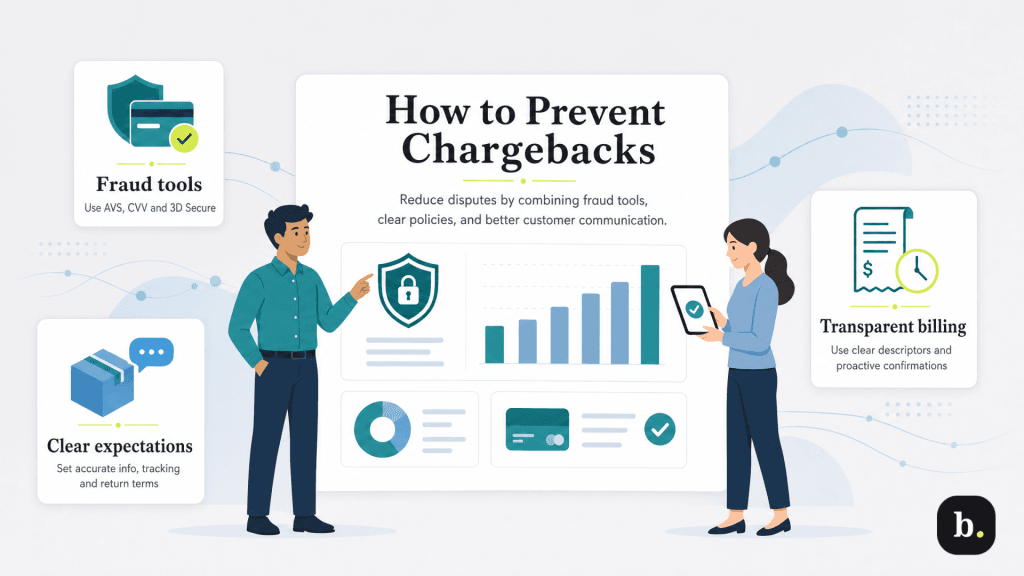
By the time you’re fighting a chargeback, you’re already playing defense. The most effective approach to avoiding chargebacks is to prevent disputes before they happen, whether that means stopping fraud, setting clearer customer expectations or making legitimate purchases easier for cardholders to recognize later. Here are some top strategies for reducing the most typical chargeback types.
Reduce fraud-related chargebacks.
Fraud-related chargebacks are especially common in card-not-present environments, but they can affect almost any business that accepts credit cards over the phone, online or through mobile payments.
Start with the basics:
- Use Address Verification Service (AVS): This confirms that the billing address provided by the customer matches the address on file with the issuing bank.
- Require CVV verification: For online and phone transactions, this helps confirm the customer has the physical card, not just the card number.
- Enable 3D Secure: For eligible online purchases, this layer of e-commerce security adds one more verification step through the cardholder’s bank before the transaction is approved. For authenticated purchases, it can also shift certain chargeback liability away from the merchant.
Next, watch for behavioral red flags that don’t always show up in your fraud tools, such as the following:
- Billing and shipping addresses that don’t match
- Unusually large quantities
- Rush shipping requests on high-value purchases
- Multiple orders placed in rapid succession from the same IP address
None of these situations automatically signal fraud, but taken together, they’re often worth a closer look.
Reduce service and fulfillment chargebacks.
Not every chargeback starts with fraud. Many start with a customer who feels disappointed, confused or left in the dark about what they ordered or when it’s supposed to arrive. A few practical habits can go a long way toward preventing these types of chargebacks:
- Create clear product descriptions: Use accurate photos, dimensions, materials and any important limitations to set realistic expectations before the sale.
- Stay on top of shipping: Ship orders promptly, always use trackable delivery methods and, for high-value purchases, consider requiring a signature so you have proof of delivery if a dispute is filed.
- Communicate with customers: If an order is delayed, backordered or otherwise running behind, tell the customer before they have to wonder where it is. Silence is one of the biggest drivers of chargebacks; when customers stop hearing from a business and stop seeing updates, calling the bank can start to feel like the fastest way to get answers.
- Set clear, reasonable return and refund policies: Make your return and refund policies easy to find, easy to understand and easy to use.
Customers who can resolve problems directly with you are far less likely to escalate to a chargeback. And when a customer reaches out with a complaint, treat it as a chance to deliver
excellent customer service and prevent a dispute, not just another support ticket.
Reduce billing and recognition chargebacks.
A surprising number of chargebacks start because the customer doesn’t recognize a charge on their statement. A few small communication habits can make those disputes far less likely.
- Use a recognizable billing descriptor: The business name that appears on customer statements should match the name customers actually know. If your legal entity name differs from your customer-facing brand, work with your processor to update your billing descriptor. “Main Street Fitness” tells the customer exactly what they bought. “MSF Operations LLC” usually doesn’t.
- Send receipts and order confirmations right away: Immediate paper or digital receipts, order confirmations and shipping updates give customers a reference point if they check their statement days or weeks later.
- Be transparent about recurring billing: If your business runs on a subscription business model — or offers memberships, retainers or other recurring services — send reminders before each charge and make cancellations easy to find. When customers feel stuck in a recurring payment they can’t easily stop, calling the bank can start to feel easier than calling you.
- Disclose trial and renewal terms upfront: Make trial periods, auto-renewal policies and cancellation procedures easy to understand before the customer signs up, not after the charge appears.
According to
Mastercard, roughly one in four chargebacks now involves a recurring transaction, often when customers forget about a purchase, don't recognize a renewal or struggle to cancel through a
subscription website.
Reduce friendly fraud.
Friendly fraud can be one of the toughest chargeback categories to prevent because the original purchase was legitimate. In many cases, the customer really did place the order, receive the product or use the service before deciding to dispute the charge.
That’s why documentation matters. Keep detailed records of every transaction, along with customer emails, chat logs and other communications. Use delivery confirmation and, for higher-value shipments, consider requiring a signature. If you sell digital products or online services, maintain access logs showing when the customer signed in, downloaded the product or actively used the service after purchase.
And don’t overlook the value of a direct conversation. When a chargeback notice comes in, it’s sometimes worth picking up the phone or sending a quick email before you start building your representment case. Not every dispute starts with bad intent. Sometimes the customer is confused, forgot about the purchase or simply doesn’t recognize the charge. A short conversation can clear that up, improve customer satisfaction and, in some cases, lead the customer to work with their bank to correct the dispute.
Keeping chargebacks under control
Chargebacks are an unavoidable cost of accepting card payments, but they’re largely manageable with the right approach. Prevention is almost always cheaper (and far less time-consuming) than fighting disputes after the fact. The combination of strong fraud detection tools, clear customer communication, accurate billing descriptors and thorough recordkeeping addresses the vast majority of chargeback risk.
When chargebacks do happen, move quickly and document everything. Know when a dispute is worth fighting and when it makes more business sense to take the loss, learn from it and focus on preventing the next one. And don’t wait until chargebacks start piling up to look at your numbers. Track your chargeback ratio regularly and treat it like any other key business metric.
Most importantly, make it easy for customers to resolve problems directly with you. A business that’s responsive, transparent and easy to work with will almost always see fewer chargebacks than one that forces customers to go through their bank to get answers. Your return policy, your customer service responsiveness and your billing clarity are still your first — and often your most effective — line of defense.