Business.com aims to help business owners make informed decisions to support and grow their companies. We research and recommend products and services suitable for various business types, investing thousands of hours each year in this process.
As a business, we need to generate revenue to sustain our content. We have financial relationships with some companies we cover, earning commissions when readers purchase from our partners or share information about their needs. These relationships do not dictate our advice and recommendations. Our editorial team independently evaluates and recommends products and services based on their research and expertise. Learn more about our process and partners here.
Want to track your employee retention? Learn how to calculate your company's staff turnover rate.


Some level of employee turnover is natural for all businesses. While employees used to stay with one company for the majority of their careers, job-hopping has become much more common for today’s professionals. However, if several employees have recently left your business, you may wonder if that’s normal or a sign of a bigger problem. To get a clearer picture, it helps to determine your employee turnover rate and compare it to similar businesses.
With this information, you can see whether your turnover rate is cause for concern and take steps to improve employee retention if necessary.
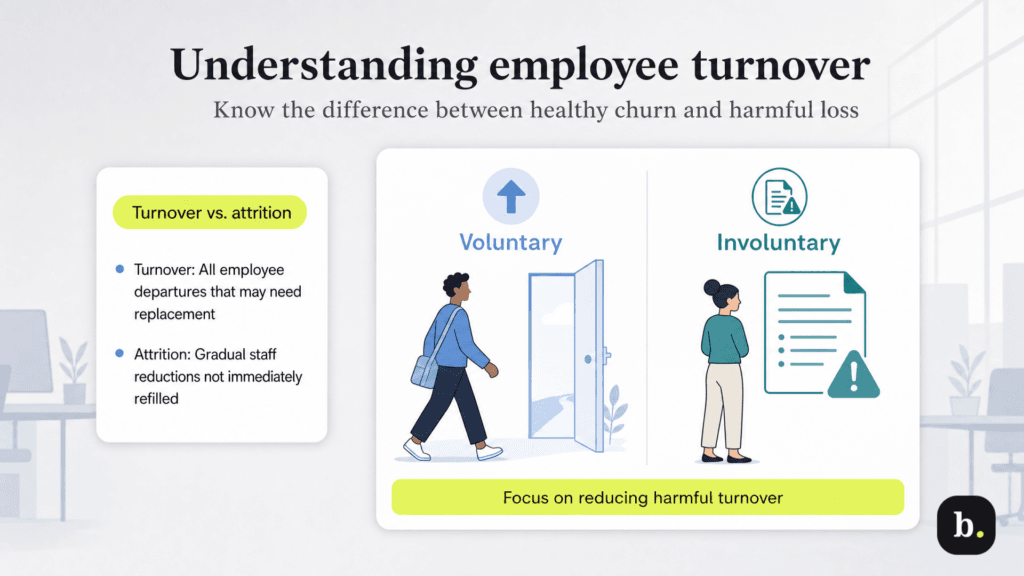
Employee turnover refers to employees leaving a company over time due to resignations, retirements, layoffs, terminations or other separations. You may have heard the terms “employee turnover” and “employee attrition” used interchangeably, but there’s an important distinction.
Employee attrition generally describes a gradual reduction in staff through resignations, retirements, deaths or positions that are eliminated and not immediately filled. Turnover casts a wider net, covering both voluntary and involuntary departures, including positions a business may need to fill again. The two overlap, but turnover can become costly and disruptive, especially when you’re regularly replacing departing employees.
There are two standard types of employee turnover:
Turnover isn’t always bad for a business, however. Marc Prosser, co-founder of Choosing Therapy, said it’s helpful to distinguish between good and bad employee turnover and offered the following examples:
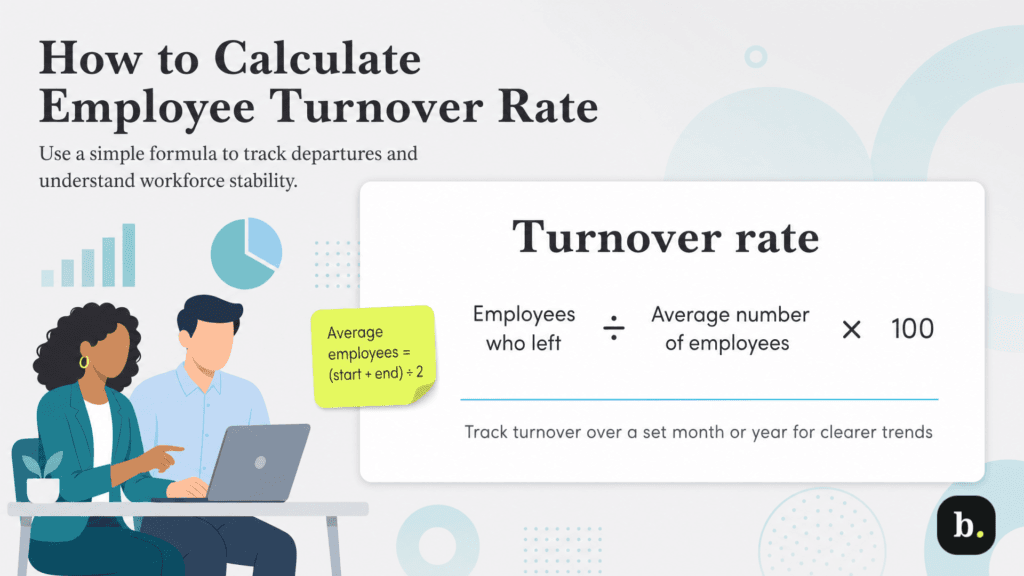
To determine whether you have an employee turnover problem, you first need to calculate your turnover rate over a defined period, such as a month or a full year. Sue Andrews, a senior human resources (HR) professional and fellow of the Chartered Institute of Personnel and Development, explained that you’ll need three key figures:
Start by finding your average number of employees. Add your employee count at the beginning of the period to the count at the end, then divide that number by two.
Once you have your average employee count, calculating your turnover rate is straightforward:
Turnover rate = (Employees who left ÷ Average number of employees) × 100
Say you want to calculate your business’s turnover rate for July. During the month, two employees retired and two quit. You’ll use the following figures:
First, calculate your average number of employees:
(180 + 176) ÷ 2 = 178
Then, plug those numbers into the turnover formula:
Turnover rate = (4 ÷ 178) × 100
That gives your business an employee turnover rate of about 2.25 percent for July.
Your internal HR department can track turnover manually by keeping accurate records of employee departures and headcount. If you’d rather automate the process, many of the best HR outsourcing services and HR software platforms include tools that calculate and report turnover for you.
Bob Teasdale, former relationship manager at Agilio Software, explained how the calculation can be automated: “For example, [the] system generates an exportable staff turnover report that automatically calculates staff headcount at the end of each month and provides a turnover percentage.”
According to the latest annual data from the Bureau of Labor Statistics (BLS), U.S. employers recorded 62.8 million employee separations in 2025. That included 38 million employees who quit and 21.2 million who were laid off or discharged. The annual average total separations rate was 3.3 percent, unchanged from 2024. The average quit rate was 2.0 percent, while the layoffs and discharges rate was 1.1 percent.
Although BLS reports these as annual averages, the percentages represent average monthly rates. In other words, the 3.3 percent figure reflects separations in a typical month, not the percentage of employees who left over the entire year.
Still, there’s no universal turnover rate that’s considered healthy for every business. Rates can vary considerably by industry, so comparing your company with similar employers gives you a more useful benchmark than looking at the national average alone.
BLS data shows just how wide those differences can be. In 2025, finance and insurance businesses had an average monthly total separations rate of 2.1 percent, while arts, entertainment and recreation businesses had a rate of 6.1 percent. The accommodation and food services category was also well above the national average at 5.5 percent.
Tracking employee turnover can tell you a great deal about what’s happening within your workforce, helping you spot potential problems, understand why employees are leaving and determine where your retention efforts may need more attention.
Here are three reasons why tracking employee turnover is crucial.
Your turnover rate can be a useful indicator of how employees feel about working for your company. If that rate starts climbing, particularly among strong performers, it may point to problems with compensation, management, advancement opportunities or your workplace culture.
High turnover can also make it harder to attract and retain talented employees, especially if frequent departures start to affect morale or your reputation as an employer. Low turnover, meanwhile, can be a good sign that employees are happy to stay, particularly when you’re also seeing strong engagement and performance. Building a happy and productive work culture can help keep employees engaged and give them more reasons to stick around.
Tracking turnover can help you see when pay or benefits may be part of the problem. If employees keep leaving for similar jobs that offer better compensation, take a look at how your own packages compare with employers in your industry and region.
Don’t assume compensation is always the problem, however. Employees leave for many reasons, including limited advancement opportunities, poor management, workplace culture and work-life balance. Looking at your turnover data alongside exit interviews and employee feedback can help you identify what’s actually driving people to leave.
Employee turnover can get expensive quickly, especially when you regularly need to recruit, hire and train replacements. Tracking your turnover rate helps you anticipate these expenses and budget for them rather than being caught off guard by frequent departures.
Ellen Mullarkey, vice president of talent advisory solutions at Messina Talent Advisors, emphasized the importance of planning for those costs: “If you know that you have to hire several times a year, you should set aside enough time and money to do so. It’s not cheap, so you have to plan.”
The true cost of losing an employee varies by position, industry and how long it takes to find and train a replacement. However, the Work Institute’s 2025 Retention Report estimates that replacing an employee costs about 33 percent of their base salary. For an employee earning $50,000, that’s at least $16,500 in turnover costs.
Those expenses include both direct and indirect costs when someone leaves:
Your turnover rate tells you how many employees are leaving, but it doesn’t tell you what’s driving those departures. To understand what’s happening in your company, look at the employees who left, when they left and what may have prompted their decisions. This can help you identify problems that could affect your company culture and your ability to attract and retain top talent.
Consider the following questions:
Employees leave for all kinds of reasons, and not every departure is within an employer’s control. However, many are preventable. According to the Work Institute’s latest report, 74.69 percent of the reasons employees gave for leaving in 2025 fell into categories the organization considers preventable.
Some of the most common issues include:
Once you understand your turnover rate and why employees are leaving, you can start addressing the issues within your control. The right approach will depend on what you’ve uncovered, but these strategies can help improve employee retention:
Sean Peek contributed to this article. Source interviews were conducted for a previous version of this article.