Business.com aims to help business owners make informed decisions to support and grow their companies. We research and recommend products and services suitable for various business types, investing thousands of hours each year in this process.
As a business, we need to generate revenue to sustain our content. We have financial relationships with some companies we cover, earning commissions when readers purchase from our partners or share information about their needs. These relationships do not dictate our advice and recommendations. Our editorial team independently evaluates and recommends products and services based on their research and expertise. Learn more about our process and partners here.
Disconnected systems create data silos and inefficiency. Here’s how unified ERP platforms transform business operations.


This article is sponsored by Intuit.
If your business runs payroll through one platform, tracks inventory in spreadsheets, manages customers in a separate CRM, and handles accounting in QuickBooks, you already know the frustration. Each tool works well enough on its own, but they don’t talk to each other. Data lives in silos. Reports require hours of manual compilation. Errors multiply every time someone re-enters a number from one system into another.
You’re not alone. According to Intuit’s 2024 QuickBooks Business Solutions Survey, growing businesses use an average of 10 different software programs to manage their operations, and they spend roughly 25 hours per week on manual data entry and reconciliation across those apps. That’s more than half a full-time position dedicated entirely to moving data between systems rather than analyzing it.
This is the problem that end-to-end ERP systems solve. In this article, we’ll break down what “end-to-end ERP” actually means, why disconnected systems become unsustainable as businesses grow and how to evaluate whether a unified platform is the right move for your organization.
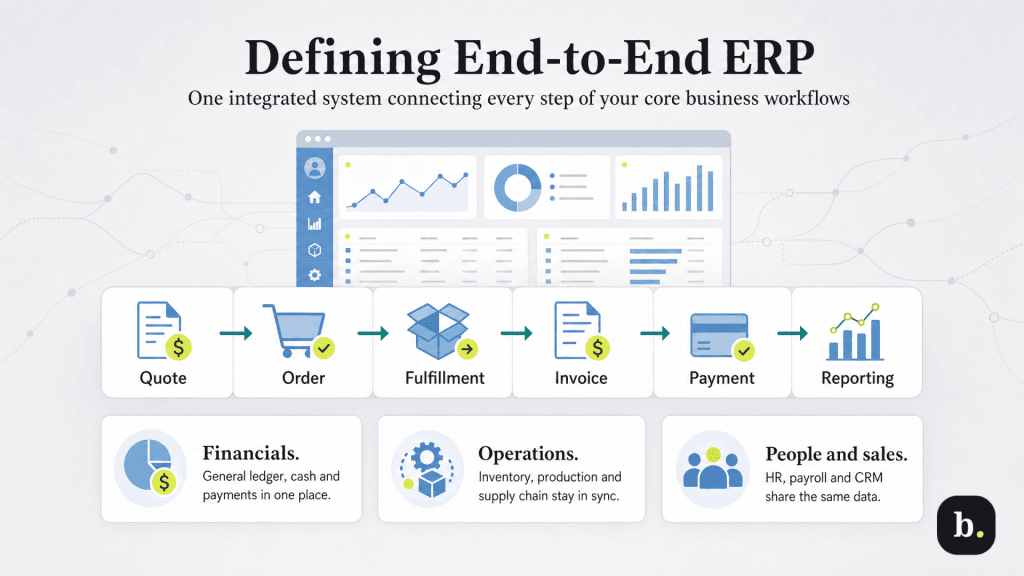
Enterprise resource planning (ERP) software brings a company’s core business functions into a single, integrated platform. The “end-to-end” distinction is important: it means the system covers the full lifecycle of your key business processes rather than just one function.
Think of it in terms of the workflows that drive your revenue and operations. A “quote-to-cash” process, for example, begins when a salesperson creates a proposal and doesn’t end until the payment clears your bank account. In between are order entry, fulfillment, shipping, invoicing and revenue recognition. In a truly end-to-end ERP environment, every one of those steps happens within the same system, with data flowing automatically from one stage to the next.
The same principle applies to other process chains: “procure to pay” covers everything from a purchase requisition through vendor payment and expense recognition. “Hire to retire” spans the entire employee lifecycle, from onboarding through payroll, benefits and offboarding.
The core modules in a modern end-to-end ERP typically include financial management (general ledger, accounts payable and receivable, cash management), inventory and supply chain, manufacturing and production planning, HR and payroll, CRM and sales, and project management. Not every business needs all of them, and many platforms let you activate modules as your needs grow.
Understanding the case for end-to-end ERP starts with understanding what disconnected systems actually cost you, not just in terms of software licensing fees but also in terms of the operational drag they create across your business.
When your sales data lives in a CRM system, fulfillment runs through an inventory system and invoicing happens in your accounting software, you have three systems maintaining three separate versions of the truth. Every transaction that crosses a system boundary requires someone to manually move data, verify it matches and troubleshoot discrepancies when it doesn’t.
The impact is quantifiable. According to PwC data, finance teams spend roughly 30% of their time collecting data and reconciling it between systems. That’s nearly a third of your finance department’s capacity consumed by work that, in an integrated environment, happens automatically. McKinsey research supports this finding, indicating that automating finance processes can free up to 40% of a finance team’s capacity for higher-value work like analysis and forecasting.
When your CEO asks for a current view of revenue by product line, and the answer is “we’ll have that next week,” the delay almost certainly traces back to disconnected systems. Reports that require pulling data from multiple platforms, exporting to spreadsheets, reconciling discrepancies and formatting for presentation are inherently slow and error-prone.
The real cost isn’t just the time spent compiling those reports — it’s the decisions that get made on stale or inaccurate data. These include inventory shortages you didn’t see coming, invoices that went out late because fulfillment status didn’t flow to billing and cash flow surprises that could have been avoided with real-time visibility across the business.
Disconnected systems may be manageable when your company has 20 employees at a single location, but complexity doesn’t scale linearly. Adding employees means more manual handoffs. Opening new locations multiplies the number of data pathways that need to stay synchronized. Adding a subsidiary introduces multi-entity consolidation requirements that spreadsheet-based workarounds simply can’t handle reliably.
At a certain point, every new process you add requires a new integration, and each new integration introduces another potential failure point. This is typically the inflection point where businesses move from tolerating their disconnected systems to actively seeking an alternative.
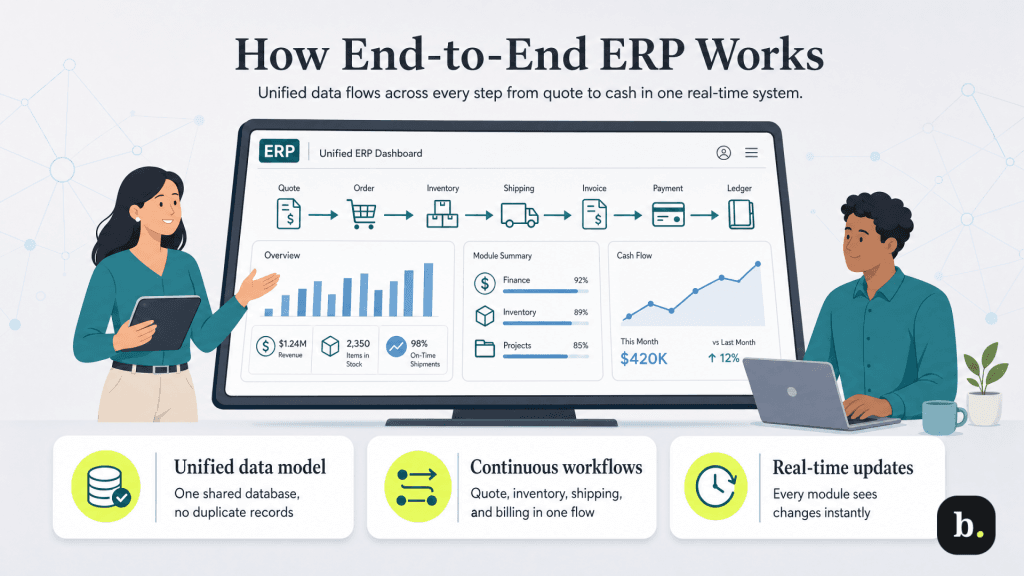
The foundation of any end-to-end ERP is a unified data model: a single database architecture where all modules share the same underlying data. When a salesperson closes a deal, the inventory system sees it immediately. When a payment is received, the general ledger updates in real time. There are no synchronization delays, no batch imports and no reconciliation steps because there’s only one set of data to begin with.
This is fundamentally different from connecting separate systems via APIs or middleware, where data is copied between platforms on a schedule. Even well-built integrations introduce latency, create opportunities for sync failures and require ongoing maintenance as individual systems update their APIs.
Intuit Enterprise Suite, for example, structures its platform around this integrated data approach, consolidating finances, payroll, payments and workforce management into a single connected environment. With a unified data platform, all your data lives in one place and is available to all modules in real time.
To see how this works in practice, consider the quote-to-cash process. In a disconnected environment:
In an end-to-end ERP, this becomes a single, continuous workflow that doesn’t require hand-offs from one team member to another. The quote converts to a sales order with one click. The system automatically checks inventory availability and allocates stock. Fulfillment and shipping update the order status in real time. The invoice generates automatically based on the shipment, applying the correct pricing, taxes, and terms from the original quote. When payment arrives, the system matches it to the invoice and recognizes revenue according to your accounting policies.
The same seamless flow applies to procurement. A purchase requisition triggers a purchase order, which flows to goods receipt, invoice matching, payment processing, and expense recognition, all within a single system. For project-based businesses, this integration extends to project setup, budgeting, time and expense tracking, billing, and real-time profitability analysis.
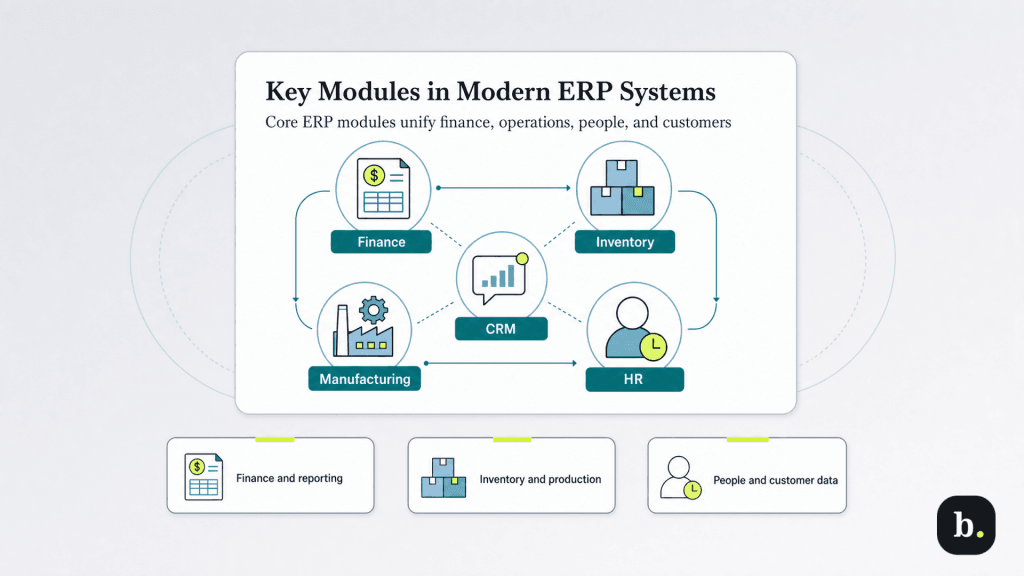
While every ERP platform structures its modules slightly differently, most cover the same core business functions. Understanding what each module does will help you evaluate which capabilities matter most for your business.
Not every business needs an ERP system, and implementing one before you’re ready can create as many problems as it solves. But there are clear signals that you’ve outgrown disconnected systems and would benefit from a unified platform.
