Business.com aims to help business owners make informed decisions to support and grow their companies. We research and recommend products and services suitable for various business types, investing thousands of hours each year in this process.
As a business, we need to generate revenue to sustain our content. We have financial relationships with some companies we cover, earning commissions when readers purchase from our partners or share information about their needs. These relationships do not dictate our advice and recommendations. Our editorial team independently evaluates and recommends products and services based on their research and expertise. Learn more about our process and partners here.
How to Identify Industries That Are Ready for Disruption
Some of today's most successful startups have grown quickly by shaking up their industries.
Business.com earns commissions from some listed providers. Editorial Guidelines.
Table of Contents
While some organizations cling to traditional ways of doing business, others are busy rewriting the rules. Many of today’s most successful companies started out as disruptors, proving that entrepreneurs who find new ways of doing things can reshape entire industries — and position themselves as the next market leaders.
At the same time, the pace of technological change has made disruption more accessible, even for small businesses. The challenge is spotting the opportunity and acting on it. Below, we’ll explain how to identify industries that are ripe for disruption and what signals to look for before making your move.
What does disruption mean?
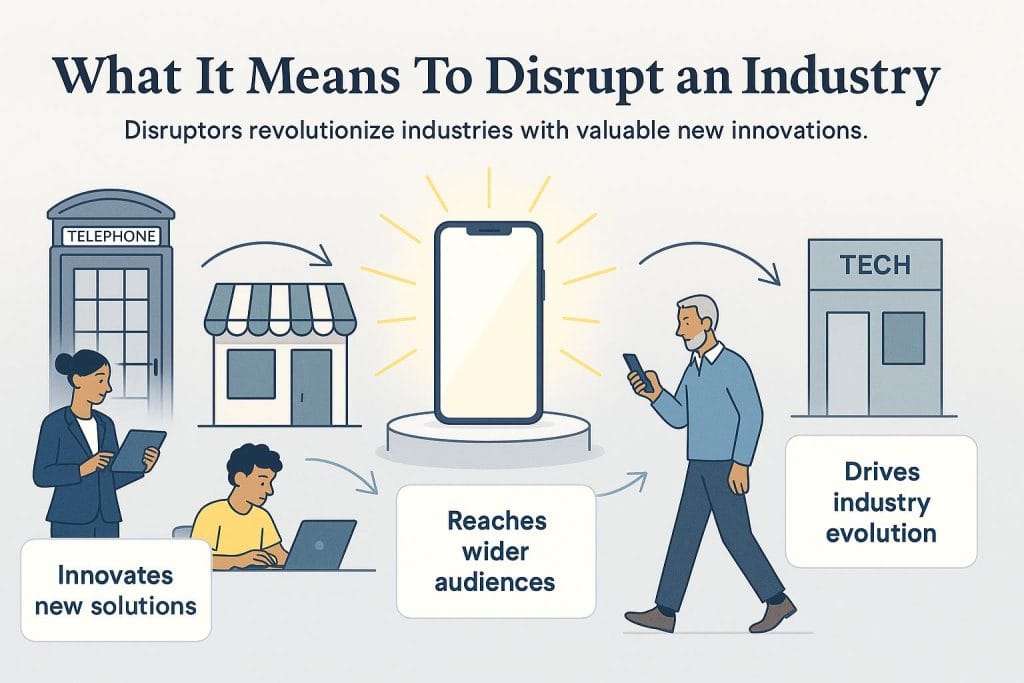
Disruptive companies introduce new ways of doing things — often using technology to reach broader audiences and reshape how industries operate.
Disruption happens when a company introduces something new that fundamentally changes how an industry operates and delivers new value to the market.
Perhaps the most famous example of disruption is the emergence of Uber, one of the first household names in ridesharing to challenge the traditional taxi industry. Uber first came on the scene in 2009, and today it remains a dominant force with $193 billion in annual gross bookings for 2025 — a clear example of how disruptive ideas can scale quickly.
Disruption often goes hand-in-hand with reinvention. According to PwC’s 29th Global CEO Survey (2026), 42 percent of CEOs say their companies have already started competing in new sectors — a sign that industry boundaries are shifting quickly. That creates a clear opportunity for entrepreneurs: If incumbents fail to adapt to digital innovation and shifting consumer demands, they leave the door wide open for disruptors to take over.
How to identify industries ready for disruption
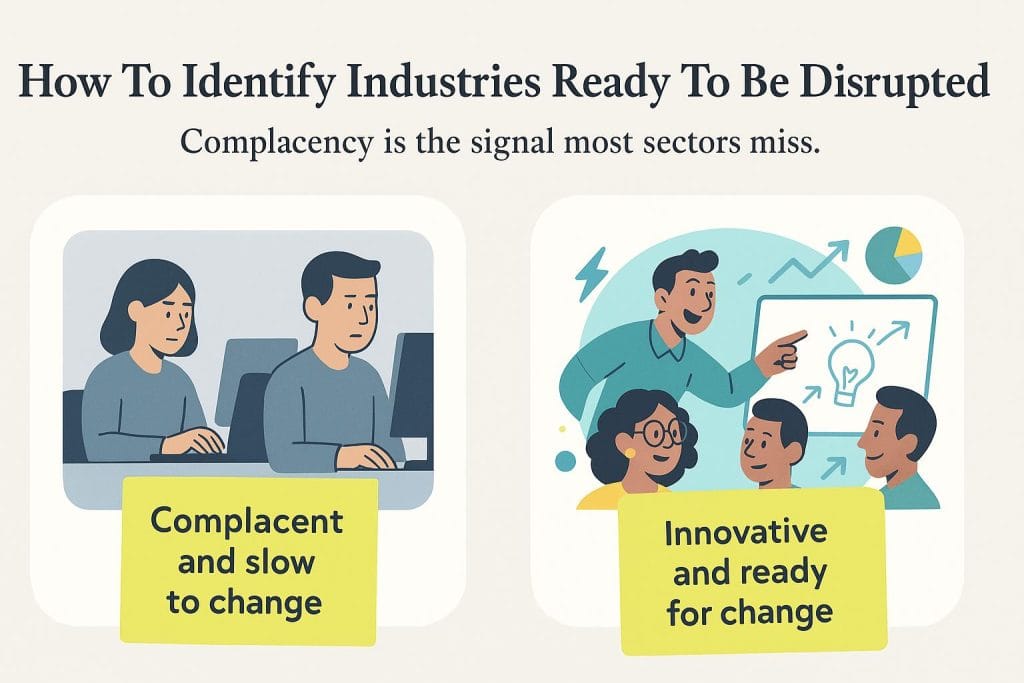
Industries that resist change often create opportunities for more agile, innovative competitors to step in and disrupt the market.
Many entrepreneurs look for industries they can disrupt, but spotting the right opportunity isn’t always straightforward. If it were, every business owner would enter the market and quickly rise to the top. However, there are a few clear signs that a sector is ready for disruption.
Market complacency
Complacency in the marketplace is one of the clearest signals that something needs to change. For existing businesses in any given industry, complacency can be an early warning sign that disruption is coming.
A good example is the legacy cable industry, which became complacent and opened the door to streaming platforms. While cable companies stuck with restrictive contracts and clunky hardware, companies like Netflix and Hulu stood out from the competition by offering simpler, lower-cost, on-demand options that better matched what customers actually wanted.
Customer frustration
When consumers run into ongoing friction with products or services, they start looking for alternatives. That creates an opening for entrepreneurs to pinpoint what’s not working and offer something better.
The auto insurance industry offers a recent example of this dynamic. According to the J.D. Power 2025 U.S. Auto Insurance Study, overall customer satisfaction declined again, and 38 percent of customers now fall into the lowest satisfaction segment, meaning they’re far more likely to shop around for a better option.
This widespread frustration has paved the way for insurance startups to disrupt the market by offering usage-based pricing, mobile apps that make it easier to manage policies, and faster, more transparent claims processing, often with fully online claims and real-time updates.
Hidden friction (“tension points”)
Not every industry on the verge of disruption has obvious problems. In many cases, the opportunity lies in smaller frustrations customers have learned to live with. These subtle issues, sometimes called “tension points,” include awkward workarounds, outdated processes or gaps between what customers expect and what they actually experience. Because they don’t always feel urgent, established companies tend to overlook them.
But when a new entrant listens to customer feedback and finds a way to fix one of these friction points, it can quickly stand out and reset expectations across the industry.
A good example is the eyewear industry. For years, customers accepted high prices and the inconvenience of trying on glasses only in-store. Warby Parker addressed that friction with a direct-to-consumer model and a home try-on program, making the process simpler and more affordable.
Did You Know?
Business strategist Luke Williams identifies four common types of tension points: workarounds, values gaps, inertia and the gap between what customers feel they should do and what they actually want.
Market concentration
When a few large companies control most of a market, it can look stable on the surface. But that kind of dominance can also slow things down, especially when it comes to adapting to new technology or changing customer expectations.
Lean startups tend to move faster. They can test new ideas without layers of approvals and focus on gaps that bigger players overlook. Over time, that’s often enough to gain traction and start chipping away at the market.
A good example is the mattress industry, which for years was controlled by a small group of established brands selling through traditional retail stores. Casper disrupted the space with a direct-to-consumer model, simple pricing and a “bed-in-a-box” approach that made buying a mattress faster and more convenient.
Technological lag
Some industries are simply slow to modernize, and that gap can create real opportunities. Companies still relying on outdated systems often struggle to keep up with how customers expect to interact: quickly, online and on their own terms.
When established players fall short, newer companies step in. By offering things like mobile apps, self-service tools and faster support, they can meet those expectations and win over customers who are ready for something easier.
A good example is the banking industry, where traditional institutions were slow to fully embrace mobile-first experiences. Fintech companies like Chime gained traction by offering faster account setup, fewer fees and app-based tools that made managing money simpler.
FYI
Netflix's industry disruption began when it shifted from DVD rentals to streaming, giving customers instant, on-demand access without late fees or physical stores. That move raised expectations for convenience and pricing and left traditional media companies scrambling to catch up.
A simple way to evaluate disruption opportunities
You can think about disruption opportunities across two factors: how easy it is to enter a market and how much room there is for change. Consider this framework:
Market accessibility
High disruption potential
Low disruption potential
High accessibility
Strong opportunities to disrupt
Crowded, hard to stand out
Low accessibility
Longer-term opportunities with higher barriers
Not worth pursuing
To understand how accessible a market is, consider:
How much capital you need to get started
Regulatory or compliance hurdles
Technical complexity and access to talent
How difficult and expensive it is to acquire customers
To gauge disruption potential, look at:
How frustrated customers are
Whether new technology could improve the experience (e.g., AI, automation, blockchain)
How concentrated the market is among a few large players
Industry disruption assessment checklist
If you’re trying to figure out whether an industry is ready for disruption, these questions can help you pressure-test the opportunity. No industry will check every box, but the more of these you see, the stronger the opportunity.
Market structure
Is the market controlled by a few large, slow-moving players?
Are prices staying high even when the experience hasn’t improved?
Do contracts or switching costs make it hard for customers to leave?
Customer experience
Do customers keep complaining about the same issues?
Are there clear gaps in what’s being offered?
Does the experience feel outdated, complicated or overly manual?
Are certain customer groups being overlooked?
Technology
Are companies slow to adopt newer tools like AI or automation?
Are they still relying on outdated systems behind the scenes?
Could technology make the customer experience faster or easier?
Regulations
Are rules holding back innovation more than protecting customers?
Could new regulations change how the industry operates?
Do compliance costs favor large incumbents over new entrants?
Are there regional differences that create openings in certain markets?
Tip
Technology leads to new opportunities, but usually because something isn't working in the first place. When customers are dealing with slow processes or outdated systems, even small changes can be enough to pull them toward something better.
Theoretical frameworks of disruption
If you want a more structured way to think about disruption, a couple of well-known frameworks can help.
Foundational disruption theory
Clayton Christensen introduced the idea of disruptive innovation to explain how smaller companies can take on established players. In practice, it usually shows up in one of two ways:
Low-end disruption: Some companies start by serving customers who don’t need (or want to pay for) premium features. Instead of competing head-on, they focus on a simpler, lower-cost option. Budget airlines are a classic example. They cut extras like meals and seat selection, which appealed to price-sensitive travelers and helped them build a strong customer base that traditional carriers had largely overlooked.
New-market disruption: Other companies grow by bringing in people who weren’t customers at all. This often happens when a product becomes easier to use or more accessible. Personal health technology is a good example. Devices that track heart rate, sleep and activity have made it possible for consumers to monitor data that once required a clinical setting, opening up an entirely new market.
Blue Ocean Strategy
The Blue Ocean Strategy focuses on finding opportunity outside crowded markets. Instead of competing directly with established players, the goal is to create something different enough that you’re not fighting for the same customers.
In practice, that often means rethinking how a product is delivered, priced or positioned. When it works, it attracts new demand rather than pulling customers away from competitors.
Industry reports and market analysis
If you’re looking for where disruption is heading next, major research firms are already tracking it.
McKinsey Global Institute:McKinsey, for example, has identified 18 “arenas of competition,” including areas like digital services and green technology that could reshape the global economy. The firm estimates that just 12 of these could generate up to $29 trillion to $48 trillion in revenue by 2040, expanding their share of global GDP from 4 percent today to as much as 16 percent.
AlixPartners: At the same time, many business leaders already feel the pressure to keep up. In the 2026 AlixPartners Disruption Index, 52 percent of CEOs said their executive teams lack the agility needed to respond to change, and half believe their companies aren’t adapting quickly enough. Another 72 percent said it’s becoming harder to prioritize which disruptive forces matter most — a sign that disruption isn’t slowing down, it’s getting harder to navigate.
Gartner: Technology trends point in the same direction. Gartner highlights the rise of “agentic AI,” predicting that by 2028, at least 15 percent of day-to-day work decisions will be made autonomously, up from virtually none in 2024. Looking further ahead, the firm expects 30 percent of knowledge workers to rely on AI-augmented digital workspaces by 2030.
The path forward for entrepreneurs
For entrepreneurs, disrupting an industry can feel risky, but it usually starts with noticing what others ignore. When a sector stops evolving or solving real customer problems, it often creates an opening for something new.
Here are a few things to pay attention to:
Know the market: Spend time understanding what customers actually need, how the industry operates and where competitors fall short.
Use technology with purpose: New tools can create better experiences, but only if they solve a real problem or remove friction.
Stay flexible: Early ideas rarely stay the same. Be ready to adjust based on what customers do, not just what you planned.
Plan for the long haul: Disruption doesn’t happen overnight. It often takes more time (and capital) than expected.
Understand the rules: Regulations can slow you down or create opportunity, depending on how you approach them.
The next wave of disruption is already taking shape, especially as generative AI continues to evolve. Many companies are still figuring out how to turn that shift into real value, which leaves room for new entrants to move faster.
For entrepreneurs willing to challenge conventional thinking, the opportunity isn’t just in having a big idea, it’s in spotting the right moment and acting on it.
Sean Peek co-founded and self-funded a small business that's grown to include more than a dozen dedicated team members. Over the years, he's become adept at navigating the intricacies of bootstrapping a new business, overseeing day-to-day operations, utilizing process automation to increase efficiencies and cut costs, and leading a small workforce. This journey has afforded him a profound understanding of the B2B landscape and the critical challenges business owners face as they start and grow their enterprises today.
At business.com, Peek covers technology solutions like document management, POS systems and email marketing services, along with topics like management theories and company culture.
In addition to running his own business, Peek shares his firsthand experiences and vast knowledge to support fellow entrepreneurs, offering guidance on everything from business software to marketing strategies to HR management. In fact, his expertise has been featured in Entrepreneur, Inc. and Forbes and with the U.S. Chamber of Commerce.