Business.com aims to help business owners make informed decisions to support and grow their companies. We research and recommend products and services suitable for various business types, investing thousands of hours each year in this process.
As a business, we need to generate revenue to sustain our content. We have financial relationships with some companies we cover, earning commissions when readers purchase from our partners or share information about their needs. These relationships do not dictate our advice and recommendations. Our editorial team independently evaluates and recommends products and services based on their research and expertise. Learn more about our process and partners here.
Master the art of interviewing by choosing the right format and style combination for every role in your organization.

Hiring the right talent can make or break your small business. Yet many entrepreneurs struggle with creating an effective interview process that accurately assesses candidates while respecting everyone’s time. Whether you’re hiring your first employee or building out a growing team, understanding different interview approaches helps you make better hiring decisions faster. Let’s explore how to combine formats with styles to create an interview process that fits your business needs and resources.
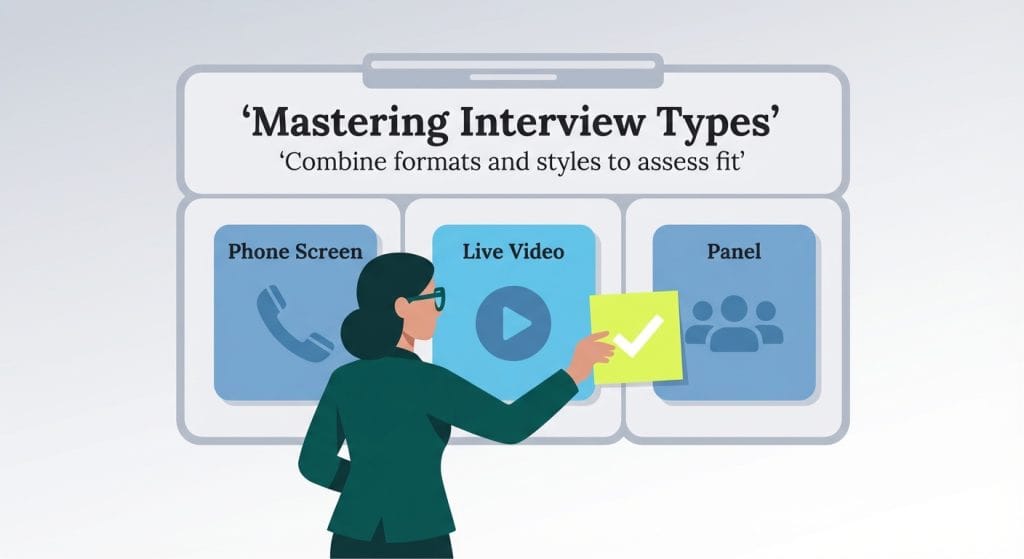
Interview types combine a format (modality plus structure) with a style to assess candidate fit and skills. Think of it as choosing both the “where and how” (format) and the “what you’re evaluating” (style) when vetting potential hires.
Small businesses often default to whatever interview type feels familiar, but a structured hiring process with strategic combinations yields better results.
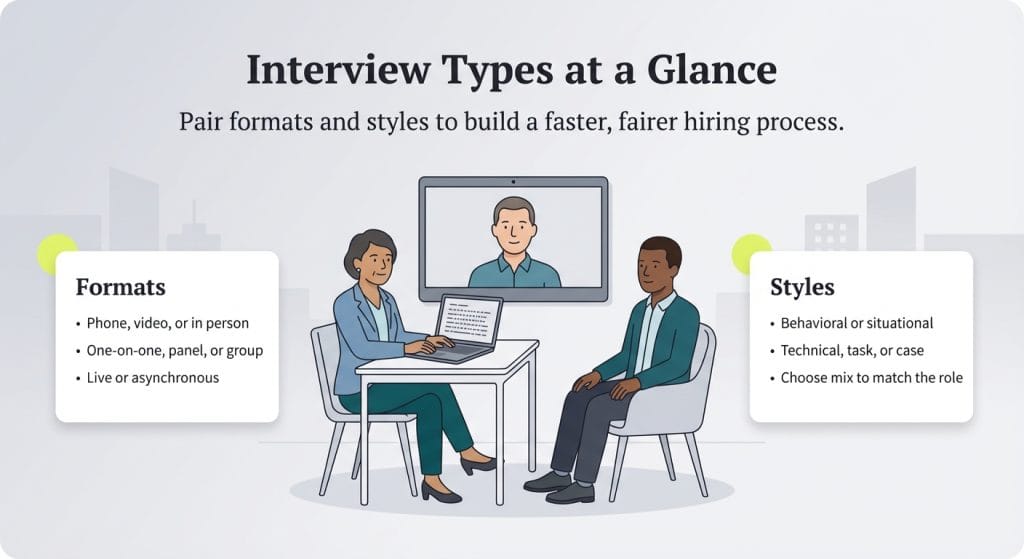
Understanding each interview format helps you build a hiring process that balances efficiency with thoroughness. Think of formats as tools in your toolkit — each serves a specific purpose in evaluating candidates.
Phone screen interviews offer fast qualification of basic requirements and cultural alignment. They’re perfect as a first pass for small teams who need to quickly eliminate obviously unqualified candidates. Keep these conversations at 15 to 30 minutes and focus on deal-breakers like availability, salary expectations and core competencies.
Live video interviews serve as a remote alternative to onsite meetings. Treat these as formal and structured sessions, not casual chats. They work particularly well for remote positions or when geographic constraints make in-person meetings impractical. Ensure both parties test technology beforehand to avoid technical difficulties disrupting the conversation.
One-way video interviews present preset questions that candidates answer on their own schedule. This format is ideal for high-volume screening when consistency across a large applicant pool is a priority. Candidates record their responses, and hiring managers review them at their convenience — eliminating scheduling headaches while keeping the evaluation process standardized.
In-person interviews remain the gold standard for final fit assessments and collaboration tests. Use these for critical hires or final rounds when you need to evaluate subtle interpersonal dynamics. The investment in coordinating schedules pays off when hiring for leadership or customer-facing roles where presence matters.
Panel interviews involve multiple interviewers who share an evaluation rubric. They prove efficient for cross-functional roles where the new hire needs to work with various departments. Panels reduce individual bias and provide diverse perspectives, though they require more coordination and can intimidate some candidates.
Group interviews assess several candidates simultaneously, making them a practical option for frontline or multi-hire situations such as seasonal retail openings or high-turnover entry-level roles. Pay attention to how candidates engage with peers, demonstrate leadership and navigate a competitive environment. Keep in mind that quieter but highly qualified candidates can get lost in these settings — build in individual follow-up questions to level the playing field.
While formats determine the logistics, interview styles shape the actual assessment. Combining multiple styles within your chosen format yields the most comprehensive candidate evaluation.
Behavioral interviews operate on the principle that past examples predict future behavior. Using the STAR method (Situation, Task, Action, Result), you ask candidates to describe specific instances where they demonstrated relevant skills. For example: “Tell me about a time you resolved a conflict with a difficult customer.”
This style works exceptionally well for roles requiring soft skills like leadership, teamwork or problem-solving. Listen for specific details and outcomes rather than vague generalizations.
Situational interviews present hypothetical scenarios to assess judgment and prioritization skills. Questions like “What would you do if a key vendor suddenly raised prices by 30 percent?” reveal how candidates think through problems they haven’t necessarily encountered before.
These questions prove particularly valuable for management roles or positions requiring quick decision-making under uncertainty.
Technical assessments, also known as task assessments or simulation-based assessments, require candidates to demonstrate actual job skills through practical exercises. This might include coding challenges for developers, writing samples for content creators, job simulations for customer service roles, or portfolio presentations for sales and creative positions.
Case interviews require candidates to analyze and solve business scenarios, commonly used in consulting and finance but adaptable to any analytical role. Present a realistic business challenge and evaluate their problem-solving approach, not just the final answer.
Stress interviews deliberately create pressure to test composure, though they should be used cautiously and only when the role demands it. Aggressive questioning or artificially manufactured tension can damage your employer brand and, in most roles, offers little predictive value when it comes to actual on-the-job performance.
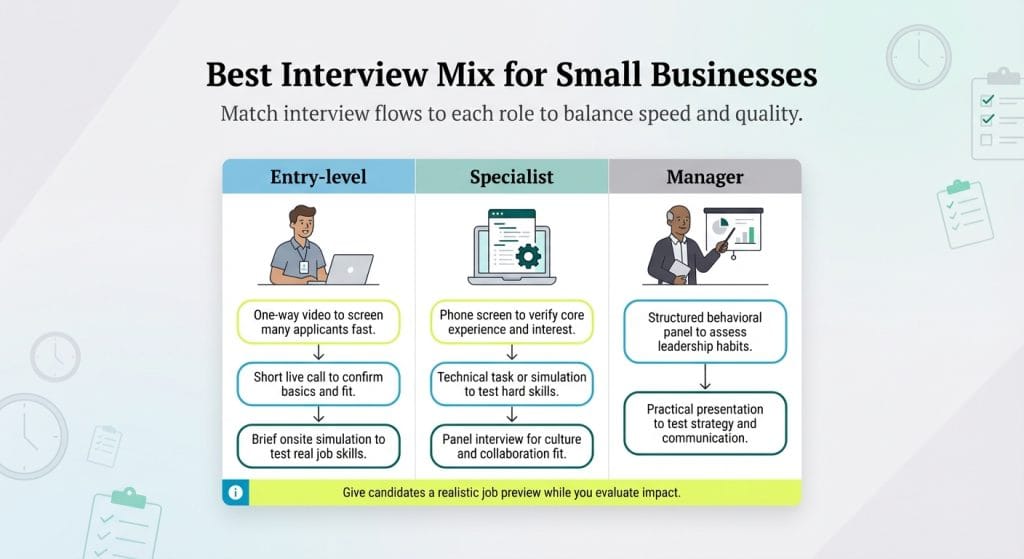
Small businesses need interview processes that are efficient without cutting corners on quality. Below are optimal format combinations for common hiring scenarios — each designed to balance thoroughness with the resource constraints most small teams face.
Remember that effective onboarding starts during the interview process. Your interview mix should give candidates realistic job previews while evaluating their potential contributions.
Picking the right interview formats means weighing several factors that are specific to your business situation. Consider these four criteria when designing your process.
Choose formats that respect both your team’s time and your candidates’ efforts — while still gathering the information you need to hire with confidence.
Transform your interview process in one month with this systematic approach. This timeline is designed to help small businesses implement professional interview practices without overwhelming their teams.
Pick your interview sequence (for example: phone screen → live video → panel) based on typical hiring needs. Write a 10-question bank per role including five behavioral questions, three situational scenarios and two role-specific task prompts. Store these in a shared document for consistency.
Create a four-point scoring rubric for each question ranging from poor to excellent. Define what constitutes each score level with specific examples. Train all interviewers on consistent note-taking and calibration through practice sessions or role-playing exercises.
Test your process with three real candidates. Track time-to-schedule, pass-through rates at each stage, and gather candidate feedback through brief surveys. Document what works smoothly and where friction occurs.
Review your pilot results to identify weak questions that fail to differentiate candidates effectively. Retire those and strengthen your question bank. Lock your rubric, and consider adding one-way video screening for high-volume roles if scheduling proved to be challenging.
This systematic rollout ensures your HR practices meet professional standards while remaining practical for small business constraints.
Strong interview questions form the foundation of effective candidate assessment. The frameworks below can be customized for virtually any role in your organization.
Fair and legal interview practices protect your business while ensuring you select the best candidates based on merit. Small businesses must understand basic compliance requirements to avoid costly discrimination claims.
Use structured questions and apply the same rubric for each role to reduce unconscious bias. Avoid off-limit topics including age, family status, religion, disability and other protected characteristics. Focus exclusively on job-related qualifications and requirements.
Keep evidence-based notes linked to each specific question rather than general impressions. Summarize candidate responses against your predetermined rubric instead of relying on gut feelings. This documentation proves invaluable if hiring decisions are ever challenged.
For pivotal roles, prefer panel interviews to balance individual perspectives and reduce single-interviewer bias. Document all hiring decisions with clear rationale tied to job requirements. This practice supports both diversity initiatives and legal compliance.
Tracking key metrics helps you continuously refine your interview process. Monitor these indicators monthly to spot areas that need adjustment before they cost you strong candidates.
Revisit these metrics monthly and cut questions or formats that don’t improve hiring speed or quality. Your process should evolve alongside your business as you learn what truly predicts success in your environment.
Building an effective interview process doesn’t require a large HR team or expensive systems. Start with one role, execute the fundamentals consistently, then scale what works as your confidence grows. Prioritize using the same questions and evaluation criteria for every candidate applying to the same role — this straightforward practice measurably improves outcomes while keeping you legally protected.
Consider your company culture when designing interview experiences. Your process should reflect your values and give candidates accurate previews of working with your team. Remember that interviewing is a skill that improves with practice and feedback. Invest in basic interviewer training for anyone involved in hiring decisions. Even a two-hour workshop on questioning techniques and bias reduction pays dividends in better hiring outcomes.
