Business.com aims to help business owners make informed decisions to support and grow their companies. We research and recommend products and services suitable for various business types, investing thousands of hours each year in this process.
As a business, we need to generate revenue to sustain our content. We have financial relationships with some companies we cover, earning commissions when readers purchase from our partners or share information about their needs. These relationships do not dictate our advice and recommendations. Our editorial team independently evaluates and recommends products and services based on their research and expertise. Learn more about our process and partners here.
Use customer relationship management software to measure CLV in B2B industries.
Companies spend significant time and money acquiring new customers, often dedicating entire sales and marketing budgets to customer acquisition efforts. However, not all customers are the same. Some buy from you because you’re offering the best deal. Others are long-term, loyal customers who will do business with you repeatedly.
Often, it costs the same to attract both customer types — even though long-term customers are more valuable. For B2B businesses to truly maximize the ROI of their sales and marketing efforts and earn repeat business, they must evaluate the customer lifetime value (CLV) metric.
The CLV metric measures the total revenue a business can expect to generate from a particular customer over the length of the buyer-seller relationship. This calculation considers both acquisition and retention costs, making it a key metric for understanding long-term profitability.
CLV is about predicting future earnings. It’s a type of predictive data analytic that forecasts a customer relationship’s future value.
Lauren O’Brien, chief revenue officer at Cloudastructure, highlighted the importance of customer retention in optimizing CLV. “Customer retention, of course, is key in this game,” O’Brien explained. She noted that her company, a B2B business, maintains nearly 100 percent customer retention; also, it’s reevaluating its pricing strategy based on insights into customer acquisition costs (CAC) and CLV.
“On the flip side, our CLV is huge per customer,” O’Brien continued. “Because of this, our focus on customer retention is critical and almost as important as generating sales.”
By definition, CLV isn’t a fixed number. It varies depending on the factors a business chooses to include. However, the following is a commonly used formula for calculating CLV that emphasizes the significance of customer retention and relationship longevity:
CLV = gross contribution per customer x (yearly retention rate / 1 + yearly discount rate – yearly retention rate)
While this formula provides a starting point, businesses often adjust it to reflect their specific needs and priorities. Factors such as service tiers, variable operational costs and upsell potential are frequently layered in to build a more granular view of long-term profitability.
CLV is widely adopted in B2C industries. This is especially true in retail and telecommunications, where companies benefit from analyzing data across large customer bases.
The stakes are considerably higher for B2B companies, where CLVs can reach millions of dollars per account. B2B and B2C organizations also approach CLV differently. In B2B settings, executives’ judgment and experience tend to be more reliable than purely statistical models, simply because they manage far fewer customer relationships. B2C companies, by contrast, deal with large volumes of disparate customers, making a data-driven, statistical approach far more practical.
Adding another metric to the pile of estimations sales teams deal with can be daunting, especially if it will affect their key performance indicators (KPIs). Still, O’Brien stressed that understanding your CLV — and having the patience to let that value materialize — can completely change your entire customer acquisition strategy. “You would be surprised how you can improve your pricing and sales strategy and accelerate sales by understanding these metrics,” O’Brien noted.
Want to get your salespeople on board? Share the following ways CLV metrics can improve and benefit sales and marketing departments’ efforts.
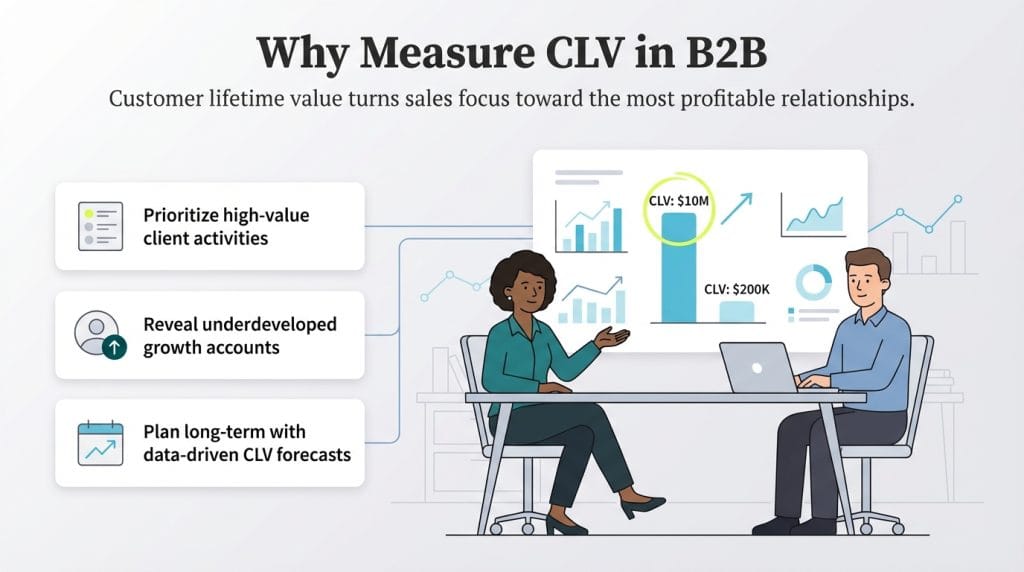
Understanding CLV allows sales teams to identify and prioritize customer accounts based on their long-term value. This practice prevents disproportionate sales efforts on less profitable leads or clients. By analyzing various accounts’ comparative values, your sales team can focus its time and resources on nurturing high-value relationships.
For example, say Customer A has a $200,000 CLV and Customer B has a $10 million CLV. Knowing this, your sales department can more efficiently prioritize nurturing and retention efforts.
Stephan Liozu, a pricing thought leader and value coach, explained the unique challenge of applying CLV in B2B. “In B2B, lifetime value takes on a unique dimension, as procurement teams are generally structured to focus on short-term savings rather than long-term value,” Liozu explained.
This highlights the need for sales teams to use CLV metrics to shift their focus from immediate wins to customers who bring sustainable revenue growth. When salespeople concentrate on high-CLV accounts, they can work more efficiently and spend less time on cold calling and prospecting.
CLV measurements can yield true revelations for more successful sales account management. You may view an account as mediocre; however, calculating its CLV can show that it’s woefully underdeveloped, with more potential than your team realized.
Consider a scenario where a customer places small, sporadic orders. That account likely hasn’t made much of an impression on the sales department and isn’t really on anyone’s radar. But when you calculate its full potential over the expected length of the relationship, you may find it actually ranks in the top 20 percent of your accounts — which means it deserves a better development strategy.
CLV’s predictive nature provides valuable insights into a company’s market potential based on its real accounts. It offers a holistic, multidimensional view of growth opportunities — enabling more informed long-term planning.
For instance, calculating the CLV of your entire customer base, strategic accounts or regional market segments can help you uncover trends and areas for optimization. This data ensures that decision-making isn’t skewed by customers whose short-term value might be insufficient or misleading.
Alex Schlee, founder and CEO of Anamap, highlighted another advantage of CLV. “Used for comparison purposes, CLV also allows companies to find high-value segments of customers and optimize toward getting additional customers from that segment,” Schlee explained.
Identifying and targeting these high-value segments helps companies sharpen their acquisition and retention strategies — focusing resources on the customers who contribute most to their long-term success.
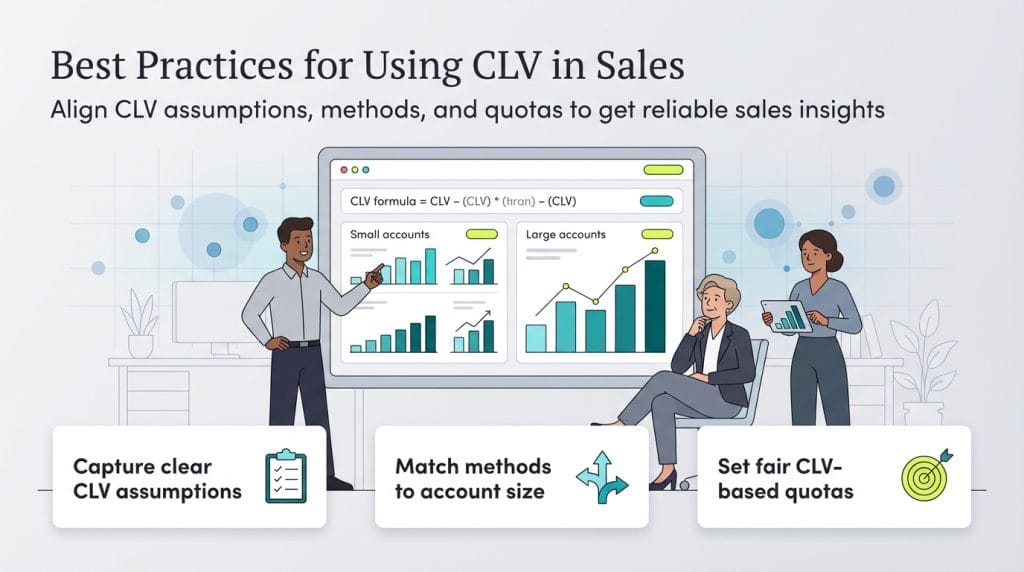
You and your sales team must agree on your CLV measurement approach. Here are some of the most critical points to consider:
Recorded assumptions aren’t hard data. Still, they’re instrumental to CLV calculations at B2B companies because there are so many subjective factors to consider.
Relevant assumptions can cover various factors, including the following:
These assumptions are part of a sales rep’s CLV formula breakdown, complete with descriptions and brief justifications for each variable. Without documented assumptions, tracing a miscalculation or misjudgment back to its source becomes nearly impossible.
Businesses have accounts of varying sizes. For this reason, introducing two distinct CLV calculation types makes sense:
When using CLV as a metric to evaluate sales force performance, setting realistic quotas is essential. Ideally, the quota should be set at 80 percent of the actual CLV and 60 percent of the potential CLV. This ratio gives sales reps a reasonable target while still incentivizing them to develop accounts.
Mitigating the human factor in CLV calculations can be the most significant challenge. Consider the far-reaching implications of the following situations:
For many B2B companies, incorporating the CLV metric into sales strategies can become a cornerstone of corporate CRM policy. The metric has its downsides, such as reliance on human judgment and challenges in areas with high uncertainty. However, its benefits consistently outweigh these limitations.
By defining individual customers’ contributions to the seller’s revenue streams, CLV helps businesses prioritize accounts. It also helps set better business goals and align resources more effectively. In addition, it can assist sales teams in identifying new opportunities for account development, nurturing high-value relationships and fostering long-term business growth.
Jennifer Dublino contributed to the reporting and writing in this article. Source interviews were conducted for a previous version of this article.