Business.com aims to help business owners make informed decisions to support and grow their companies. We research and recommend products and services suitable for various business types, investing thousands of hours each year in this process.
As a business, we need to generate revenue to sustain our content. We have financial relationships with some companies we cover, earning commissions when readers purchase from our partners or share information about their needs. These relationships do not dictate our advice and recommendations. Our editorial team independently evaluates and recommends products and services based on their research and expertise. Learn more about our process and partners here.


This article is sponsored by Erase.com
Ask three reputation management firms what they charge and you will usually get three sales calls instead of three numbers. Pricing in this category is unusually opaque, which leaves business owners trying to evaluate a proposal with no real sense of whether it is reasonable.
The harder problem, though, is not the missing price tag. It is that most comparisons between handling reputation in-house and hiring a firm are not comparisons at all. Outsourcing is generally counted in dollars while in-house work gets treated as free, but that doesn’t take into account the hours your team will spend on it. Below, we’ll break down the factors that drive the cost of online reputation management (and the costs of ignoring it.)
Before weighing what the two approaches cost, it helps to establish what sits on the other side of the ledger.
The most rigorous estimate of what ratings are worth comes from Harvard Business School researcher Michael Luca, who matched Yelp ratings against restaurant revenue data from the Washington State Department of Revenue. Because Yelp rounds its ratings to the nearest half-star, Luca was able to isolate the effect of the displayed rating from the underlying quality of the restaurant. He found that a one-star increase produced a 5 to 9 percent increase in revenue, and that the effect appeared almost entirely at independent restaurants rather than chains with established reputations. The study covers a single city and industry and its data is now more than a decade old, but the causal design makes it the strongest available evidence that visible reputation moves money on its own.
Consumer behavior has only intensified since then. BrightLocal’s 2026 Local Consumer Review Survey found that 97 percent of consumers read reviews when evaluating a local business and that 41 percent now say they always do, up from 29 percent a year earlier. The average consumer consults six different sources before deciding.
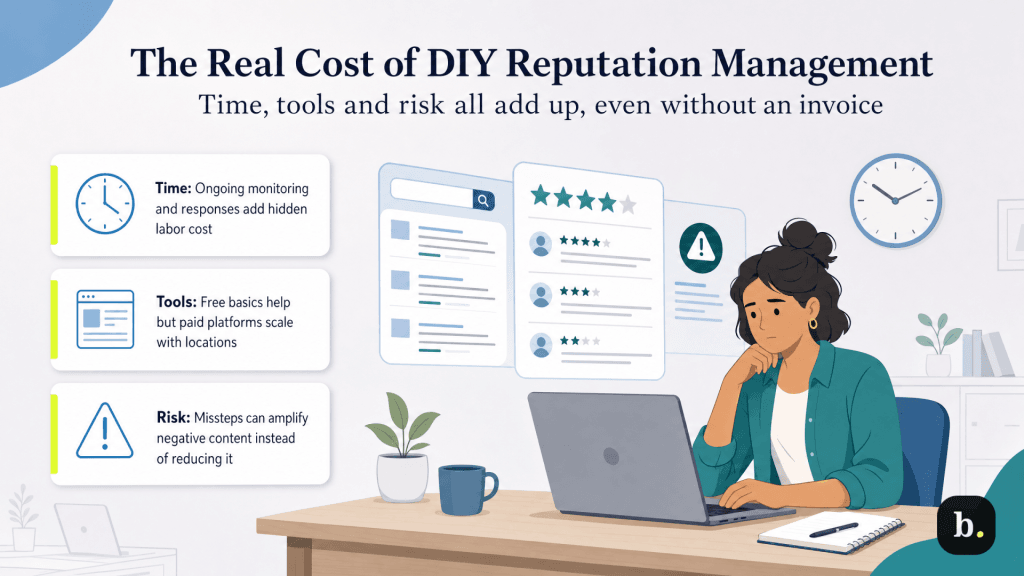
Managing your online reputation internally produces no invoice, which is why it often gets miscounted. The costs are still real, they are just distributed across time, tools and risk instead of arriving in a single line item.
Reputation work is recurring, not one-time. A realistic month includes monitoring search results and review platforms, writing and posting responses, filing removal or correction requests with individual platforms, following up on the requests that stall and producing the positive content that eventually outranks the negative.
To determine the cost of all this work, multiply the hours against salary plus payroll taxes and benefits (rather than base salary alone.) If you are doing the work yourself as the owner, use what an hour of your time is worth in the billable or strategic work you are not doing instead. The Bureau of Labor Statistics publishes median wages by occupation if you need a benchmark.
The result tends to surprise people. Even 10 hours a month adds up to a meaningful fraction of a role over a year, and active reputation repair typically demands more than that in the early months.
Some of the most useful reputation management tools are free. Google Business Profile, Google Alerts and Google’s “results about you” dashboard cost nothing and cover a real portion of the basics. Paid monitoring and review management platforms add a recurring subscription on top, and these are frequently priced per location, which means multi-location operators watch this line scale in a way single-location businesses do not.
This is the line item that DIY comparisons almost never include. Aggressive or clumsy removal attempts can amplify the exact content you are trying to bury. A defensive public reply to a bad review can become the screenshot that travels further than the review ever would have. And hours spent pursuing a removal that was never going to succeed, because the content does not actually violate any platform policy, are hours you do not get back.
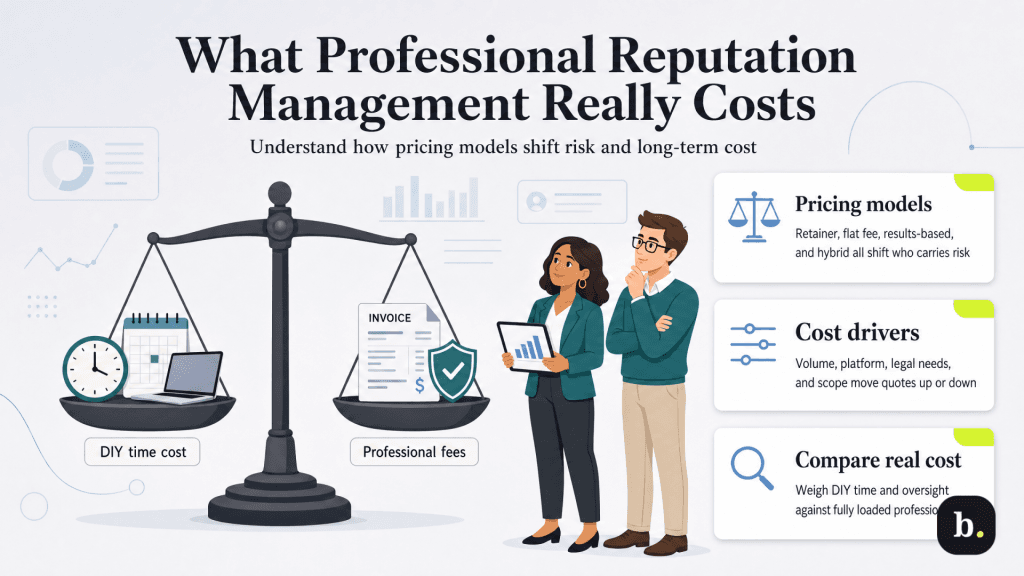
Outsourcing your reputation management converts a distributed cost into a visible one. What varies most between firms is not the headline number but the structure behind it, and that structure determines who carries the risk when the work does not produce results.
Several factors drive a quote in either direction:
One more thing worth knowing, and any firm worth hiring will volunteer it: nobody can guarantee removal. Platforms and publishers have the final say. A firm guarantee of deletion should be treated as suspect; an honest online reputation management company knows not to make that promise.
Once you have scoped the problem, run both options through the same categories rather than comparing a subscription price against an agency quote.
Cost factor | Handling it in-house | Hiring a firm |
|---|---|---|
Direct spend | Monitoring and review software subscriptions | Retainer, project fee, per-result fee or some combination |
Labor | Recurring staff or owner hours at your fully loaded rate | Oversight and approval hours only |
Speed | Slower; every platform has its own process and learning curve | Faster on removals; suppression still often takes months |
Risk exposure | Escalation, wasted effort on unwinnable requests | Vendor selection; results not guaranteed |
Ceiling | Limited to what platforms grant on request | Adds legal and policy escalation paths |
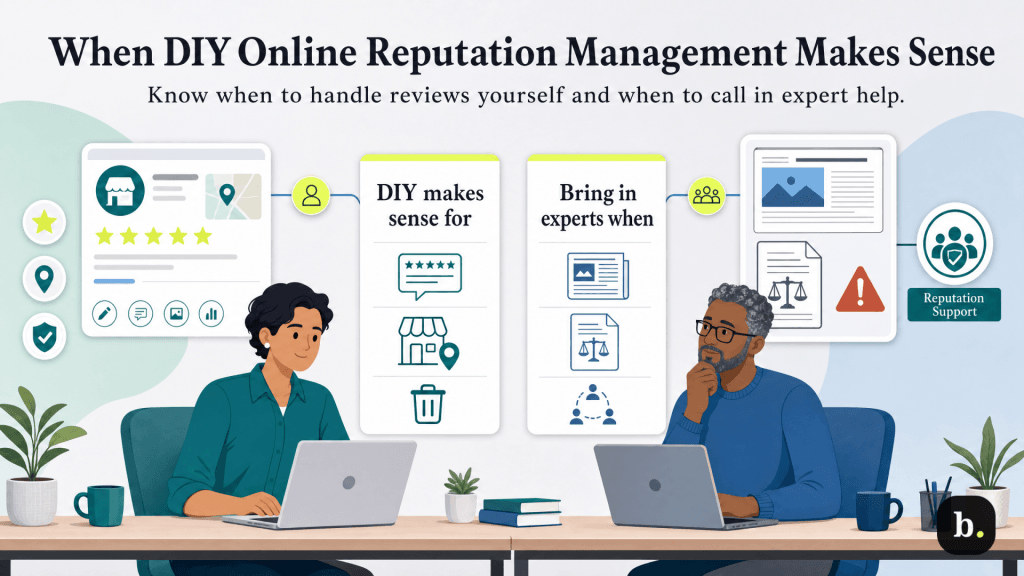
Handling online reputation management yourself covers a real share of the work. Responding to reviews, keeping your Google Business Profile accurate and complete, requesting removal of exposed personal contact information and building out legitimate positive assets are all within reach of a competent in-house marketer.
Google’s free tools have improved meaningfully here. The “results about you” dashboard monitors search results for your personal contact details and lets you request removal directly. Google expanded it in February 2026 to cover government-issued ID numbers and redesigned it the following month so removal requests can be submitted straight from the search results page. More than 10 million people have used it.
DIY hits a wall when it comes to published news articles and court records, coordinated review attacks, anything requiring a copyright or defamation claim, multi-location operations where the same work has to happen dozens of times over, and cases where an executive’s personal name is the asset at risk. In those scenarios the constraint is usually not effort or budget, but access to escalation paths that individual businesses do not have.
If you decide to bring in outside help, these four questions surface most of what separates a solid engagement from an expensive one:
When selecting a firm, look for honest answers to these questions rather than lofty promises that are likely to come up short. Online reputation management isn’t a space where guarantees make sense. Only sustained, dedicated work can suppress negative content and promote positive content about your brand. Oftentimes, the costs of working with the right reputation management company are worth the results.
