Excellent leadership can take an organization to the next level. It can also ensure employee loyalty, teamwork and an overarching commitment to shared business goals. Leadership styles differ and personality plays a role. But, you can cultivate specific traits and skills to become the kind of leader your employees respond to.
We’ll explore five traits employees prefer in their leaders. We’ll also share the behaviors and tendencies to avoid at all costs if you want to maintain employee respect.
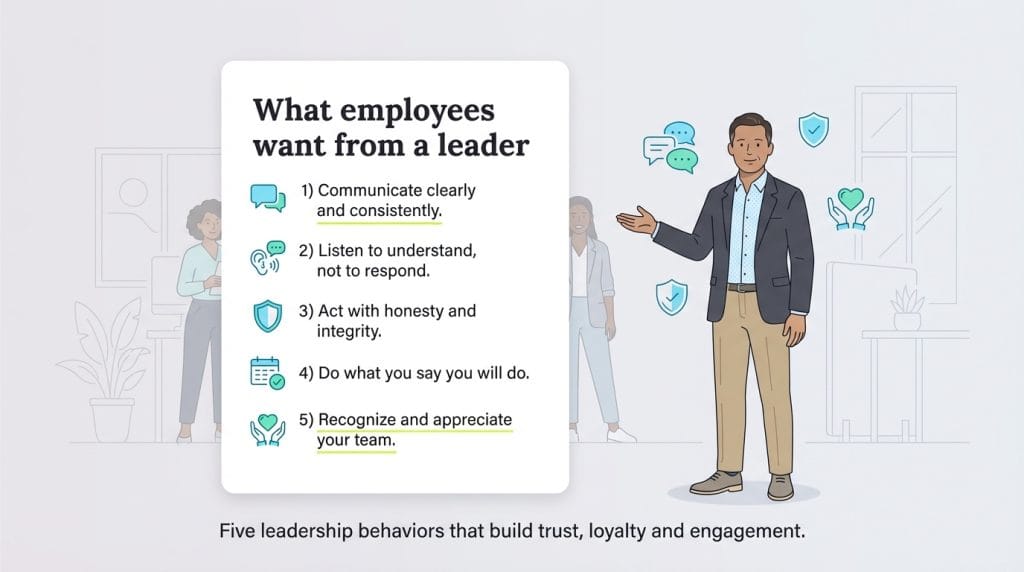
What employees want from a leader
Recent research makes it clear that managers have an outsized influence on how employees feel about their jobs. Gallup has found that managers are responsible for roughly 70 percent of the difference in employee engagement levels. And the American Psychological Association’s 2025 Work in America survey found that 93 percent of workers say it’s important to work for an organization that values their emotional and psychological well-being.
With that in mind, here’s a breakdown of five traits people want from their leaders and tips on cultivating these qualities.
1. Employees want leaders who are excellent communicators.
Communication is a cornerstone of inspirational leadership. Excellent communication makes your employees’ jobs easier by setting clear expectations and parameters. The good news is that anyone can improve their communication skills with a little effort.
Jacob Goldstein, founder and executive director of the Leadership Laboratory, emphasized the importance of leaders tailoring their communication style to their team members’ needs.
“The way that I would like to be communicated with is probably different than how you would, and it’s going to be different still than how someone else would,” Goldstein explained. “So, as leaders, having those conversations and asking those questions of our direct reports early on allows us to be able to customize that communication to meet the needs and preferred styles of our direct reports.”
Here are some tips for becoming a better communicator:
- Become more self-aware: Reflect on your personal qualities and pinpoint your communication shortcomings and bad habits. Once you understand where you struggle, you can start improving.
- Get feedback on your communication habits: Enlist trusted advisors, mentors and colleagues to help you identify where you can improve. For example, are your memos frequently ignored? Ask someone you trust if your written communication needs work. Do employees frequently miss deadlines? Consider whether your instructions clearly explain what needs to be done, why it matters and when it’s due.
- Focus on two-way communication: One-sided communication won’t earn employee respect. Make sure you’re engaging in meaningful conversations, not just delivering information.
Effective communicators go beyond words and pay attention to the signals they send. They avoid
body language mistakes and nonverbal cues that make them seem nervous, imposing, uninterested or inattentive.
2. Employees want to feel heard by their leaders.
Active listening is more than a communication skill; it’s essential to building trust and support within your team, helping create a stronger company culture with deeper loyalty and improved teamwork.
Employees who feel heard — and seen — are more likely to stick around during tough times, improving your employee turnover rates. In contrast, employees who feel invisible and unimportant will have less loyalty and are more likely to leave.
Listening also fuels better ideas. Leaders who genuinely pay attention uncover practical insights, honest feedback and creative solutions from the people doing the work every day.
Here are a few ways to hone your listening skills and help your employees feel truly heard:
- Understand your listening habits: Develop a keen awareness of your listening habits and practice behaviors to improve them. For example, do you interrupt your employees when they speak? Do you steamroll past topics you don’t want to discuss? Again, rely on your network of trusted advisors and mentors to help identify how to improve your listening skills.
- Quiet your inner dialogue: Ensure you’re fully present when someone is speaking. To quiet your inner dialogue and be a better listener, schedule time early in the day to reflect and get your thoughts down on paper. Brainstorm solutions and write notes about next steps; you’ll get significant topics off your mind. This practice enables you to dedicate your time and energy to listening to your employees’ needs.
- Listen to understand, not rebut: Goldstein cautioned that leaders may focus more on responding to or rebutting what someone is saying instead of genuinely hearing them.
“When someone is saying something to us, our minds are often fixated on our actual response — what we are going to negate or add as a counterpoint,” Goldstein explained.
“Our effort instead should be focusing on listening to comprehend what they are saying, even if that means thinking about it and getting back to them later on.” - Focus on respecting people’s time: It’s also crucial to develop an awareness of and respect for everyone’s time — yours included. If a conversation wanders off-topic, bring it back to the subject at hand. Set clear agendas to show your team you value their time and keep meetings on track. This habit also helps keep your schedule in check and sets an excellent example for your team.
Inspirational leaders cultivate a
growth mindset. They see potential in their organization and their teams and inspire everyone to tackle challenges and move forward.
3. Employees want leaders with integrity.
Integrity is a gateway to trust, respect and inspiration. Doing the right thing because it’s the right thing will earn your employees’ respect and set a strong example for them to follow.
Business transparency is increasingly valued today. In the 2026 Edelman Trust Barometer, 78 percent of people said their employer is a trusted source of information, placing employers among the most trusted institutions. When leaders communicate openly and act consistently, they reinforce that trust and protect their personal reputation and the company’s brand.
Here are several ways to cultivate integrity:
- Do the right thing.
- Tell the truth, even when it’s not pretty.
- Admit when you’re wrong.
- Open up about your vulnerabilities.
Everyone’s human, and we all make mistakes. A leader with integrity is honest and relatable — and doesn’t have to be perfect.
4. Employees want leaders who follow through.
Excellent people management requires following through on commitments. By making and keeping promises, you demonstrate your reliability and set a great example for your team.
“It’s this idea of, if I commit to doing something, I’m going to follow through, and if for whatever reason I can’t, I provide that rationale,” Goldstein explained.
Failing to follow through on a commitment can be just as damaging as telling an outright lie. Once you demonstrate that you only pay lip service to something, you may spend years regaining that lost respect and trust. Following through on your commitments fosters an environment of respect and value that spreads throughout an organization.
5. Employees want to feel valued by their leaders.
Employees want to feel like valued team members whose contributions help the greater good. Here are a few ways to ensure your employees feel valued.
- Credit successes to your team: Great leaders give credit where it’s due. Not every great idea comes from C-suite executives, and business success is a collective effort. Ensure your employees get the accolades they deserve to create an environment where people feel valued for their opinions, thoughts and ideas. Leaders who highlight their team’s successes will be rewarded with their employees’ respect and admiration.
- Advocate for your direct reports: Britney Cole, chief innovation officer at Blanchard, highlighted the importance of advocating for your employees to engender trust and ensure they feel valued. “I would … much prefer to have a leader who I know has my back, and I can trust that they’re going to advocate for me, that they’re going to support me when I ask for it,” Cole said.
- Meet with team members frequently: Employees feel more valued when their leaders take the time to meet with them and hear their thoughts. It can be tempting for busy managers to skip or postpone one-on-one meetings with their staff, but Cole cautioned that this is a mistake. “Take that [employee meeting] just as seriously as a client call because your employees are your clients,” she advised.
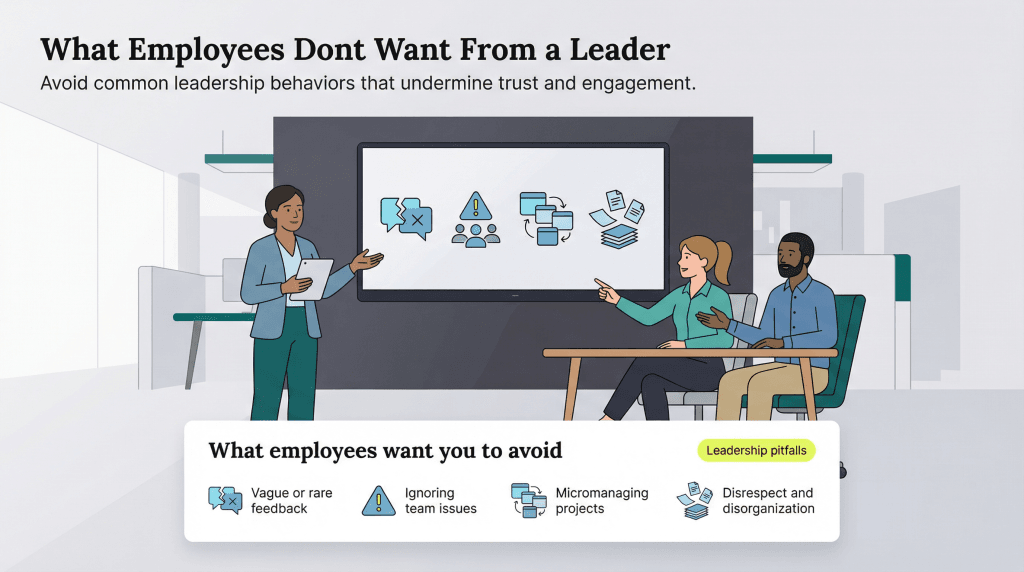
What employees don’t want from a leader
To be the best leader possible, you must continuously improve your professional and people skills and avoid the behaviors that drive employees away. Here are the top behaviors to avoid when working on your leadership goals.
1. Employees don’t want leaders to give unconstructive feedback.
The best employees want constructive feedback with clear employee performance goals to help them improve and advance their careers. They don’t want leaders to give vague or unclear feedback or, perhaps worse, no feedback at all.
A recent Workhuman/Gallup Human-Centered Workplace report underscores how much this matters: Employees who received meaningful feedback in the past week were five times more likely to be engaged, 57 percent less likely to experience employee burnout and 48 percent less likely to be job-hunting.
Valuable feedback also goes further. It includes noticing more subtle characteristics and habits that can help an employee go beyond improving day-to-day tasks to find ways to reach long-term goals. For example, a great customer service agent may hit daily number goals, but are they polite? Do they foster loyal customers?
Goldstein advised leaders to avoid focusing excessively on negative feedback without clearly outlining their expectations. “So, it’s creating that crystal-clear target or bull’s-eye of what it is that we’re looking for, as opposed to the easiness of saying what we don’t want to see or what isn’t there,” Goldstein explained.
Feedback sessions should also be an opportunity to learn more about your team. Ask them about their long-term career goals and how you can help them get there. Building relationships can help you have challenging conversations; the practice can also encourage employees to come to you when they’re struggling or feeling underappreciated.
2. Employees don’t want leaders to ignore workplace issues.
Teams often have weak links. For example, some employees have workplace absenteeism issues. Or, they may habitually show up late, fail to turn in paperwork on time or routinely stir dissent in the office.
Instead of confronting problematic employees, leaders may choose to take the easy way out and ignore the issue. They may be uncomfortable with conflict and hope the issue goes away without their involvement. They may even think having a weak link is better than going through the process of terminating the employee and hiring a replacement.
However, these sentiments are short-sighted. Every employee must be held to the same standards to avoid a toxic work culture, productivity losses and accusations of workplace nepotism.
3. Employees don’t want micromanaging leaders.
A micromanager can turn an already complex project into chaos. While hands-on leadership has its place, refusal to delegate tasks can stifle employee growth, reduce skills development and morale and make it impossible to reach goals.
Excellent leaders foster an empowered employee culture. Employees must feel ownership over their work and maintain control to produce creative ideas and remain productive. Trust your team to use their strengths to accomplish a project everyone can be proud of.
“We want to make sure that we’re not creating an army of executors, where we as leaders are spending our day saying, ‘Go and do this. Go and do that,'” Goldstein advised. “We want to elevate our direct reports to be their strongest, best selves. So, in order to do that, asking questions, being curious and coming from that sense of, ‘How can I empower my direct reports?’ is a really, really huge skill.”
At the same time, employees may have different perceptions of micromanagement. While a new employee, intern or early career worker might appreciate very specific direction, someone with a high level of experience likely will not.
“You don’t want to micromanage a high performer and tell them what to do when they’re competent at doing it because it’s just going to annoy them,” Cole cautioned.
Be clear about everyone’s responsibilities. Once you step back, the team might exceed your expectations.
4. Employees don’t want disrespectful leaders.
Making your way to the top takes work. But once you’re there, you can’t do your job alone. It’s crucial to treat every team member with respect and empathy.
Participating in unprofessional, disrespectful leadership behavior — such as gossiping, boasting about your pay or making your employees feel guilty about putting family before work — can quickly mark you as a bad boss.
The U.S. Surgeon General’s Framework for Workplace Mental Health and Well-Being identifies respect and the opportunity for input as core elements of a healthy work environment. When leaders ignore those basics, they risk creating the kind of workplace that fuels burnout and turnover.
Respect is a vital element of
emotional intelligence — a level of insight and awareness shared by the most successful professionals.
5. Employees don’t want disorganized leaders.
Bosses are held to a higher standard than their teams. They’re responsible for organizing workers and managing projects. Unfortunately, some leaders have messy desk syndrome, are frequently late or lose track of essential documents.
Leaders must take time for self-care and focus on personal and business organization. Bosses don’t have to be perfect. However, their teams should see them as prepared, on task and in touch.
Erin Donaghue and Angela Koch contributed to this article. Source interviews were conducted for a previous version of this article.