Business.com aims to help business owners make informed decisions to support and grow their companies. We research and recommend products and services suitable for various business types, investing thousands of hours each year in this process.
As a business, we need to generate revenue to sustain our content. We have financial relationships with some companies we cover, earning commissions when readers purchase from our partners or share information about their needs. These relationships do not dictate our advice and recommendations. Our editorial team independently evaluates and recommends products and services based on their research and expertise. Learn more about our process and partners here.
Cash flow is one of the most essential metrics for small businesses to track. Strong cash flow is critical for sustained growth and supporting operations without seeking costly financing.


This article is sponsored by Intuit
A profitable business can still run out of money, and it happens more often than most owners expect. Profitability just means you’ve earned more revenue than incurred expenses, but when that cash lands in your account determines whether you can actually fund your business. A signed contract does not make payroll, a deposited check does.
Most small businesses struggle to close the gap between earning and collecting. Nearly 3 in 5 businesses (59 percent) have invoices overdue by 30 days or more, and those waiting on unpaid invoices are owed an average of $17,700, according to the 2026 Small Business Late Payments Report from Intuit QuickBooks. Nearly 2 in 5 owners (39 percent) said a single late payment made it hard to cover payroll or bills in the past year.
An annual budget will not warn you about any of that. It was written once, it assumes customers pay on schedule and it has been wrong since about week three. A rolling cash flow forecast is the alternative. This report offers a short-horizon that is frequently updated with a view of the money you actually expect to move in and out of your bank account. Here is how to build one and, more importantly, how to keep it alive.
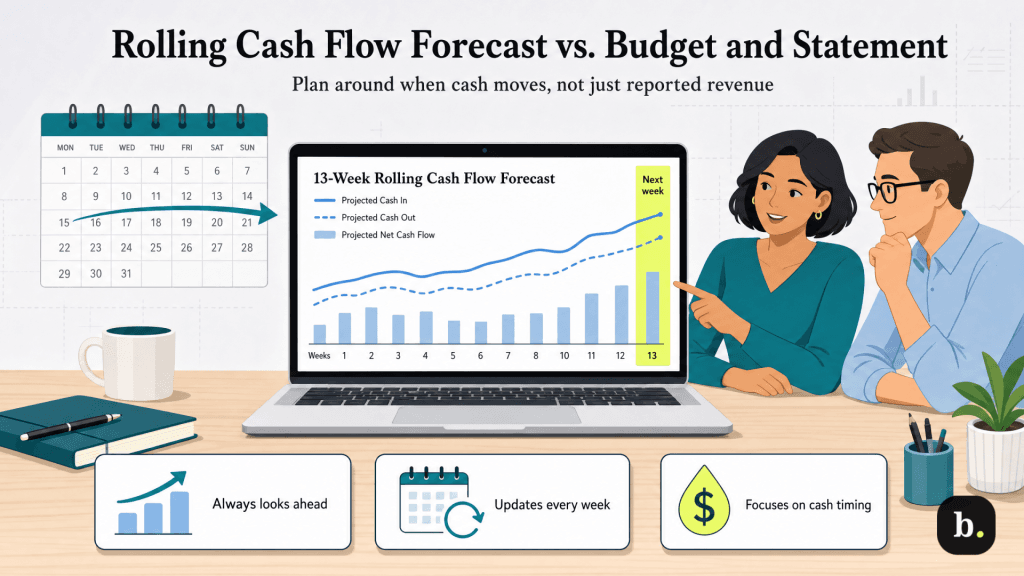
A rolling cash flow forecast projects your expected cash inflows and outflows over a fixed forward window and moves that window forward as time passes. When week one closes, you drop it, add a new week at the far end, and update everything in between with what you have learned. Your rolling cash flow forecast is always looking ahead at the same range, most commonly 13 weeks.
A rolling cash flow forecast is forward-looking and perishable by design. It tells you what is about to happen while you can still do something about it. That is what separates the rolling cash flow forecast from the two documents you may already have.
A key fact to keep in mind is that a rolling cash flow forecast is a cash document, not a revenue document. An invoice you send in March for net-30 terms is March revenue, but it is April cash (or May cash, if the customer pays their invoice late.) The forecast tracks the second number.
Thirteen weeks is one quarter, expressed weekly. The horizon is popular because it provides both detail and accuracy. Weekly granularity helps catch the problems most annual budgets hide: that you can be comfortably cash-positive for a month while being dangerously short during the specific week rent, payroll and a quarterly tax payment all land together.
It is also short enough that your assumptions are still defensible. You know who owes you money right now and roughly when they tend to pay. You know what your payroll runs cost. Push the window to 12 months and those knowable facts thin out into guesswork.
Thirteen weeks is a default, not a rule. If your business runs on long project cycles, seasonal swings or lumpy contract revenue, a 12-month rolling forecast in monthly buckets may serve you better for planning. Many finance teams run both, using the weekly view for liquidity and the monthly view for strategy. If you are in a genuine cash crunch, a four-week or six-week view updated more often is entirely reasonable. Match the horizon to the decisions you actually need to make.
Every forecast is based on the cash you have today. If you get this number wrong, every week downstream inherits the error. This is the least glamorous step, but also the one most likely to ruin the entire forecast.
Your starting position is not the balance in your business bank account; it is your reconciled cash position. This is the balance adjusted for checks that have not cleared, payments in transit and transactions that have posted to your books but not your account. If you have multiple accounts, consolidate them, but only the ones you would genuinely draw on to cover an obligation. A tax reserve account you refuse to touch is not operating cash.
This is where bookkeeping discipline pays off. If your bank feeds are reconciled through last week, your starting number is a fact you can look up. Accounting platforms such as QuickBooks Online import bank and credit card transactions automatically and flag what has not yet been matched, which turns reconciliation into a review task rather than a data-entry project. If your books are three months behind, fix that before building the forecast. A model on top of stale books produces confident, precise, wrong answers.
Work out when the money you’re owed actually arrives. Start with your accounts receivable aging report, which lists every open invoice, its amount and how long it has been outstanding. This is your single best source of near-term inflow data, because the work is already done and the money is already owed.
The key is to forecast against observed behavior, not stated terms. Your net-30 customer who has paid on day 44 for two years is a day-44 customer. Put that invoice in week seven, not week five. Owners consistently forecast their receivables optimistically, assuming the terms they wrote down are the terms that will be honored. Instead, look at the last six months of payment history per customer and use what you find.
Weight the uncertain lines rather than treating them as binary. If a proposal has a reasonable chance of closing and collecting inside the window, some owners include a risk-adjusted portion of it; others exclude unsigned work entirely and treat it as upside. Either approach works. What does not work is booking speculative revenue at full value on the strength of a promising phone call.
Outflows are easier to predict than inflows because you control most of them. Unfortunately, many owners rush this step and miss the items that cause the actual crisis.
Start with the fixed and contractual outflows like payroll and payroll taxes, rent, loan and lease payments, insurance, software subscriptions and utilities. Then layer in the variables like inventory and materials, contractor payments, marketing spend and merchant processing fees. Pull your accounts payable aging for what you already owe and when it comes due.
Pay close attention to payroll timing. Two payroll runs a month is not the same as biweekly. Biweekly means two months a year contain three payrolls, and those months are where otherwise healthy businesses discover a problem they did not know they had. Map the actual dates on an actual calendar.
The obligations that break forecasts are the ones that do not arrive monthly. These include quarterly estimated taxes, annual insurance premiums, equipment purchases, license renewals and annual software contracts. They are entirely predictable and routinely forgotten, because they are invisible in any given month of ordinary bookkeeping.
Sit down with the last 12 months of bank statements and flag every payment over some threshold that is meaningful to you (whatever amount would ruin your week if it landed unexpectedly.) Those are your lumpy outflows. Place each one in the week it will actually hit. This single exercise catches more forecasting errors than any other.
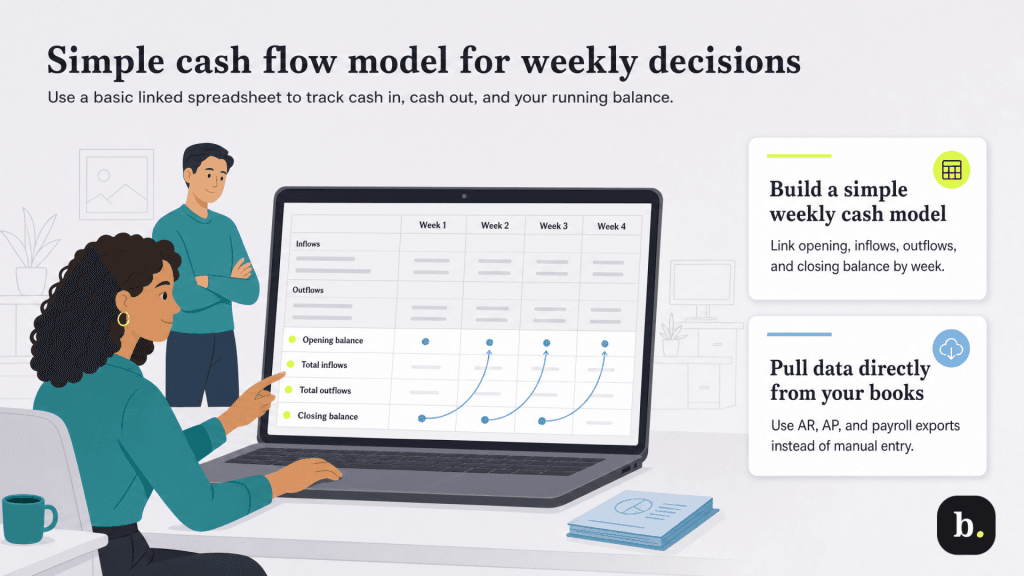
The structure is simple enough that a spreadsheet handles it comfortably. Columns are weeks. Rows are line items, grouped into inflows and outflows. The following four rows are key:
Each week’s closing balance becomes the next week’s opening balance.
Resist the urge to build something elaborate. Line items should be grouped at the level you would actually make a decision about (for example, “payroll,” not seventeen individual employees.) A forecast with 200 rows will not get updated on a Monday morning, and a forecast that does not get updated is worth nothing regardless of how precise its architecture is.
The data entry is where this gets tedious, and where pulling from your accounting software beats hand-keying. AR and AP aging reports, recurring transaction schedules and payroll records already exist in your books; exporting them is faster and less error-prone than retyping.
QuickBooks Online generates aging reports on demand and includes built-in cash flow forecasting tools that project forward from your existing transaction data, which can serve as a starting point or a sanity check against a model you build yourself. Whatever the source, the forecast should pull from your books, so your books stay current.
This is the step that makes the forecast rolling. Everything up until this step produced a document. This step produces a system.
Pick a consistent time (Monday morning works for most) and do four things. Record what actually happened last week. Compare it to what you forecast. Understand why they differ. Then roll the window: drop the closed week, add a new week 13, and update every assumption the variance just taught you something about.
The variance review is the part that carries the value. A customer who paid three weeks late is not a rounding error; it is information about that customer’s behavior that should change how you forecast them going forward. A recurring miss in one category means your assumption is broken, not your luck. Over two or three months of this, your forecast stops being a guess and starts being a model of how your business actually moves money.
Expect to be wrong. A forecast within roughly 5 to 10 percent is doing its job; precision was never the point. The point is direction and timing — knowing that week nine looks tight while it is still week two.

A forecast that predicts a crisis you cannot avoid is just an early warning. The value is in the lead time. Spotting a projected shortfall in week nine while you are sitting in week two gives you seven weeks of options, while discovering it on the day payroll bounces gives you none.
Early steps you can take to resolve cash flow issues on the horizon include:
Once the model exists, scenario planning is nearly free. Copy the sheet and ask hard questions. What happens if your largest customer pays 30 days late? If a major renewal does not close? If sales drop 20 percent for six weeks? Doing so allows you to determine which of these events you would survive comfortably and which ones would end you, and that tells you where to build the buffer.
Avoid these common cash flow forecasting mistakes to make sure your model actually serves your business.
The forecast itself is not the point, the weekly rhythm is. Spening the 20 minutes of sitting down with the numbers, seeing what moved and adjusting is what actually benefits your business. Owners who build the habit find that cash stops being a monthly source of anxiety and becomes something they manage on purpose, with lead time and options.
Start rough. Thirteen columns, your reconciled opening balance, your AR aging, your known bills and your best guess at everything else. The first version will be wrong in ways you will discover in week two, which is the mechanism working — that is precisely how it gets better. What matters is that the wrongness shows up while you can still respond to it.
Then do it again next Monday.
