Business.com aims to help business owners make informed decisions to support and grow their companies. We research and recommend products and services suitable for various business types, investing thousands of hours each year in this process.
As a business, we need to generate revenue to sustain our content. We have financial relationships with some companies we cover, earning commissions when readers purchase from our partners or share information about their needs. These relationships do not dictate our advice and recommendations. Our editorial team independently evaluates and recommends products and services based on their research and expertise. Learn more about our process and partners here.
Learn how business credit cards and lines of credit differ in cost, flexibility and borrowing power so you can choose the right financing option for your business.


A business credit card and a business line of credit are both flexible ways to access financing when your business needs it. Both let you borrow, repay and borrow again up to an approved limit. However, they serve different purposes. Business credit cards are typically designed for everyday spending, while business lines of credit are often a better fit for larger expenses, cash flow gaps and other financing needs.
Understanding the differences can help you choose the right option for a particular situation — and avoid paying more than necessary in fees or interest. This guide explains how business credit cards and lines of credit work, compares their costs and features, and outlines when each may be the better choice.
A business credit card is a revolving credit account that allows a company to make purchases up to a previously approved credit limit. As balances are paid down, the available credit returns, so the card can be used again as needed.
Business credit cards are commonly used for everyday operating expenses, including office supplies, software subscriptions, travel and other recurring purchases. Many cards also offer rewards, expense management tools and employee cards, although businesses should also consider business credit card fees when comparing their options.
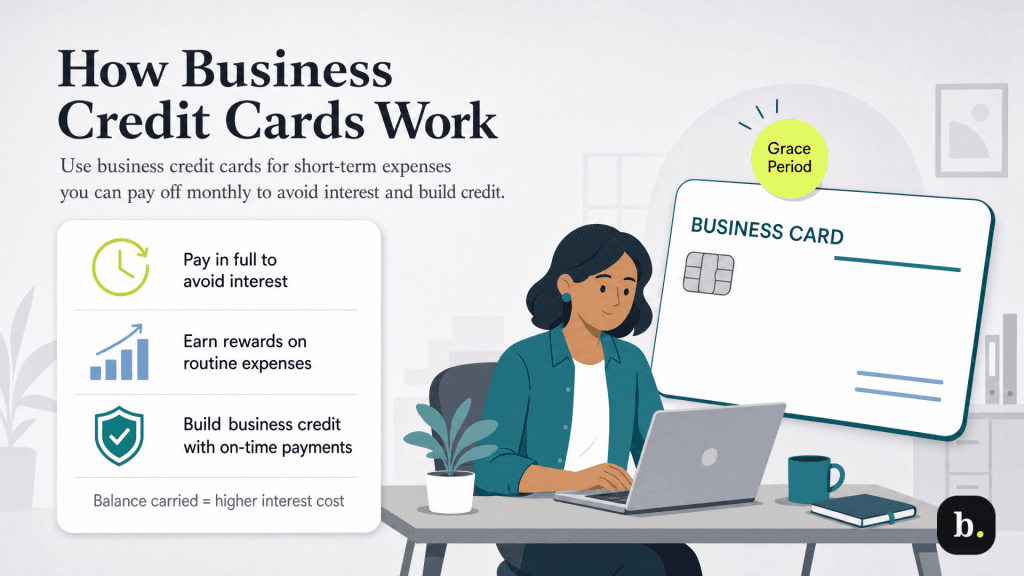
Business credit cards operate on a monthly billing cycle and require at least a minimum payment each month. One of their biggest advantages is the grace period. If you pay your statement balance in full by the due date, you typically won’t pay interest on purchases, giving your business access to short-term financing while also earning rewards in many cases.
If you carry a balance, however, interest charges begin to matter. Business credit card APRs are often higher than the rates associated with a business line of credit, which can make carrying debt more expensive over time.
Business credit cards are generally easier to qualify for than lines of credit and are best suited to routine operating expenses that can be paid off regularly.
A business line of credit is a flexible financing tool that gives a business access to funds up to an approved borrowing limit. Like a business credit card, it can be used repeatedly as balances are repaid and credit becomes available again.
Business lines of credit are often used to manage cash flow, cover short-term expenses and handle costs that may not be practical to pay with a credit card. (Businesses considering larger financing needs may also compare a line of credit vs. a term loan to determine which borrowing structure better fits their situation.)
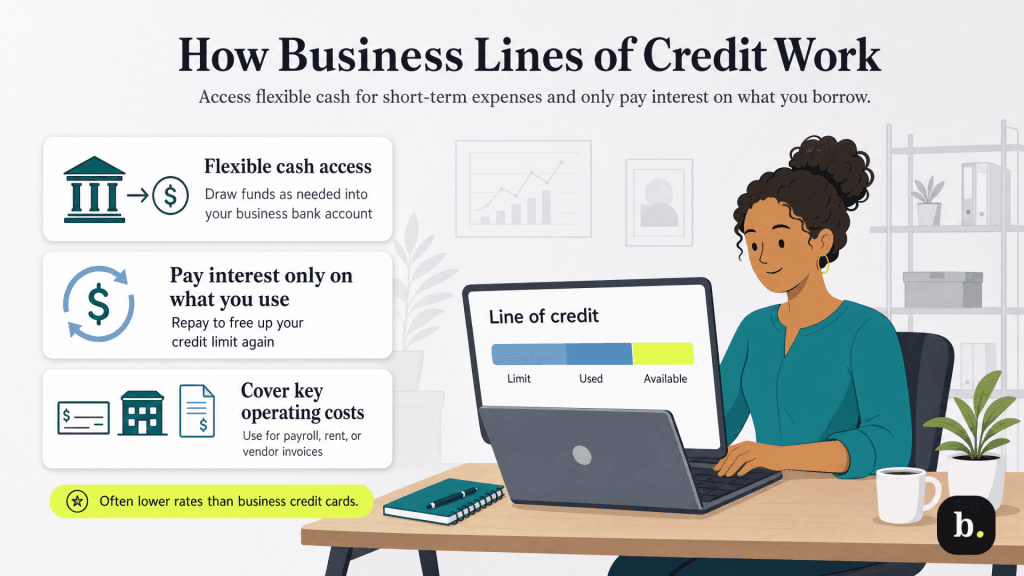
With a business line of credit, businesses draw cash as needed rather than making purchases with a payment card. The funds are often transferred directly into a business bank account, and interest applies only to the amount that’s actually borrowed. Paying down the balance frees up room to borrow again later.
Because a line of credit provides a way to access cash, it can be used for expenses you likely wouldn’t be able to pay with a credit card, such as payroll, overhead costs like rent or lease payments, and some vendor invoices.
Business lines of credit may be secured or unsecured. They can also come with costs that business credit cards typically don’t have, including draw fees, maintenance fees or origination fees. However, business line of credit rates are often lower than business credit card APRs, making them a more cost-effective option for carrying a balance.
Here’s a quick side-by-side look at how business credit cards and business lines of credit compare on cost, access, qualification and everyday use.

Feature | Business Credit Card | Business Line of Credit |
|---|---|---|
Credit limits | Typically lower maximums | Often higher; suited to larger needs |
Interest rates | Often higher; commonly in the high teens or above 20% APR (more for cash advances) | Typically lower, especially for well-qualified borrowers |
Interest-free option | Yes — pay statement in full within the grace period | No purchase-style grace period; interest accrues on drawn funds |
Access to funds | Card purchases; cash advances may be available but costly | Cash drawn to your bank account; can cover payroll, rent and ACH payments |
Rewards/perks | Common — cash back, points, travel perks | Rare or none |
Collateral | Typically unsecured | Secured or unsecured |
Qualification | Often easier to qualify for | Often stricter requirements |
Fees | May include annual, late, foreign transaction or cash advance fees | May include draw, maintenance or origination fees |
Note: Specific limits, rates and fees vary by issuer, lender and your business’s creditworthiness. Figures here describe general tendencies, not guarantees.
A business credit card and a business line of credit can both provide flexible access to financing, but they aren’t designed for the same situations. The best choice often depends on how you plan to use the funds, how quickly you’ll repay what you borrow and whether you need purchasing power or access to cash.
A business credit card is often the better fit in the following situations:
A business line of credit is often the stronger option when you need access to cash, expect to carry a balance for a while or are managing expenses that aren’t easily handled with a credit card. Here are some situations where you’d likely opt for a line of credit:
In many cases, the decision comes down to how long you’ll need the funds. For expenses you’ll pay off in the near future, a business credit card’s rewards and grace period can provide meaningful value. If the balance is likely to stick around for a while, a lower-rate line of credit may cost less in the long run.
Yes — and many businesses do. A business credit card and a business line of credit aren’t necessarily competing products. In many cases, they work best together because each serves a different purpose.
A common approach is to use a business credit card — or multiple business credit cards — for everyday operating expenses that can be paid off quickly. That allows the business to earn rewards and take advantage of the grace period. A business line of credit can then be reserved for larger expenses, cash flow gaps or other funding needs that may take longer to repay.
Used this way, each financing tool plays to its strengths. The credit card gets used for routine purchases, while the line of credit is available for bigger funding needs. That way, a balance that may take months to repay doesn’t end up sitting on a high-interest credit card.
A business credit card and a business line of credit can both be valuable financing tools, but the lowest-cost option often depends on how the funds will be used and how quickly they’ll be repaid.
Before borrowing, think about whether you’re making routine purchases, covering a short-term cash flow need or financing a larger expense that may take time to pay off. The answer can help determine which option is likely to cost less and provide the most flexibility.
Many businesses ultimately use both. The goal isn’t to choose a winner — it’s to understand when each tool makes the most sense and avoid paying more for financing than necessary.
