Business.com aims to help business owners make informed decisions to support and grow their companies. We research and recommend products and services suitable for various business types, investing thousands of hours each year in this process.
As a business, we need to generate revenue to sustain our content. We have financial relationships with some companies we cover, earning commissions when readers purchase from our partners or share information about their needs. These relationships do not dictate our advice and recommendations. Our editorial team independently evaluates and recommends products and services based on their research and expertise. Learn more about our process and partners here.
From current rates to smart borrowing strategies, here’s what to expect in 2026


If you’re a small business owner shopping for a loan in 2026, the interest rate landscape is better than it was a year ago — but still far from simple. The Federal Reserve cut rates three times in the second half of 2025, bringing the federal funds rate down to a target range of 3.5 percent to 3.75 percent and the prime rate to about 6.75 percent. That relief, however, has been tempered by persistent inflation, elevated energy costs driven in part by Middle East tensions, and geopolitical uncertainty that has given the Fed reason to pause its easing cycle.
The result is a borrowing environment where rates vary dramatically, from under 7 percent at traditional banks to well over 50 percent for some alternative financing products. The rate you’ll actually pay depends on the type of loan, the lender, your creditworthiness and the collateral you bring to the table. Understanding these ranges and the forces shaping them is the first step toward applying for a business loan and securing affordable capital for your organization.
Several macroeconomic forces are shaping the business lending environment this year, and understanding these broader lending trends can help you anticipate where rates may be headed.
The Federal Reserve’s three rate cuts in late 2025 — each by 25 basis points, in September, October and December — brought meaningful relief after a prolonged period of elevated rates. However, the Fed held rates steady at both its January and March 2026 meetings, keeping the federal funds rate at 3.5 percent to 3.75 percent. The March meeting’s “dot plot” pointed to one additional cut this year and another in 2027, though the timing remains uncertain. Markets widely expect another hold at the upcoming April 28-29 meeting.
While inflation has cooled considerably from its 2022 peak, it hasn’t returned to the Federal Reserve’s 2 percent target. Headline CPI rose to 3.3 percent in March 2026 — up from 2.4 percent in February — driven in part by a 12.5 percent increase in energy costs year over year. Core CPI, which strips out food and energy, rose a more modest 2.6 percent year over year, suggesting that underlying inflation remains relatively contained.
The picture may shift in the months ahead. Energy prices may moderate in the coming months, which could allow the Fed to look past the March spike and refocus on the underlying inflation trend. Even so, the Fed has made clear it wants sustained progress before resuming rate cuts, and with headline inflation running well above its 2 percent target, that timeline remains difficult to predict.
The U.S. war with Iran has injected uncertainty into the global economy, particularly through their impact on oil prices. Rising energy costs can simultaneously push inflation higher and slow growth, putting the Federal Reserve in a difficult position. Chair Jerome Powell has acknowledged these risks but indicated the committee is taking a wait-and-see approach.
For small business borrowers, that uncertainty points to a rate environment that’s likely to stay relatively range-bound in the near term. That makes the window for refinancing business loans or locking in current rates more relevant than waiting for cuts that may not arrive on a predictable schedule.
For fixed-rate loan products (particularly SBA 504 loans), Treasury bond yields matter as much as the prime rate. As of early April 2026, the five-year Treasury yield was approximately 3.92 percent, and the 10-year yield was around 4.30 percent, both higher than at the start of the year. These elevated yields have pushed up borrowing costs for fixed-rate products even as the prime rate has held steady.
There is no single “average” business loan rate. What you’ll pay depends on your business’s financial circumstances, the product you choose and the lender you work with. Here’s an estimate of what to expect from each major category.
| Loan Type | Estimated Interest Rate Range in 2026 |
| Bank term loan | 8% – 13% |
| Online term loan | 10% – 40% |
| SBA 7(a) loan | 9.75% – 14.75% |
| SBA 504 loan | 5% – 7.5% |
| SBA microloan | 8% – 13% |
| Merchant cash advance | 40% – 350% |
Banks offer the lowest rates but have the strictest requirements. According to the Federal Reserve Bank of Kansas City’s Small Business Lending Survey, median interest rates on new small business term loans were in the high-6 percent to low-7 percent range in the fourth quarter of 2025.
In practice, borrowing costs can vary more widely depending on the borrower and loan structure. While bank loans for stronger applicants tend to stay in the single digits, high risk business loans can reach into the double digits or higher. Expect to need a personal credit score of 680 or higher (720-plus for the best rates), at least two years in business, strong revenue and often collateral and a personal guarantee from the business owner. The application process is longer than with online lenders, typically taking several weeks from application to funding.
SBA loans are partially guaranteed by the federal government, which helps reduce risk for lenders and keeps borrowing costs lower than many other financing options. Here’s how rates for the most common SBA loan programs compare.
Online lenders tend to prioritize speed and accessibility over price, making them a go-to option for fast business loans. Many can fund within 24 to 48 hours, compared to several weeks to a few months for SBA loans.
But that speed comes at a cost: term loan APRs range from 14 percent to 99 percent, with many lenders clustering in the 18 percent to 45 percent range for average-risk borrowers. Lines of credit through online platforms typically carry rates of about 10 percent to 35 percent APR for established businesses, though rates can run higher for newer or higher-risk borrowers.
Merchant cash advances aren’t technically loans; they’re advances against future sales, repaid as a percentage of daily credit or debit card revenue. They use factor rates, typically between 1.1 and 1.5, rather than interest rates. When you convert that to an effective APR, MCAs can exceed 50 percent and often climb into the triple digits, depending on how quickly they’re repaid. In some cases, they can even go past 200 percent. They’re best understood as a last-resort financing option for businesses that don’t qualify for more traditional credit.
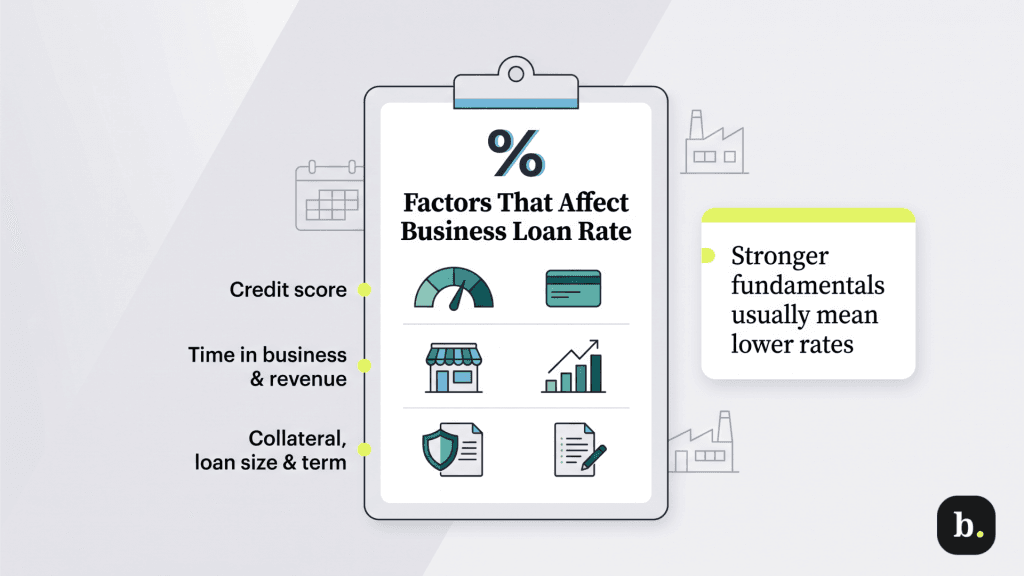
While macroeconomic conditions set the broader rate environment, several borrower-specific factors determine the rate you’ll actually receive.
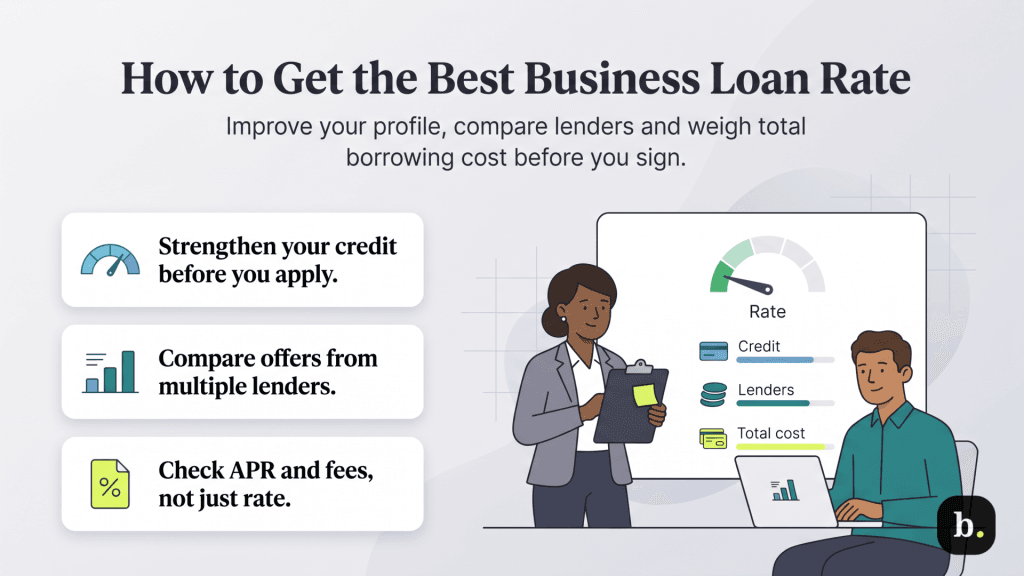
You can’t control the Federal Reserve or the price of oil, but there are meaningful steps you can take to secure the most competitive rate possible.
Business loan interest rates in 2026 cover a wide range, from under 7 percent at traditional banks to well over 50 percent for merchant cash advances. The Fed’s three rate cuts in late 2025 brought some real relief, but rates have held steady so far this year as policymakers watch inflation and geopolitical risks. One additional cut is possible in 2026, but the timing depends on how the broader economy plays out.
For borrowers, the takeaway is pretty simple: preparation and lender selection matter just as much as the rate environment. A well-qualified borrower who shops multiple lenders and understands the full cost of each offer will often pay significantly less than someone who takes the first option available. Rates may not return to pre-2022 levels anytime soon, but with the right approach, affordable financing is still within reach.
