Business.com aims to help business owners make informed decisions to support and grow their companies. We research and recommend products and services suitable for various business types, investing thousands of hours each year in this process.
As a business, we need to generate revenue to sustain our content. We have financial relationships with some companies we cover, earning commissions when readers purchase from our partners or share information about their needs. These relationships do not dictate our advice and recommendations. Our editorial team independently evaluates and recommends products and services based on their research and expertise. Learn more about our process and partners here.
Discover the benefits and risks of carrying multiple business credit cards, along with practical tips for managing payments, expenses and rewards.


Many businesses end up with more than one business credit card. One card might offer better travel rewards, another may be used for recurring software expenses, and a third might be reserved for employee spending. The challenge isn’t opening multiple accounts — it’s keeping them organized.
More cards can mean more rewards, higher available credit and better expense tracking. They also mean more due dates, more statements and more opportunities for something to slip through the cracks. This guide explains why businesses carry multiple cards, the risks that come with them and the systems that can help keep everything under control.
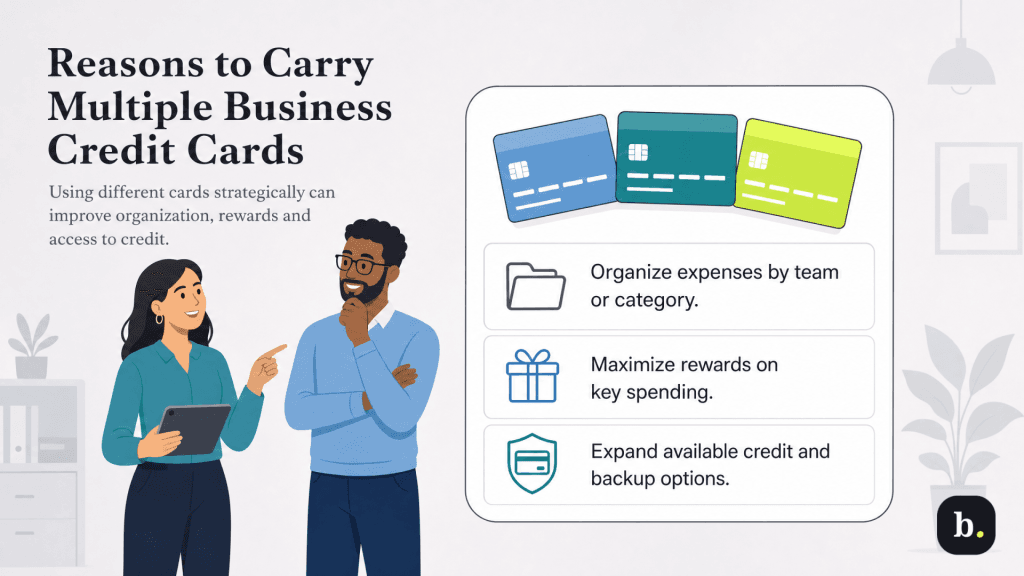
Carrying multiple business credit cards isn’t necessarily a sign of overextended business debt. Many companies use different cards for different purposes, whether that’s keeping expenses organized, earning rewards in key spending categories or maintaining access to additional credit when needed. When managed carefully, multiple cards can provide flexibility that a single card can’t.
Here are some of the most common reasons businesses choose to carry more than one card.
Many businesses assign specific cards to different departments, projects or spending categories. For example, one card might be used for marketing expenses, while another is reserved for travel or recurring software subscriptions. Separating purchases this way can make spending easier to track throughout the month, help with budget planning and simplify reporting at tax time.
Different cards reward different types of spending. One card might offer elevated rewards on advertising and shipping, another on travel, while a flat-rate card may be the best option for everyday purchases. If your business spends significantly in multiple categories, using the right card for each type of expense can increase the overall value you earn from your spending.
Each business credit card comes with its own credit limit, so carrying multiple cards can increase your total available credit. That additional capacity can be useful during busy seasons, periods of rapid growth or unexpected expenses. Responsible use can also contribute to a stronger business credit history (and a higher business credit score) over time if the issuer reports account activity to commercial credit bureaus.
Many business credit cards offer welcome bonuses to new cardholders who meet a certain spending threshold within the first few months. If your business already has planned expenses coming up, adding a new card from time to time may allow you to earn more than one bonus.
Not every bonus is as easy to earn as it once was, though. For example, American Express generally limits welcome bonuses to once per lifetime per card, while Chase has added restrictions to some of its Ink business cards. Before applying, look at how you’ll actually use the card after the bonus is gone. The strongest choice is usually the one that still makes sense for your business a year from now.
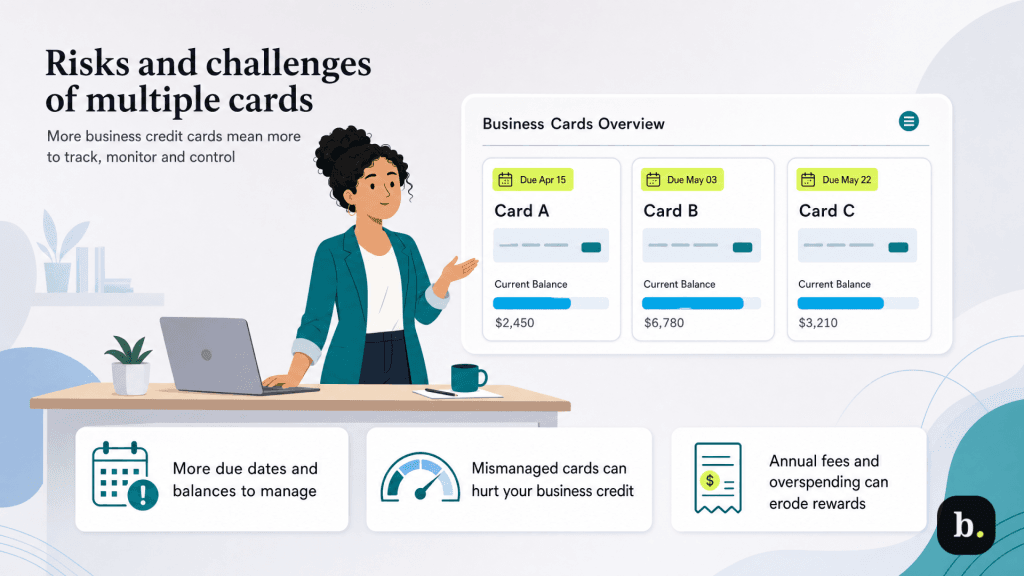
The benefits of multiple business credit cards are easy to see. The challenges tend to show up more gradually. A second or third card can make spending more flexible, but it also creates more accounts to monitor, more payments to track and more opportunities for small mistakes to become expensive ones.
Before adding another card to your wallet, it’s worth understanding where businesses often run into trouble.
The more cards you carry, the more administrative work that comes with them. Each account has its own statement closing date, payment due date, balance and rewards structure. What starts as a simple system can become surprisingly difficult to manage if you aren’t paying close attention.
A missed payment isn’t just an inconvenience. Depending on the issuer, it can trigger late fees, penalty APRs or damage to your business credit profile. That’s why many businesses use calendar reminders, the best accounting software platforms or automatic payments to keep everything on track.
Multiple cards can help or hurt your credit depending on how they’re managed. Making payments on time and keeping balances under control can contribute to a stronger business credit profile over time. On the other hand, carrying large balances across several cards can push up your credit utilization and make your business appear more reliant on borrowed funds.
It’s also worth remembering that each new card application may also result in a hard credit inquiry. One inquiry generally isn’t a big deal, but submitting several applications within a short period can have a more noticeable effect.
A card with a $95 or $195 annual fee may be easy to justify when the rewards and benefits outweigh the cost. The math gets a little different when you’re paying multiple annual fees year after year.
Many businesses sign up for a card because a welcome bonus or specific perk makes sense at the time. A year or two later, that same card may be sitting in a drawer while the annual fee continues to appear on the statement. Reviewing your cards periodically can help ensure each one is still earning its place in your wallet.
Higher credit limits can be helpful during busy seasons or when an unexpected expense pops up. The challenge is that having more credit available can make it easier for spending to creep up over time.
This isn’t usually the result of a single large purchase. More often, it happens gradually as expenses spread across multiple accounts and become harder to monitor. A successful multi-card strategy starts with the same principle as any credit strategy: charge only what the business can afford to pay back.
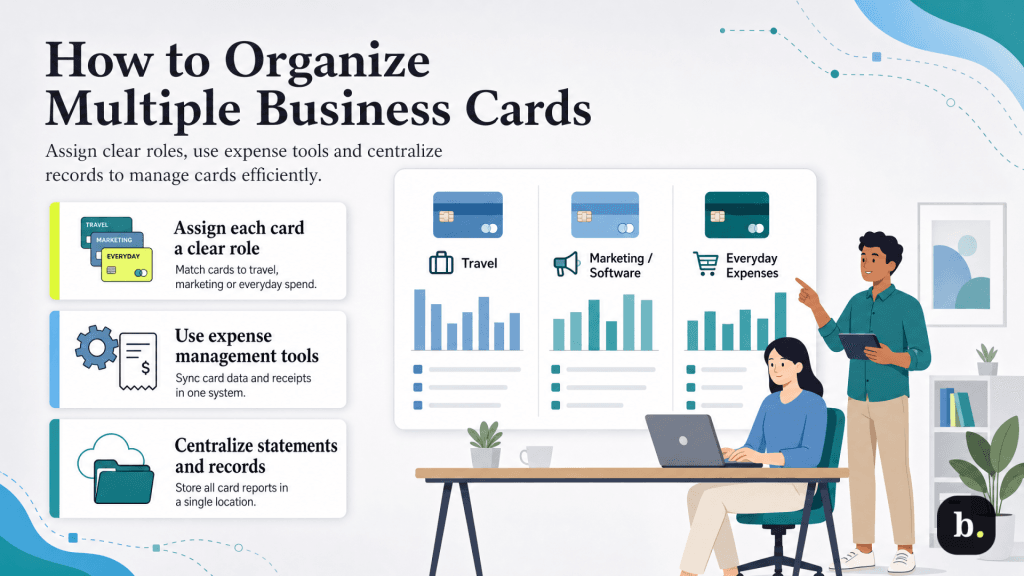
Managing multiple business credit cards doesn’t have to be complicated, but it does require a system. Problems tend to arise when cards are added over time without a clear plan for how they’ll be used or monitored. Knowing which card is used for which expenses, where transactions are tracked and when payments are due can make day-to-day management much easier. Here are a few ways to stay organized.
The easiest way to manage multiple cards is to avoid treating them interchangeably. Assign each card a clear role based on how your business operates. One card might be reserved for travel expenses, another for advertising and software subscriptions, while a third serves as a general-purpose card for everyday purchases.
Some businesses take a different approach and assign cards by department, team or project. Either way, a clear system reduces guesswork and makes expenses easier to track throughout the month.
As the number of cards grows, manual tracking becomes more difficult. Expense management software can pull transactions from multiple accounts into one place, automatically categorize purchases and digitize receipts to help with employee expense reimbursements.
Many business credit card issuers now include at least some expense management features, and most accounting platforms can help consolidate spending across multiple cards. For businesses managing several accounts, these tools can save a significant amount of time.
When reconciliation time arrives, the last thing you want is to hunt through multiple portals looking for statements. Creating a single location for card records — whether that’s within your accounting software, a document management system or a shared folder — can make bookkeeping much easier.
Many issuers also offer accounting integrations and downloadable reports that can feed directly into your books. Using those features can cut down on manual data entry and save time when it’s time to reconcile accounts.
A big part of managing multiple business credit cards is making sure payments don’t fall through the cracks. The more accounts you add, the easier it becomes to overlook a due date or underestimate how much is owed across all of your cards. A few simple habits can help keep payments predictable and prevent small mistakes from becoming costly ones.
There’s no magic number of business credit cards that’s right for every company. Some businesses operate with one card, while others successfully manage several. Instead of focusing on the number of accounts, it’s more helpful to periodically evaluate whether your current setup is still serving the business. Here are a few questions worth asking.
The best multi-card strategies are intentional. One card may be used for travel, another for recurring software subscriptions and a third for employee spending. Each account has a clear role and provides value through rewards, spending controls or other benefits.
If you’re not sure why you’re still carrying a particular card, or you’re paying an annual fee for benefits you rarely use, that account may deserve a second look.
Sometimes simplifying your setup can make life easier without giving up much value. In some cases, that may mean shifting spending onto a smaller number of cards and stopping the use of accounts that no longer fit your needs.
It can be tempting to close a card as soon as it stops making sense, but it’s worth looking at the bigger picture first. Closing an account lowers your available credit and may affect your utilization ratio. In some cases, moving to a no-fee version of the same card can accomplish the same goal while keeping the account open.
Carrying multiple business credit cards isn’t necessarily a problem. In fact, many businesses use different cards to earn rewards, manage employee spending, separate expenses or increase available credit.
The challenge is keeping those benefits from being overshadowed by extra complexity. The more cards you add, the more important it becomes to stay organized, monitor spending and keep up with payments.
A good rule of thumb is that every card should serve a clear purpose. If a card no longer provides meaningful value, or managing it feels like more trouble than it’s worth, it may be time to simplify your setup.
