Business.com aims to help business owners make informed decisions to support and grow their companies. We research and recommend products and services suitable for various business types, investing thousands of hours each year in this process.
As a business, we need to generate revenue to sustain our content. We have financial relationships with some companies we cover, earning commissions when readers purchase from our partners or share information about their needs. These relationships do not dictate our advice and recommendations. Our editorial team independently evaluates and recommends products and services based on their research and expertise. Learn more about our process and partners here.
Learn which business credit card fees matter most, how much they typically cost and which charges you can often avoid with the right card and payment habits.


It’s easy to focus on rewards, welcome bonuses and other perks when comparing business credit cards. But fees can have just as much influence on whether a card ultimately saves your business money or costs more than it’s worth. Some fees are unavoidable, while others depend on how you use the card.
Understanding the most common fees can help you evaluate the true costs involved before you apply for a business credit card. Here’s a breakdown of the fees you’re most likely to encounter, what they typically cost and how to avoid paying more than necessary.
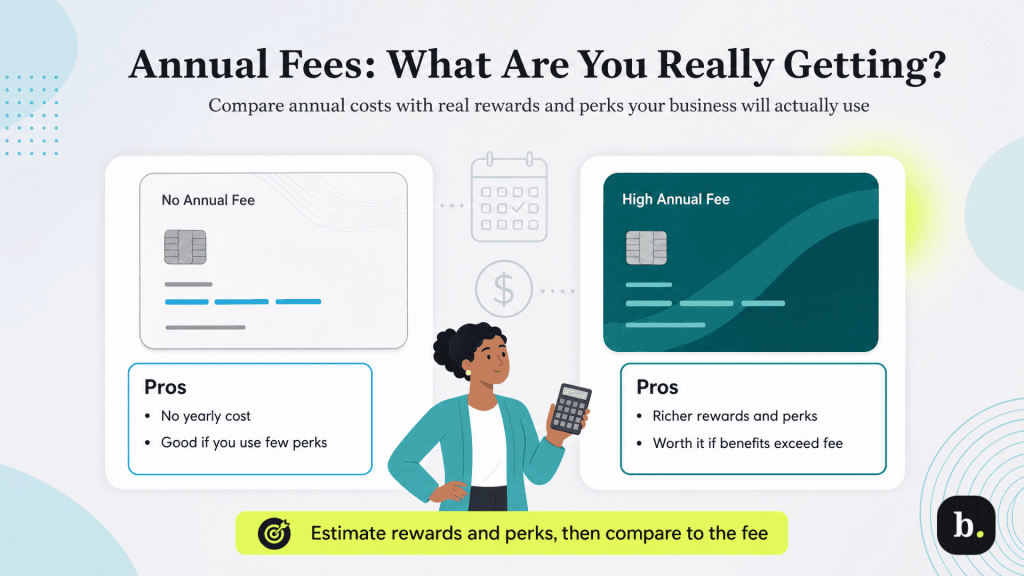
An annual fee is a flat yearly charge for holding a credit card. Many business credit cards charge no annual fee, while others charge anywhere from $95 to several hundred dollars per year in exchange for richer rewards, travel perks, statement credits and other benefits. Neither option is automatically better; the key is determining whether the value you receive outweighs the cost.
It depends on how much value your business gets from the card. A premium card with a high annual fee can easily pay for itself if you regularly use its benefits. However, if those features go largely unused, a no-annual-fee card may provide better overall value.
One way to evaluate an annual fee is to estimate the value you’ll realistically get from the card. Consider the rewards your business is likely to earn, along with any credits, travel perks or other benefits you’ll actually use, and compare that total to the fee. The best choice depends on your spending habits and whether you’ll consistently use the features you’re paying for.
The annual percentage rate, or APR, is the interest charged when you carry a balance on your credit card instead of paying it off in full. Like business loan interest rates, APRs aren’t the same for every borrower. Many business credit cards have APRs in the high teens to mid-20s, although some are higher. The rate you receive may depend on factors such as your personal credit profile, business credit history and the card itself.
For businesses that pay their statement balance in full each month, APR may not have much day-to-day impact. However, if you regularly carry a balance, interest charges can quickly become one of the most expensive costs associated with the card.
Most business credit cards charge different APRs depending on the type of transaction. The purchase APR applies to everyday purchases, while the cash advance APR applies when you withdraw cash using the card.
Cash advance APRs are almost always higher than purchase APRs and often approach or exceed 30 percent. Some cards also have a penalty APR that can be triggered by a missed payment or other account issues. In some cases, that higher rate can remain in effect for an extended period.
The easiest way to avoid interest charges is to pay your statement balance in full every month. Most business credit cards offer a grace period on purchases, meaning interest isn’t charged on new purchases if the previous statement balance is paid by the due date.
Note that grace periods are usually limited to purchases. Cash advances and balance transfers work differently; in many cases, the meter starts running as soon as the transaction goes through.
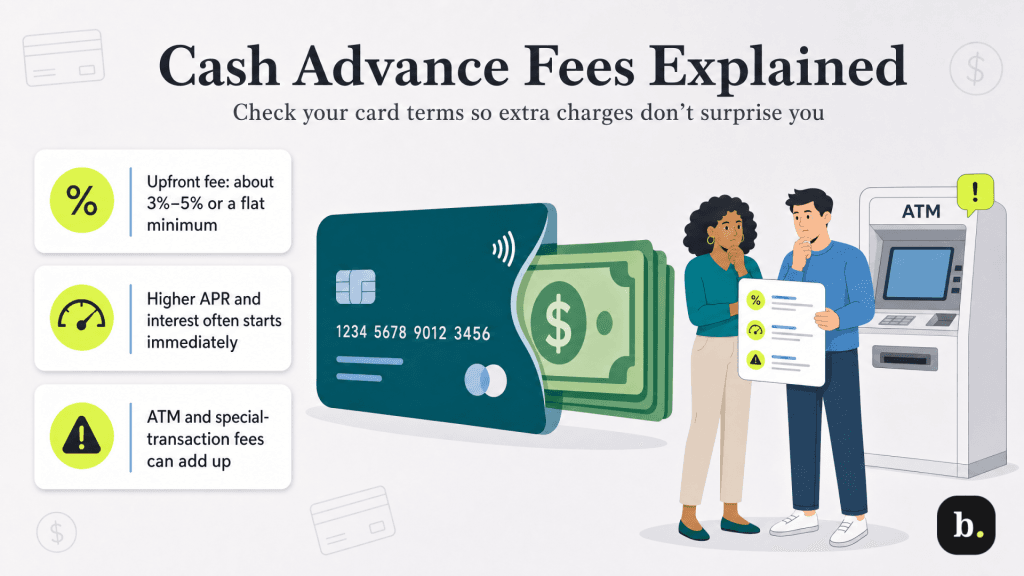
A cash advance lets you borrow cash against your credit card’s available credit line, but it’s usually one of the most expensive ways to access funds. Most issuers charge an upfront fee of about 3 percent to 5 percent of the amount withdrawn, or a flat minimum fee (often $5 to $10), whichever is greater.
The costs don’t stop there. Cash advances usually come with a higher APR than everyday purchases, and charges often begin adding up right away instead of after a grace period. And if you use an ATM to access the funds, you may also see a separate fee from the ATM operator.
Physical cash isn’t always involved, either. Depending on the issuer, purchases such as money orders, cryptocurrency or certain peer-to-peer and digital payments can be classified as cash advances. It’s worth checking your cardholder agreement so those fees don’t catch you off guard.
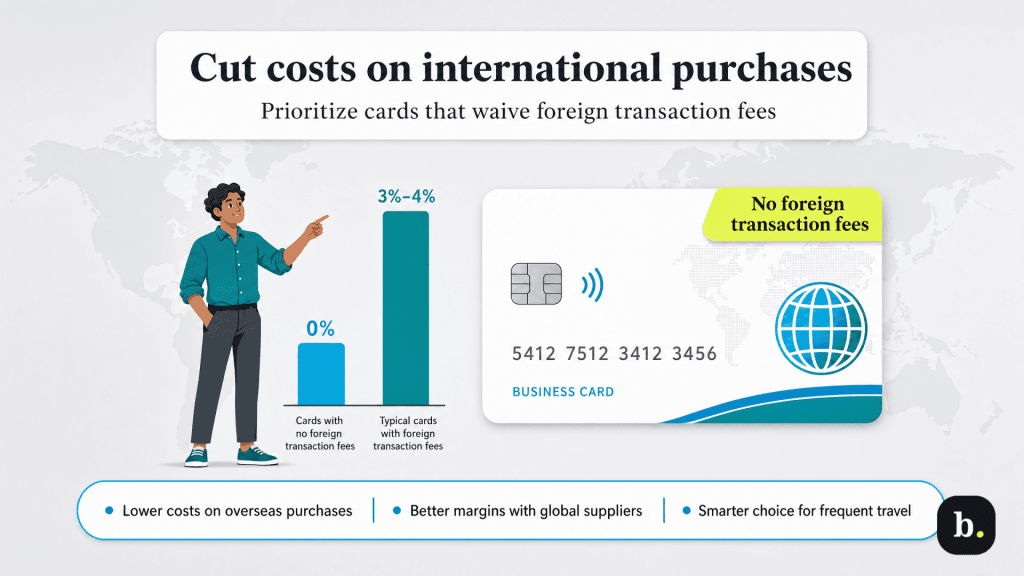
Foreign transaction fees can increase the cost of purchases made outside the United States. You may have heard about these types of fees in the context of international travel, but businesses can also encounter them when paying overseas vendors or making purchases that are processed through foreign banks.
Most cards charge a foreign transaction fee of about 3 percent, although some charge closer to 4 percent. That may not sound like much, but the costs can add up quickly for businesses that regularly make international purchases.
If your business travels abroad, works with international suppliers, is pursuing global expansion or frequently makes purchases in foreign currencies, a card that waives foreign transaction fees is often worth prioritizing.
Paying even a few days late (or missing a payment entirely) can be costly. Many business credit card issuers charge a late fee, and repeated late payments may result in higher fees or additional account restrictions.
The consequences can extend beyond the fee itself. Depending on the card issuer, a late payment may trigger a penalty APR, increase borrowing costs or negatively affect your business credit history. If the issuer reports account activity to commercial credit bureaus, repeated late payments could also affect your business credit score.
Automatic payments can take some of the pressure off keeping track of due dates. Even if you like to review statements manually each month, setting up autopay for at least the minimum amount due can help ensure a busy week doesn’t lead to a late fee.
A balance transfer allows you to move debt from one credit card to another, usually to take advantage of a lower interest rate or a promotional 0 percent APR offer. Most issuers charge a balance transfer fee of about 3 percent to 5 percent of the amount transferred, and the fee is typically added to the new balance. That means transferring a $5,000 balance could cost roughly $150 to $250 upfront.
A balance transfer can be worthwhile when the interest you save exceeds the cost of the transfer fee. Before moving a balance, compare the upfront fee with the amount of interest you’d otherwise pay if the debt remained on the original card. (In some cases, business-related credit card fees may be tax-deductible, which can further reduce the effective cost of the transfer.)
It’s worth looking beyond the promotional rate. Many cards don’t offer a grace period on transferred balances, and new purchases may not get one either until the transferred balance is paid off.
Many businesses issue employee credit cards to simplify purchasing, manage travel expenses or avoid the need for employees to pay business expenses out of pocket. Depending on the card issuer, however, providing additional cards may come with an added cost.
Some business credit cards charge a per-card annual fee for employee cards. That may not seem like a big expense when you’re issuing a card to one employee. The math changes when you’re managing a larger team and paying that fee across multiple cardholders.
Other issuers — particularly some corporate card and fintech platforms — provide employee cards at no additional charge. If you expect to distribute several cards, it’s worth comparing employee card pricing alongside rewards, spending controls and other account features.
A returned payment fee can occur when a scheduled credit card payment can’t be processed. This most often happens when there isn’t enough money in the linked business bank account, but it can also result from incorrect account information or other payment issues.
In addition to the fee itself, a returned payment can create other problems. Depending on the issuer, it may affect your grace period, trigger additional account restrictions or increase scrutiny of future payments.
Keeping a cushion in the account you use for credit card payments can help reduce the risk of a returned payment, particularly if your cash flow fluctuates from week to week.
Over-limit fees are charged when a cardholder exceeds the card’s credit limit. They’re much less common than they once were because many issuers simply decline transactions that would push an account over its limit.
Most businesses will never encounter an over-limit fee, but a few issuers still charge them. If your spending tends to fluctuate, take a look at the card’s policy and consider setting up account alerts.
Looking at a single fee rarely tells you whether a card is a good value. The real question is how much the card will cost your business after accounting for the rewards, benefits and fees that apply to the way you actually use it.
When comparing cards, consider the following:
The least expensive card on paper isn’t always the least expensive card in practice. Even a card with a higher annual fee can deliver excellent value if its rewards and benefits fit with your business’s spending patterns.
Business credit card fees aren’t all created equal. Some, such as annual fees, are easy to anticipate because they’re built into the card. Others depend on how you use the account, including whether you carry a balance, take cash advances, make international purchases or miss payments.
The good news is that many of the most expensive fees are avoidable. Paying your statement balance in full, avoiding cash advances and choosing a card that matches the way your business operates can go a long way toward keeping costs down.
When comparing cards, look beyond the rewards rate and consider the full picture. A card’s value comes from the relationship between its fees, benefits and how your business actually uses it.
