Business.com aims to help business owners make informed decisions to support and grow their companies. We research and recommend products and services suitable for various business types, investing thousands of hours each year in this process.
As a business, we need to generate revenue to sustain our content. We have financial relationships with some companies we cover, earning commissions when readers purchase from our partners or share information about their needs. These relationships do not dictate our advice and recommendations. Our editorial team independently evaluates and recommends products and services based on their research and expertise. Learn more about our process and partners here.
Small businesses can offer competitive benefits packages at an affordable price, which is key for competing when it comes to attracting top talent.


Sponsored by Justworks
When a promising candidate turns down your offer in favor of a larger company, the reason is rarely the job itself. More often, it comes down to benefits, like health insurance with better coverage, a 401(k) with a match and mental health support that actually works. For small business owners, that gap can feel unaffordable, but it doesn’t have to be.
The talent competition between small and large employers is real, but the businesses winning this fight aren’t necessarily spending more — they’re just spending smarter. According to a 2024 survey by PeopleKeep, 81% of employees say a benefits package is an important factor in whether or not they accept a job offer. That means your benefits strategy is, effectively, a recruiting strategy.
This guide covers the practical steps small businesses can take to build a competitive benefits package without the budget of a Fortune 500 company.
The first mistake many small businesses make is trying to compete on perks rather than priorities. Ping-pong tables and snack bars make for great photos, but they don’t move the needle on whether someone accepts an offer or stays long-term.
The data is clear on what employees actually want. According to ADP’s 2026 Employee Benefits Survey, medical insurance ranks as the most valued benefit, followed by a 401(k) retirement savings plan. SHRM’s 2025 Employee Benefits Survey confirms this hierarchy: healthcare benefits lead, with leave and employee retirement benefits tied for second, and flexible working benefits closely behind.
Mental health benefits represent a particularly underexploited opportunity. PeopleKeep’s 2024 survey found that 80% of employees value mental health or wellness benefits, yet only about 32% of employers offer them. For small businesses, that gap is a competitive opening.
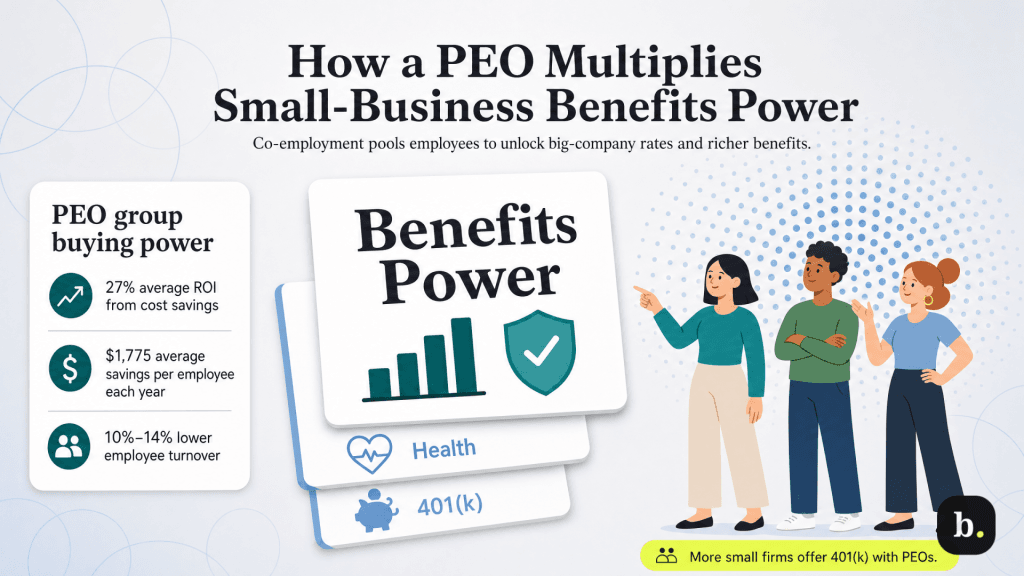
For most small businesses, the limiting factor isn’t willingness to offer good benefits, it’s cost and access. Health insurers price group plans based on the size of the group. A company with 15 employees simply cannot negotiate the same rates as one with 5,000. That’s where a professional employer organization (PEO) fundamentally changes the equation.
A PEO operates through a co-employment model: it becomes the employer of record for your workforce on paper, pooling your employees alongside those of hundreds or thousands of other small businesses. That combined headcount unlocks large-group purchasing power for health insurance, 401(k) plans, dental, vision, mental health services and more. For small businesses, this opens up the same category of benefits that enterprise companies negotiate for their workforces.
The financial case for PEOs is well-documented. According to the National Association of Professional Employer Organizations (NAPEO), businesses using a PEO see an average return on investment of 27% based on cost savings alone, with average annual savings of roughly $1,775 per employee. For small businesses with 10 to 49 employees, the retirement benefits gap is especially striking: 52% of PEO-client businesses offer a retirement plan, compared to just 23% of similar companies that don’t use a PEO.
The retention impact is equally significant. NAPEO data shows PEO clients experience 10% to 14% lower employee turnover compared to similar-sized businesses that don’t use one.
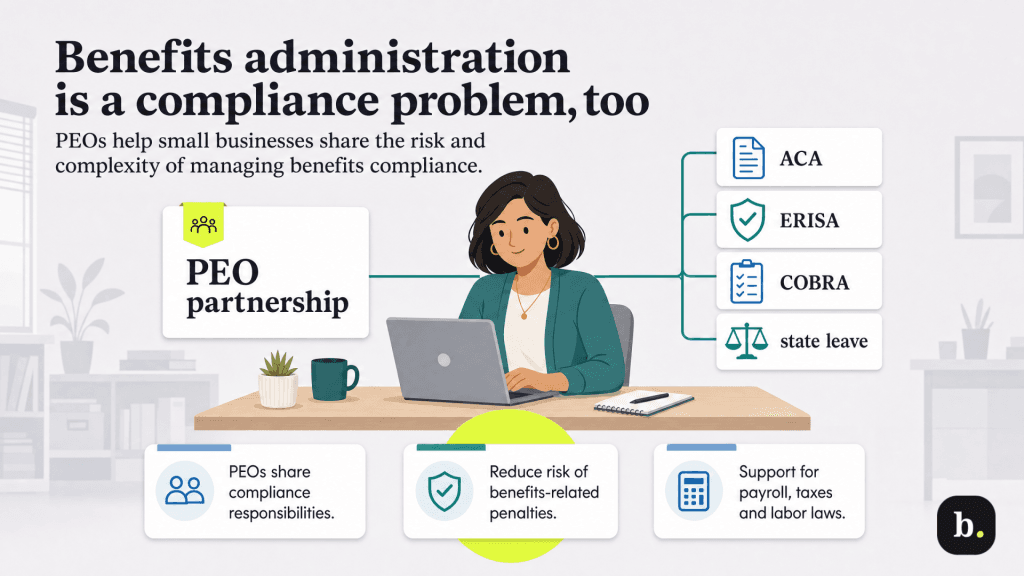
Offering competitive benefits is only half the challenge. Administering them correctly is the other half, and the consequences of getting it wrong can be severe.
Small businesses face a complex and evolving web of compliance obligations tied to benefits: the Affordable Care Act’s employer mandate, ERISA requirements for retirement plans, COBRA administration, state-mandated leave laws and shifting local employment regulations. For a business owner without a dedicated HR team, navigating this landscape while also running the business is genuinely difficult.
One underappreciated advantage of PEO partnerships is that they distribute this compliance burden. In a co-employment structure, the PEO typically handles payroll tax filing, state unemployment insurance, workers’ compensation and employment law compliance support, reducing the risk of costly errors and penalties. For small businesses that lack in-house HR expertise, that protection is part of the value proposition.
There’s a meaningful difference between administering HR and strategizing around it. As your business grows, you may reach a point where software and compliance support aren’t enough; you might also need expert guidance on compensation benchmarking, workforce planning or benefits design.
Some signals that you’ve reached that threshold:
In December 2025, Justworks launched a Dedicated HR Consulting service, pairing customers with a certified HR expert for proactive support beyond software administration. For small businesses navigating complex workforce decisions without an internal HR director, this kind of on-demand expertise can provide meaningful strategic support at a lower cost than a full-time HR hire.
It’s tempting to defer offering benefits until the business is larger or more stable. But the math on staying put is harder than it looks.
The NAPEO-average cost of PEO services is approximately $1,395 per employee per year against average savings of $1,775 per employee per year. That’s a net positive before accounting for turnover costs, which SHRM estimates can range from one-half to two times an employee’s annual salary.
There’s also the time cost. A Paychex 2025 study found that more than one in three business leaders spend over 10 hours per week on HR administration. That’s more than a full workday every week spent on tasks that don’t directly grow the business. A PEO offloads the bulk of that work, freeing owners and operators to focus on what they’re actually trying to build.
The real cost isn’t what you’ll spend on better benefits. It’s what you’re already spending on turnover, lost candidates and administrative overhead, which are costs that often go unmeasured precisely because they’re diffuse and chronic.
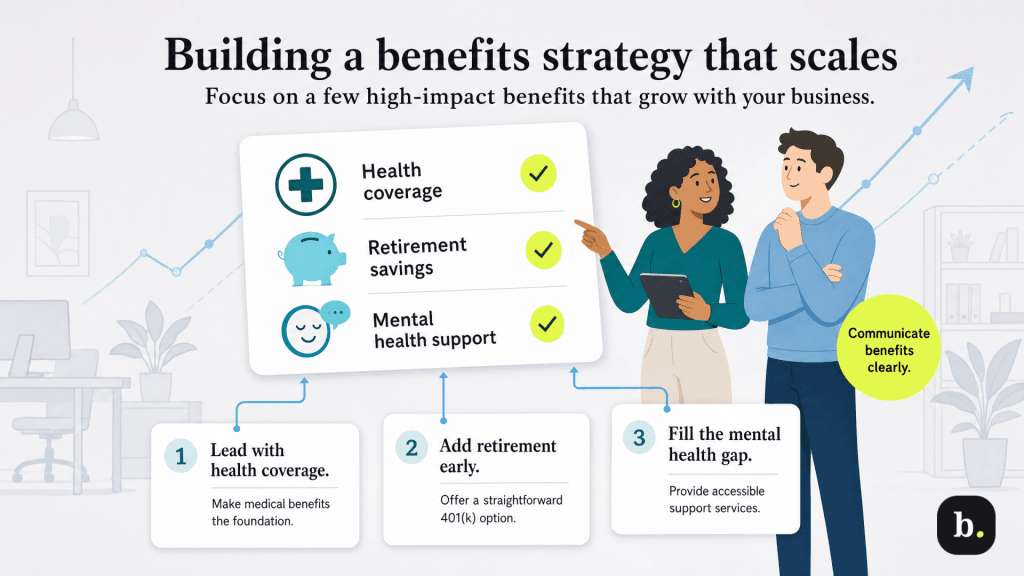
You don’t need to offer everything. You need to offer the right things, administered well, at a cost that makes sense for your business. For most small businesses, that means:
Small businesses that compete effectively for talent rarely out-spend larger competitors. They out-think them, by understanding what their people actually need and building around that. The infrastructure to do it affordably exists. The question is whether you’re using it.
Competing on benefits isn’t reserved for companies with HR departments and enterprise budgets. The PEO model was built precisely to give small businesses access to what they couldn’t otherwise afford, and the data consistently shows it works.
Start by auditing your current package against what your employees actually value. Identify the gaps. Then explore whether a PEO like Justworks could close them, not just in terms of benefits access, but in administrative efficiency, compliance support and long-term cost.
The businesses winning the talent competition aren’t bigger. They’re smarter about where they invest, and they started earlier than you might think.
