Business.com aims to help business owners make informed decisions to support and grow their companies. We research and recommend products and services suitable for various business types, investing thousands of hours each year in this process.
As a business, we need to generate revenue to sustain our content. We have financial relationships with some companies we cover, earning commissions when readers purchase from our partners or share information about their needs. These relationships do not dictate our advice and recommendations. Our editorial team independently evaluates and recommends products and services based on their research and expertise. Learn more about our process and partners here.
A sustainable business benefits your customers without jeopardizing the planet or future generations.

Many companies today prioritize building a sustainable business model that supports the environment while fostering long-term resilience and success. A green-friendly approach can reduce an organization’s environmental impact while promoting responsible resource use and helping the business stay competitive over time. This commitment can create lasting value because customers and employees want to work with companies that care about making a positive contribution to the world.
Sustainability isn’t just for large corporations. Businesses of any size can work toward a sustainable business model by following specific practices and adopting a sustainable strategy, and smaller companies often have the flexibility to adopt new, eco-friendly practices more quickly.
In a business context, sustainability refers to operating in a way that preserves natural and social resources so they are available for future operations. Sustainable development addresses the ability to meet current needs without compromising future generations’ ability to meet their own needs — a principle that closely aligns with green business practices.
To understand the full picture, it’s helpful to explore how sustainability can drive innovation, reduce risk and strengthen long-term business resilience.
According to Rex Freiberger, CEO of Superlativ Media, a sustainable business model is one that generates value for everyone involved without draining the resources that help create it.
“A business model meant to capitalize on a trend isn’t sustainable, for example, because the social resources that get it started won’t exist in years or even months,” Freiberger explained.
Lia Colabello, managing principal of Plastic Pollution Solutions, noted that there’s a difference between a sustainable business model — a business that will likely achieve profitable growth — and a business model that prioritizes sustainability.
“A sustainable business model is what every business leader hopes to achieve — a business that will turn a profit quickly and stay afloat for the long term,” Colabello explained. “A business model that prioritizes sustainability is one that, at a minimum, considers all stakeholders, assesses and addresses environmental impacts and is transparent and thorough in its reporting.”
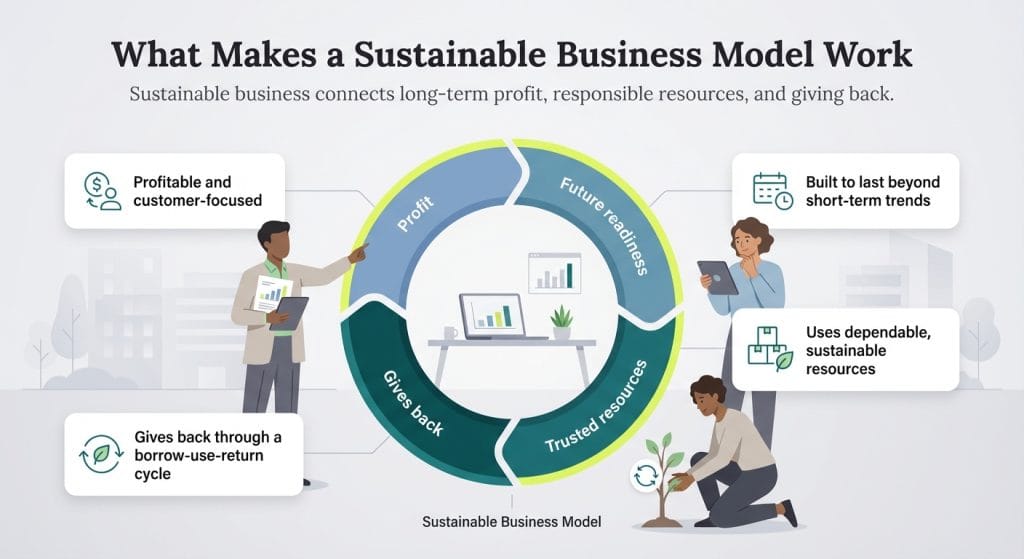
There are four key elements of a sustainable business model.
You can make a profit and be socially responsible. In fact, financial viability is a prerequisite for impact, as a business can’t effect change if it ceases to exist. What is your value proposition? Who are your target audiences? Why is your business valuable, and what niche do you fill?
A trendy business or one that relies on limited resources may be profitable for a few months, but how will it fare in a year or two? Long-term planning means thinking about supply chain disruptions and climate risks, not just current demand. Resource availability and pricing are never guaranteed or fixed; you don’t want to build your castle on a sinking rock.
You can’t have a sustainable business model without sustainable resources. Many business activities are limited by finite resources or exceptionally high prices. Meanwhile, some resources may be readily available yet environmentally harmful.
Palm oil is a famous example of a cheap and plentiful resource. However, unsustainably produced palm oil can drive deforestation and cause severe environmental destruction. Cheap resources may be tempting for business, but consider the big picture instead of taking a shortcut now.
One theory is that a truly sustainable business model is one that gives as much as it takes. This concept is called the cyclical “borrow-use-return” model.
Bob Willard, expert and author on quantifiable sustainability strategies, contrasts this model with the current “linear take-make-waste model” that so many modern businesses are built upon, which he describes as “culpable for contributing to [this world’s] unsustainability.”
Instead of taking from the Earth, a sustainable business “borrows” resources with the intent to replenish them. This concept of responsible consumption is one that both businesses and consumers can promote and practice.
A sustainable strategy takes the big picture into account. “A sustainable strategy is one that understands the flow of ‘in’ and ‘out’ — not just cash flow, but the resources, both tangible and intangible, that are required to create the product or service,” Freiberger explained.
Colabello noted that the most effective sustainability strategies start with an organization’s purpose. She encouraged businesses to ask the following questions, similar to what you’d ask when crafting a vision or mission statement:
“From there, a strategy can emerge that engages the entire brand ecosystem — internally, the supply chain, its communities and its industry,” Colabello explained. “The approach is prioritized and diagrammed out, complete with goals, KPIs [key performance indicators] and a timeline. These are communicated both internally and externally, in keeping with transparency.”
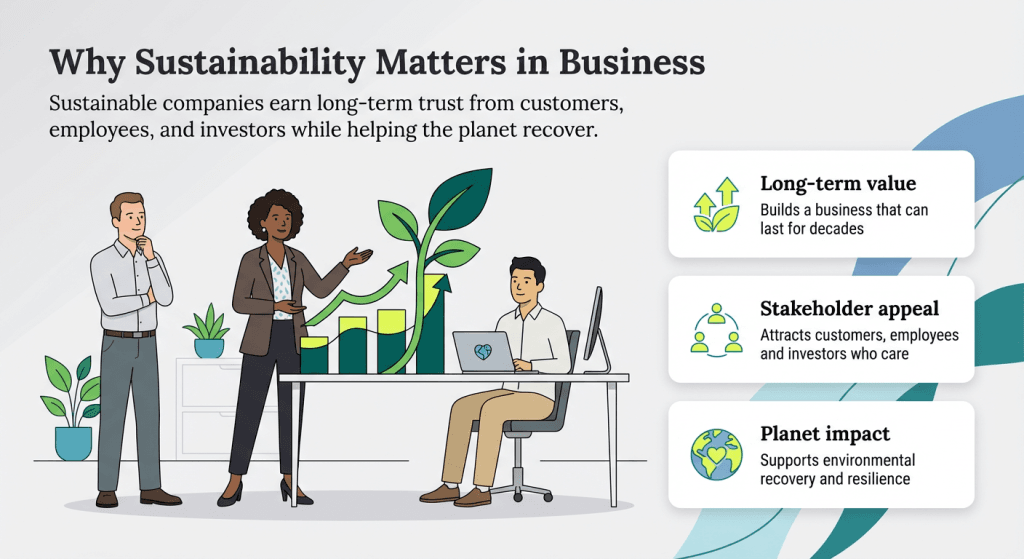
Businesses need sustainable business models for several reasons, from attracting customers to reducing long-term risk. Here’s what to consider:
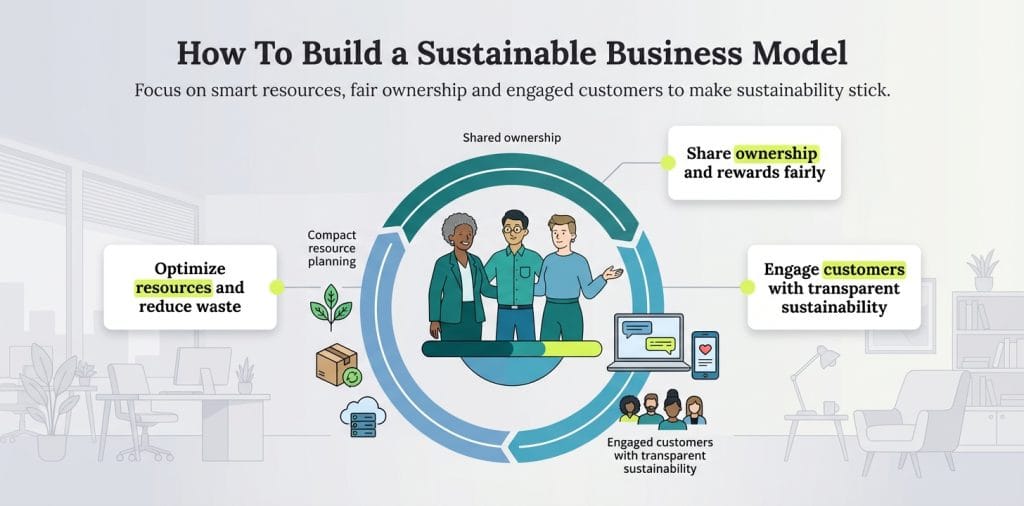
Getting started with a sustainable business model can be straightforward. Consider the following guidelines.
Consider the resources your business requires to operate and then do the following:
After you address your resource usage, outline your manufacturing and business processes. Ask yourself these questions:
The traditional top-down business model can create unreasonable wage gaps between those at the highest rungs of the ladder (CEO, other C-suite executives, founders, managers) and those at the lowest (laborers tasked with creating raw materials or carrying out the manufacturing processes). Including everyone in your sustainability goals can help you keep your business on track and give those who are typically disadvantaged a larger say.
Employee ownership or profit-sharing structures can also help align your team with your company’s long-term sustainability goals.
Going green can strengthen your company’s reputation among consumers, but your dedication to sustainability may result in higher prices. But that’s OK; in a compelling blog post, series of posts or dedicated brand story page, tell your customers why they’re paying more for your products.
You might choose to engage customers by pledging a percentage of revenue to support a charity or by offering different shipping or packaging options. Customers who love your product can be converted into brand ambassadors when you create messaging that resonates with them.
If you involve your customers in your discussions about sustainability, they will become more invested in your company’s success and your products. You could also consider crowdsourcing sustainability ideas from consumers through a forum or online group.
Building a sustainable business can feel daunting. If your business is stuck, you may struggle with one or more of these issues:
Practicing and following through with your sustainability goals helps consumers feel closer to you and instills more trust in your brand. This is crucial at a time when customers expect more warmth and honesty from companies.
Shel Horowitz, an expert on green and transformative business profitability, raised three points about why sustainability is crucial in business:
Aside from businesses’ environmental impact, Colabello noted several forces putting pressure on companies to build robust sustainability strategies:
Freiberger believes a business can become sustainable by focusing on the bare essentials it needs to survive and then growing from there. He advises making long-term projections and keeping an eye on the distant future instead of focusing on more immediate profits.
The urgency for sustainable business models is underscored by the global waste crisis:
For businesses, packaging, shipping materials and product design choices all contribute to this waste stream — and represent opportunities to cut costs while reducing environmental impact.
If you are thinking about implementing a sustainable business model, consider the short-term expenses you will incur. However, these costs are a small price to pay for a better future and a compelling brand value for increasingly eco-conscious consumers. In other words, sustainability sells.
Jamie Johnson contributed to this article. Source articles were conducted for a previous version of this article.