Emotion is the driving force in today’s buying process, and sparking the right emotions can attract new leads to your business. Customers tend to make choices based on their feelings toward a product or brand. Sales professionals must pay attention to customer mood shifts because their emotions can change throughout the purchasing process.
How do you identify customer emotions?
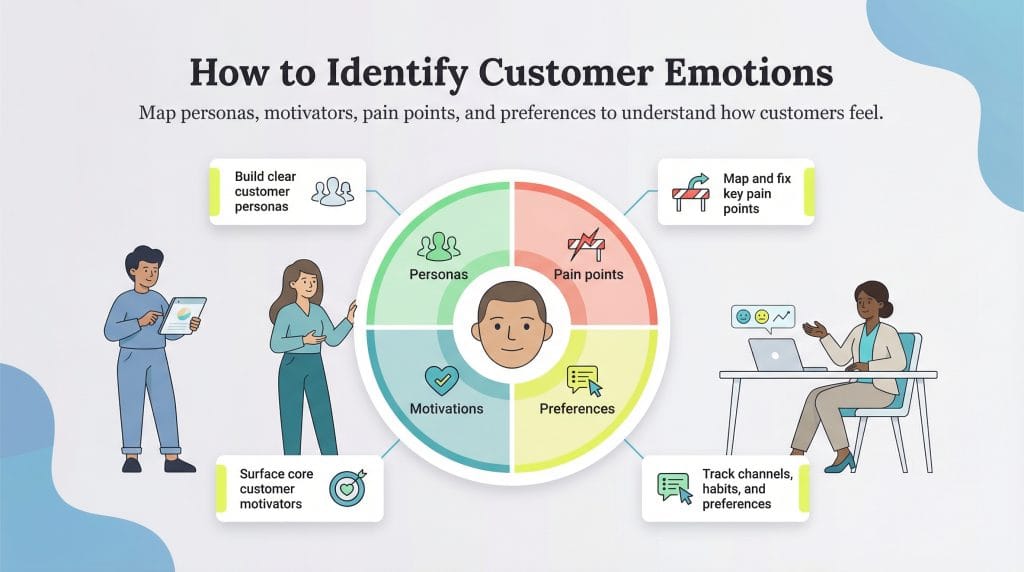
Here are the steps you’ll take to identify customer emotions:
- Develop customer personas: Identifying customer emotions starts by understanding who your customers are. Knowing your customers’ personas provides you with perspective and makes it clear what their needs and wants are.
- Know their pain points: Pain points are moments when the customer’s purchasing journey is not running smoothly. Alleviating these pain points and improving the customer experience can positively impact their feelings toward your product or service, and your brand as a whole.
- Understand their motivation: A customer’s emotions are fueled by their core motivators, which vary significantly from person to person. When someone’s motivators aren’t satisfied, they experience frustration or dissatisfaction. Four key motivators for customer happiness are function (does it work?), benefit (what value does it provide?), emotional connection (how does it make me feel?) and purpose (does it align with my values?). These can apply to both products and your business’s customer service.
- Know their preferences: You should understand a customer’s preferred communication channels, the brands they trust, their buying behaviors and what ultimately drives them to make a purchasing decision.
Understanding this information helps you identify customer emotions and develop products and services that foster positive feelings toward your brand. When analyzing why customers might be unhappy or experiencing friction, be sure you ask: “What motivators are we not satisfying?” and “How do motivators differ among customer personas?”
How do customer emotions affect sales?
Sales are fundamentally affected by customer emotions because feelings drive our decision-making processes. Here are the biggest ways customer emotions affect the sales process.
Creating customer loyalty
A positive emotional experience with your company can create loyal customers who will frequent your business, while a negative emotional experience can do the opposite. It’s important to look for areas where your customer service is lacking since one negative experience can damage your entire brand.
Word-of-mouth marketing
Naturally, making sure customers return time and again has a positive impact on your sales. Positive word of mouth generated by happy customers also drives up sales. A customer is far more likely to recommend your product to their loved ones if they’ve had a positive emotional experience with your brand or product.
Increased revenue
Marketers use positive experiences to encourage people to buy your products. This can be done by creating images and videos that stir up positive emotions. These campaigns try to make customers feel relaxed, excited, happy or appreciated. By connecting your brand with such positive emotions, customers will be drawn to your company and more inclined to buy your product.
Greater connection to your brand
Strategic campaigns help establish a distinct brand personality, which creates deeper emotional connections with customers. That connection can be fostered through special promotions — like loyalty programs — which will also positively impact your customer’s emotions, your sales and help boost your customer retention.
Every decision an individual makes is influenced by emotion, including what we buy. How we feel when we make a purchase determines whether or not we’ll make the same choice again. By ensuring customers have positive emotional experiences with your brand, sales can improve.
How can you use customer emotions in your sales strategy?
Emotions are unique to each stakeholder. Feelings may run steady or peak at various stages of the buyer’s journey for different individuals. In fact, emotions unrelated to the buy or don’t buy decision can enter the picture, too.
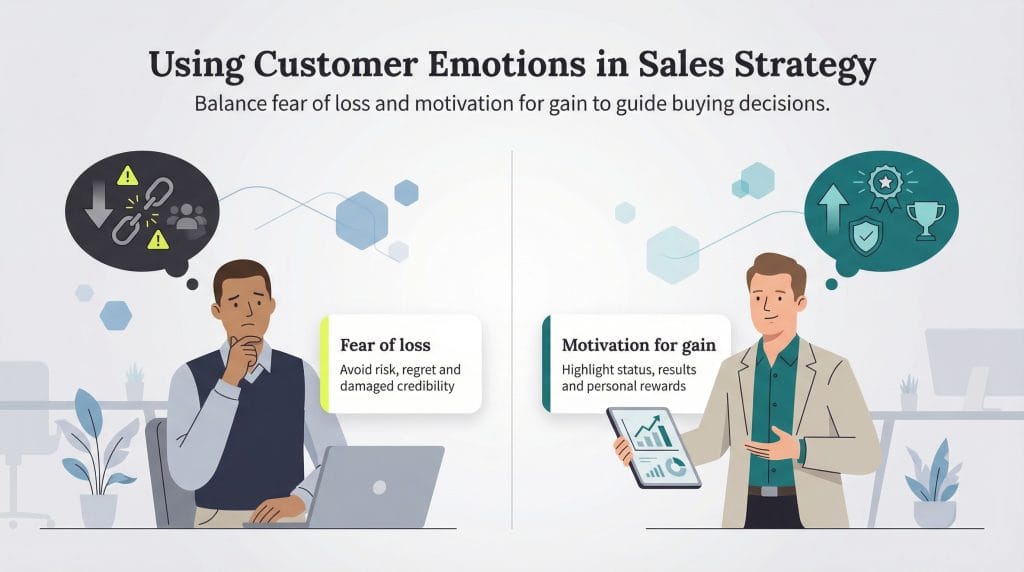
A common example of this is someone taking their frustrations out on a neutral party. This problem is even further complicated by the fact that the carryover of incidental emotions typically occurs without awareness. Sales professionals must always remember that emotions influence business decisions. Generally, these emotions fall into two categories: fear of loss or motivation for gain.
Spark a fear of loss
A poor decision carries serious implications for individuals, teams and entire organizations. People fear losing credibility, damaging relationships and potentially jeopardizing their career if a solution fails. After all, relationships and money are at stake. These factors create a burden for the decision-makers. In many cases, these emotions are strong enough to overpower the most compelling evidence for a buy decision.
In e-commerce, regret and fear of missing out (FOMO) are powerful sales drivers. When shoppers believe they are in competition with other buyers or if their desired product has limited availability, they are more likely to make a purchase. One example is Booking.com, which sends the following notifications when a customer selects a hotel:
- The most recent booking
- The number of other people viewing the hotel
These messages let the customers know about the hotel’s popularity and imply they should make the booking before other customers do. They add to this urgency by notifying customers of dwindling availability and sidebar ads promoting their recently viewed hotels.
Hotels.com employs similar tactics, notifying users when other customers viewed the same hotel in the last hour and displaying real-time booking statistics from the previous 24 hours.
Provide motivation for gain
A successful solution delivers tangible benefits such as recognition, financial gain or competitive advantage. Just as a fear of loss can deter momentum, the motivation for gain pulls a customer through the buying process. This resolve is what encourages the buyer to explore solutions.
Some of the motivators for gain are: enhancing status, making a dream come true, making amends, being defiant, feeling good or safe, forgetting their problems, making a statement and rewarding themselves. Working to provide these motivators will satisfy your customer because it fulfills the need fueling their motivation.
Here are some examples of a purchase motivated by gain:
- Buying business clothes for a job interview
- Buying designer sunglasses and eating in fancy restaurants to improve their status
- Buying an expensive sketchbook and some paint to become an artist
- Buying comfort foods because it makes a person feel better after a breakup
- Buying a high-tech security system for a home to feel safe
Customer emotions that affect their
purchasing habits are generally classified into two categories: fear of loss or motivation for gain.
How to identify the customer emotions that influence buying
Sales professionals must identify the emotions that influence the customer’s decision to either buy or walk away. Let’s look at three key buying factors, and how customer emotions affect each stage:
- Reason for change: Before a customer can confidently buy, they need to ensure they have a strong business case to support that decision. The customer’s case for change is not complete until they have evaluated all of their options and assessed value versus risk. Any big investment must help customers achieve their strategic business goals and objectives. The case for change revolves around a targeted issue — a problem or opportunity that is severe enough to warrant a change. The sales professional must help the customer compare their options, identify the best solution and evaluate value against risk. A common trap is to assume that the customer has already sold themselves internally on the reason for change. Fear of change is ever-present and the closer the customer gets to the purchase, the more their fear rises.
- Stakeholder dynamics: Buyers must get their own stakeholders on board. Questions the customer considers include: Who on my team can help me take this forward? Who do I need to align on my team? Who might be against this? Sales professionals need to identify those who will champion change and the power structure in which they operate. They must understand the differing needs among stakeholders and how to align each person.
- Decision process: Timelines and competing priorities pull stakeholders in different directions. Projects stall because new stakeholders emerge, requirements change and projects get reprioritized. Effective sales professionals manage this process. At the same time, a CFO and a procurement specialist will strongly influence the decision makers.
How customer emotions impact cognitive biases
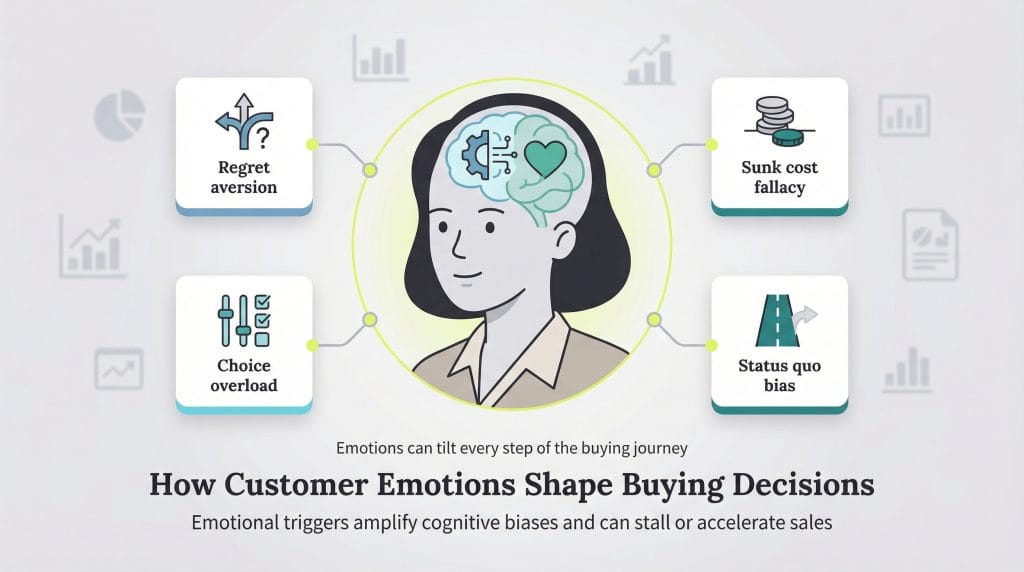
A customer’s emotions significantly affect their cognitive biases throughout the buying process, shaping how they perceive your product and process competing information. Here are some common examples:
- Regret aversion: Regret aversion is the expectation of regret. That is, the customer is anticipating regret, not actually experiencing regret. This expectation becomes another piece of information used to make the decision. In this respect, regret aversion might have equal weight to other information like ROI or price.
- Sunk cost fallacy: The customer seeks a solution because something in their business needs to change. However, the old way of doing things represents costs already incurred or sunk costs. The sunk cost fallacy is the urge to stay the course simply because the money has been spent, and changing plans leaves the results of those investments unrealized. Sales professionals must be prepared to help customers overcome this powerful bias.
- Choice overload: Simplicity drives sales success. When customers face too many options, decision paralysis often results. The sales professional’s language, written communication and visuals should be simplified for this reason.
- Status quo bias: Over time, organizations become deeply entrenched in current processes and systems. Disrupting the status quo triggers anxiety and resistance, even when change offers clear benefits. The status quo represents one of the most formidable obstacles sales professionals face. When sales professionals understand the power of the status quo, they can prepare to leverage every asset and capability they must to move the customer forward.
Purchasing decisions are affected by buying factors and biases, which are all important to understand.
In business, we often hesitate to acknowledge the crucial role emotions play in our purchasing decisions. We prefer viewing ourselves as purely rational decision-makers, wanting our choices to result from objective analysis rather than emotional influences. Rather than ignore the emotional factors, sales professionals can empower themselves by exploring the emotions at play on the customer’s side of the table. [Read related: Business Decision-Making: Gut Instinct or Hard Data?]
To do so, they must first understand if fear of loss or motivation for gain drives the business decision. Second, they must uncover how the three primary buying factors influence the buyer’s journey. Finally, sales professionals need to explore cognitive biases at work. As Benjamin Franklin famously wrote, “If you would persuade, appeal to interest and not to reason.”
Jamie Johnson and Andrea Grodnizky contributed to the reporting and writing in this article.