Business.com aims to help business owners make informed decisions to support and grow their companies. We research and recommend products and services suitable for various business types, investing thousands of hours each year in this process.
As a business, we need to generate revenue to sustain our content. We have financial relationships with some companies we cover, earning commissions when readers purchase from our partners or share information about their needs. These relationships do not dictate our advice and recommendations. Our editorial team independently evaluates and recommends products and services based on their research and expertise. Learn more about our process and partners here.
You never know when a disaster might hit your business, but having a plan in place can help you get through it.


Running a small business is hard enough without having to rebuild after a disaster. Many businesses don’t prepare properly and end up paying for it later. However, putting together a disaster recovery plan for your small business is more manageable than it sounds. We scoured the web and interviewed cybersecurity and risk management experts to bring you the best tips and resources so you can finally check “disaster plan” off your to-do list.
A disaster recovery plan outlines how your business will respond to unexpected disruptions, including natural disasters, damaging cyberattacks and supply chain breakdowns, so you can keep operating or recover quickly.
In practice, a strong plan goes beyond documentation. It’s something you actively test and refine over time. Frank Russo, managing director of Imperium Consulting Group, shared an example of a large consumer goods retailer that treats disaster preparedness as an ongoing process. After major disasters (even ones that don’t affect their business), teams meet to walk through what they would have done if the event had impacted one of their locations.
Russo described this as a “catastrophe gaming process,” where employees work through real-world scenarios to uncover gaps, like a door that can’t be locked because the facilities manager is out.
That kind of preparation can make a measurable difference. When Hurricane Ike hit Houston in 2008, the company recovered quickly and even saw higher-than-normal sales because it was one of the only businesses open.
A solid disaster plan can mean fewer days out of business, clearer communication with customers and a smoother insurance claims process if something goes wrong. In some cases, it’s what helps a small business recover while others don’t.
We know your to-do list is already packed. The good news is that building a disaster plan doesn’t have to be overwhelming, especially with the number of practical resources now available. As Russo put it, “Even a basic plan is better than no plan.”
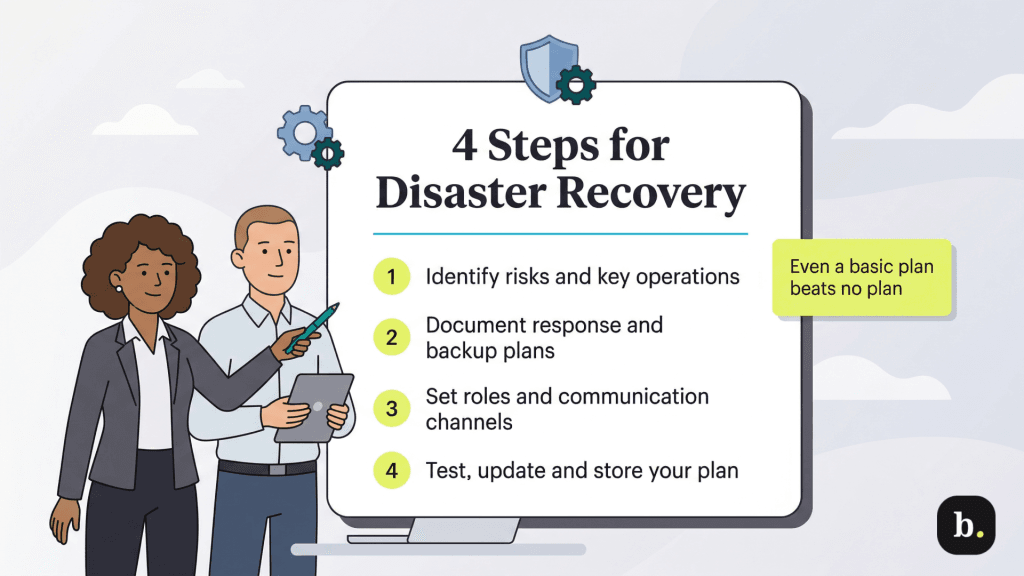
Here are four steps to help you put a plan in place.
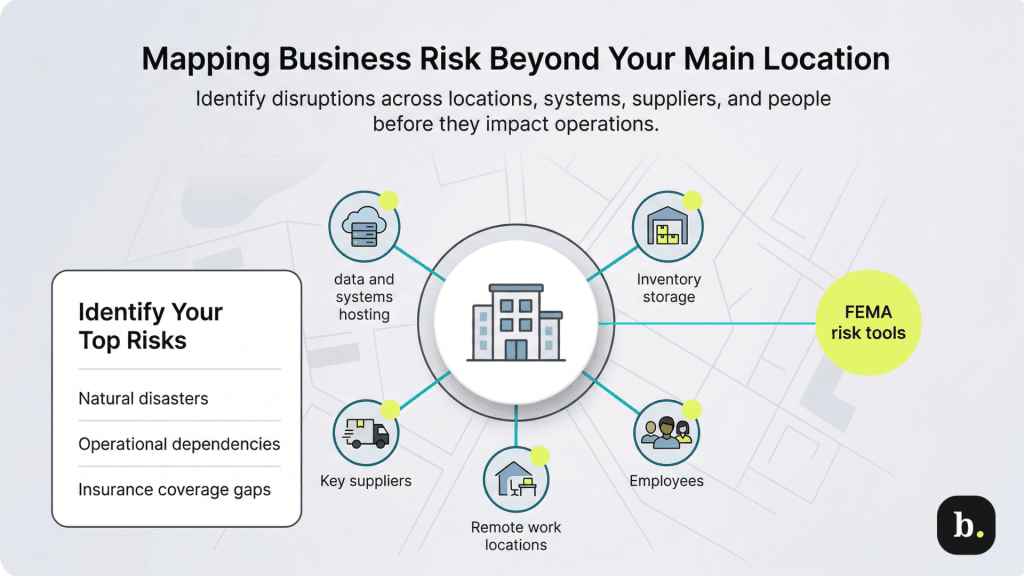
Start by identifying which types of disruptions could realistically affect your business. Depending on your location and operations, that might include:
If you operate from a single location, this part is fairly straightforward. But risk isn’t limited to your storefront or office. Think through the full footprint of your business, including the following:
This is where many plans fall short: They focus only on the main location and overlook the dependencies that actually keep the business running.
To map this out more systematically, you can use a risk assessment tool from FEMA, which walks you through identifying vulnerabilities across your operations.
Once you understand your risks, the next step is turning those insights into a plan. Here are the core elements to address:
If you’re unsure where to prioritize, your insurance broker or provider can be a helpful resource. They’ve seen how different types of disruptions play out and can often point out gaps you might miss.
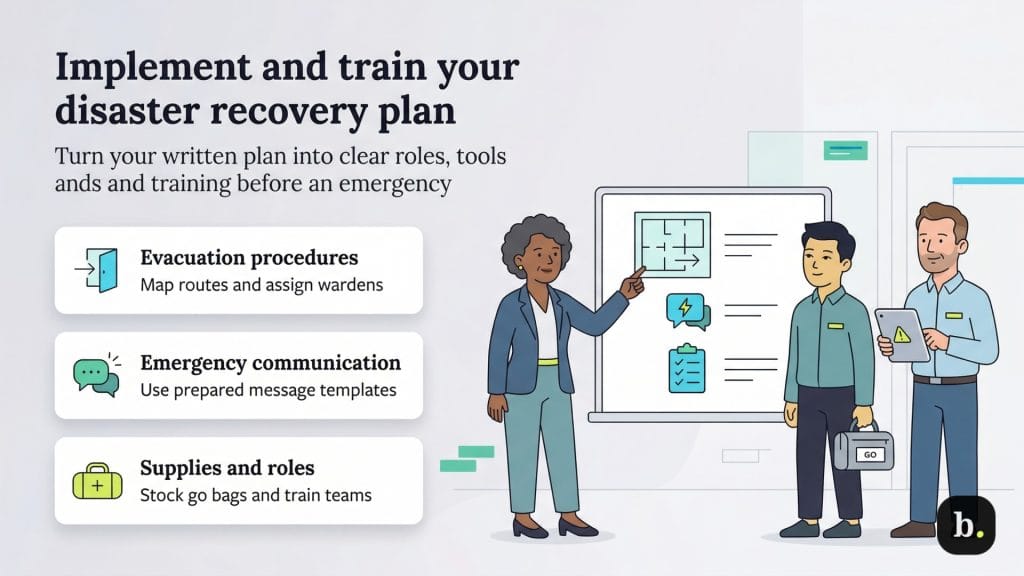
Once your plan is in place, the real work begins. A disaster recovery plan only works if people know what to do (and have the tools to do it) before something goes wrong. When putting your plan into action, focus on a few key areas:
Your business doesn’t operate in a vacuum. In a disaster, your recovery is often tied to how prepared your surrounding community is, from neighboring businesses to local infrastructure and services.
That’s why it can help to take a more proactive role. Sharing your disaster preparedness efforts and encouraging others to plan ahead can strengthen your local business environment and speed up recovery for everyone.
Becoming a disaster preparedness voice in your community can also have practical benefits for your business, including the following:
If you choose to share your plan publicly, focus on clear, helpful information that others can learn from. The goal isn’t to promote your business — it’s to contribute to a more resilient community that benefits everyone.
Once you’ve outlined your plan, the following online resources can help you build it out, pressure-test it and fill in any gaps.
If a storm or disruption is on the horizon, the following quick, actionable checklists from the Small Business Administration and Agility Recovery can help you prepare in the days leading up to an event. They’re practical, easy to follow and available as printable PDFs.
If you’re starting from scratch or want a more structured approach, FEMA’s Ready Business toolkits are a strong foundation. These guides walk through planning across six key areas — staff, surroundings, space, systems, structure and service — and can be adapted to different types of businesses.
FEMA also provides additional planning tools through its Ready Business program to help you refine your disaster recovery plan and spot gaps you may have missed. These resources cover areas like:
The following resources can help you refine your plan, assess risks and make sure you’re covering the right areas.
Seeing how disaster planning plays out in real situations can make it easier to understand what actually matters and what’s worth prioritizing. Here’s a real-world example of a small business that prepared and improvised:
Bennett’s Market & Deli, a neighborhood grocery in Atlanta’s Grant Park, had operated for five years without a single power outage. But when Hurricane Irma approached in September 2017, owners Victoria Bennett and Claire Pearson put their disaster plan into action.
They bought a generator and stocked up on ice, collected coolers from neighbors and moved backroom inventory off the floor to protect it from flooding. They also sent staff home, choosing to run the store themselves rather than risk employee safety.
When the power went out, they had to improvise. Without credit card processors, cash registers or lighting, they continued selling items like beer, wine, bread and snacks using a cash bag and handwritten receipts.
“I think the neighborhood really appreciated that we were open,” Pearson said.
Russo, who advises Fortune 100 companies on disaster planning, shared what he tells small business owners who aren’t sure where to start.
“At a minimum, have an inventory of what your assets are and make sure it’s up to date,” Russo advised — something most businesses can complete in less than an hour.
From there, the focus should be on building a plan you can revisit and refine over time.
“Have an updated planning review session once per year,” Russo recommended. “Ideally, every quarter.”
The goal is to make disaster preparedness part of how your business operates, not something you think about only when a storm is on the way. A strong plan doesn’t just help you survive a disruption; it puts you in a better position to recover and move forward.
Sammi Caramela contributed to this article. Source interviews were conducted for a previous version of this article.
