Business.com aims to help business owners make informed decisions to support and grow their companies. We research and recommend products and services suitable for various business types, investing thousands of hours each year in this process.
As a business, we need to generate revenue to sustain our content. We have financial relationships with some companies we cover, earning commissions when readers purchase from our partners or share information about their needs. These relationships do not dictate our advice and recommendations. Our editorial team independently evaluates and recommends products and services based on their research and expertise. Learn more about our process and partners here.
How you choose to accept payments matters to your customers and also your bottom line. This guide will help you decide whether you should accept cards, ACH transfers or both.


This article is sponsored by Intuit.
A customer buying lunch wants to tap a card and get back to work. A business client paying a $5,000 invoice may be comfortable authorizing a payment from their bank account. Both customers want a straightforward way to pay, but the options that work best for them carry different costs for your business.
Choosing how to accept payments starts with understanding those differences. Credit cards and Automated Clearing House (ACH) bank payments each have advantages, and offering both can make sense when you serve different customers or handle different transaction sizes. Compare the processing fees, the time until funds are available and the steps customers must take before deciding what to offer.
Card payments use a card network to process purchases made with credit or debit cards. Customers can pay in person, enter card information online or use a supported digital wallet. A credit card lets the customer draw on available credit; a debit card generally draws on funds in a bank account. Your provider’s pricing determines what you pay to process either type.
ACH payments move money between bank accounts through the ACH network. As Nacha, which administers the network’s rules, explains, ACH supports both credits that push money to an account and debits that pull money from an account. When a customer authorizes an ACH payment through an invoice, the collection typically involves a debit from that customer’s account.
The phrase bank transfer is broader than ACH. Wire transfers and other bank payment services can have different fees, timing and procedures. Confirm which type your provider supports when evaluating ACH payment options.
Factor | Card payments | ACH payments |
|---|---|---|
Customer experience | Convenient for in-person and online purchases | Requires bank payment details or a supported bank connection |
Processing costs | Depend on payment channel and provider terms | Often lower than card fees, but pricing varies |
Access to funds | Follows the provider’s deposit schedule | Follows the provider’s ACH funding schedule |
Recurring collection | Available through supported billing tools | Available through supported billing tools |
Payment problems | Declines, expired cards and disputes | Returns, insufficient funds and authorization disputes |
The difference between card and ACH fees can become meaningful as invoice amounts increase. However, neither method has a universal price. Providers may charge a percentage, a fixed amount per transaction or a combination, with additional terms that affect the total.
Start with your usual purchase or invoice amount. Then calculate the cost of collecting that payment under each available method. When comparing the best credit card processors, check their bank payment options, too. Review any minimum charge, fee cap and additional charges rather than assuming that an ACH payment will cost only a few cents.
For example, Intuit publishes standard QuickBooks Payments rates of 2.99% for invoiced card and digital wallet payments and 1% for invoiced ACH bank payments. Under those rates, the base processing charges would be:
Invoice amount | Card fee at 2.99% | ACH fee at 1% | Difference |
|---|---|---|---|
$100 | $2.99 | $1 | $1.99 |
$1,000 | $29.90 | $10 | $19.90 |
$5,000 | $149.50 | $50 | $99.50 |
These examples illustrate why payment size matters: The percentage difference stays the same, but the dollar difference grows with the invoice.
For in-person sales, use the applicable in-person card rate in your comparison. Comparing an online invoice rate with a bank payment rate won’t necessarily describe what it costs to take a card at your counter.
Processing fees are one expense in the collection process. Staff time spent explaining payment steps, following up on invoices or matching deposits also affects the economics of your choice.
Suppose a customer is ready to pay a $100 invoice by card. Under the rates above, switching that payment to ACH would save $1.99 in base fees. Consider whether the savings justify any extra effort for your customer and team. On a $5,000 invoice, the $99.50 difference may give you more reason to explain the bank payment option.
Use your own customer behavior to assess the tradeoff. A cheaper method is more useful when customers are willing and able to use it.
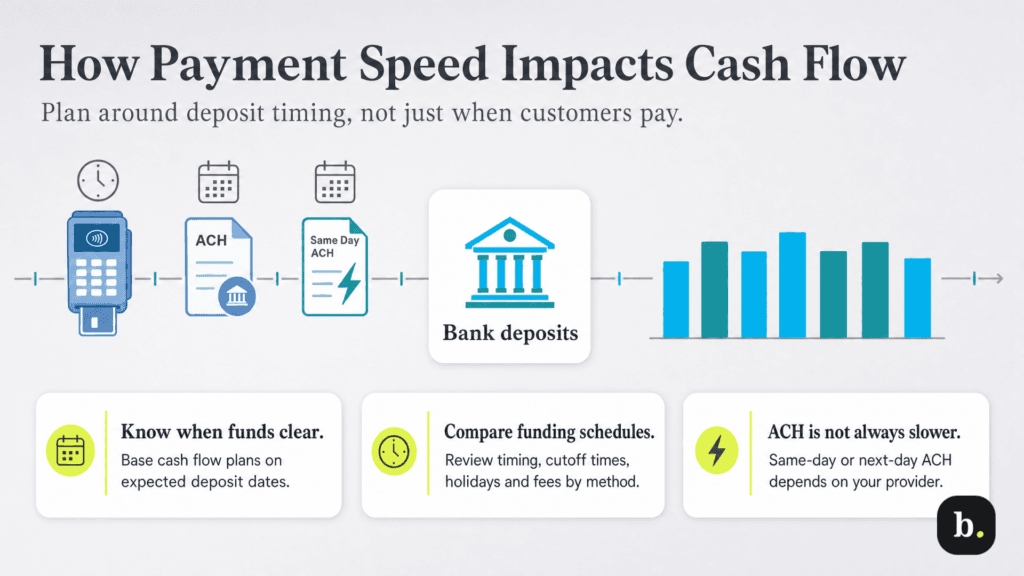
Payment speed has two parts: how soon the customer initiates payment and how soon the resulting funds become available to your business. A convenient payment option can help with the first, while your provider’s funding schedule determines much of the second.
A successful card authorization indicates that the issuer approved the transaction. It doesn’t mean the money is already available in your business bank account. Likewise, an ACH payment confirmation doesn’t eliminate the possibility of a later return.
For cash flow planning, work from expected deposit dates rather than assuming that every payment submitted today can cover tomorrow’s expenses.
Ask when funds from each payment method become available, what cutoff times apply and whether new accounts have longer initial funding periods. Also check how holidays, account reviews and faster-deposit services affect timing and cost.
Avoid assuming that ACH always means a longer wait. Intuit’s deposit guidance says most card and ACH payments are deposited the next day under its next-day deposit schedule. Cutoff times and account conditions apply, and new accounts can experience longer initial deposit times. Check the schedule that applies to your account before promising availability.
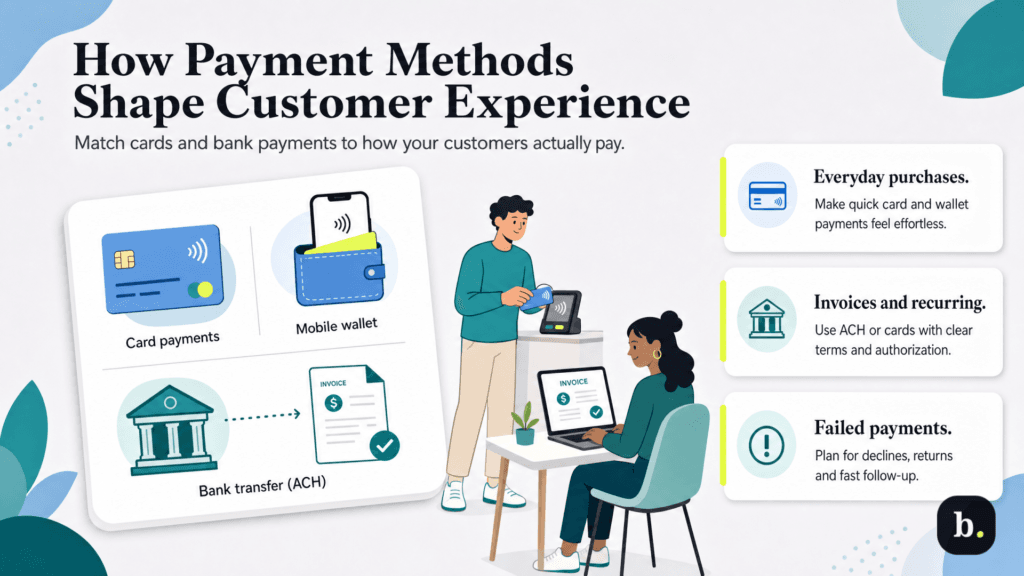
Consider what your customer is doing when they pay. Someone at a checkout counter has different expectations from an accounts payable employee reviewing an invoice. Your payment process should fit that situation.
Cards are a practical option for quick purchases, online checkout and customers buying from you for the first time. A shopper who can tap a card or use a familiar wallet may have little reason to set up a bank payment for a small purchase.
Some customers also prefer credit cards because they want to use available credit or earn rewards. Others favor debit cards or direct bank payments. Ask customers what they use, and avoid building your payment policy around an assumed preference.
ACH can suit larger invoices and established customer relationships, particularly when the payer already handles business expenses through bank payments. Provide a secure payment link, a clear due date and instructions that explain what the customer is authorizing.
For repeat services, both cards and ACH can support recurring collection when your provider offers the appropriate tools. Confirm which methods the specific recurring billing feature supports. Explain the amount or calculation, the schedule and how the customer can change or cancel the arrangement, and obtain the required authorization before collecting payments.
Customer setup is part of the choice. Bank payments may require account details or bank verification, while recurring card payments can fail when a card expires or is replaced. Plan how you will handle either situation.
Cards can be declined or disputed, and a chargeback can create costs beyond the original processing fee. ACH payments can be returned for insufficient funds, incorrect account information or authorization issues. Neither method makes collection risk disappear.
Check your provider’s procedures for notifying you of problems and resolving them. Keep payment authorizations and records of the goods or services delivered, and make sure someone on your team is responsible for following up when a payment fails.
Use transaction size and customer needs together. Large payments create a stronger reason to examine fee savings, but a customer’s payment requirements can still make card acceptance valuable. Small purchases may favor a quick card checkout, while regular invoiced payments may suit ACH.
This framework can help you choose an initial approach:
| Business situation | Approach to consider | Main reason |
|---|---|---|
| Frequent small purchases or walk-in customers | Prioritize card acceptance | Keep checkout convenient |
| Large invoices for established business clients | Offer ACH and explain the process | Evaluate meaningful fee savings |
| Recurring services | Offer supported recurring card or ACH collection | Match customer preferences and billing needs |
| Retail sales plus invoiced work | Offer both through appropriate channels | Support different purchasing situations |
| Customers with specific payment requirements | Assess those requirements before restricting options | Preserve a workable collection process |
There is no universal invoice threshold at which you should require ACH. Calculate the fee difference, ask about customer preferences and consider the effect on collection timing. If you want to encourage bank payments, start by making the option easy to find and understand.
Offering both methods is easier to manage when they share an invoice workflow. QuickBooks Payments supports customer card and ACH payments, including online payment options for QuickBooks Online invoices.
Intuit’s invoice payment documentation explains that businesses can select payment methods in their account settings and change the available options on an individual invoice. Customers then use the invoice link to pay through an enabled method. QuickBooks Payments is subject to eligibility criteria, credit and application approval.
Consider a hypothetical maintenance company that bills both homeowners and commercial clients. It could enable card and ACH options on its online invoices, letting customers choose an available method while collecting through the same system. The owner can evaluate the fees and payment timing for each group before deciding whether to encourage ACH for larger jobs.
The workflow also connects collection with bookkeeping. In QuickBooks Online, businesses can designate accounts for deposits and processing fees, then match deposits in a connected bank feed. A consistent bank reconciliation process helps confirm that payments and fees are recorded correctly.
After offering your chosen methods, track how customers actually use them. Review payment volume and fees by method, the time between invoicing and customer payment, and the time from payment submission to deposit. Also track failures and the follow-up work they create.
Revisit the mix as your business changes. Larger invoices may make ACH savings more valuable, while more retail sales may increase the importance of convenient card acceptance. Customer feedback can help explain why an option is widely used or frequently avoided.
Choose payment methods that customers can use comfortably and your business can manage predictably. Offering cards, ACH or both should help you collect what you’re owed while keeping fees, funding timing and administrative work in view.
