Business.com aims to help business owners make informed decisions to support and grow their companies. We research and recommend products and services suitable for various business types, investing thousands of hours each year in this process.
As a business, we need to generate revenue to sustain our content. We have financial relationships with some companies we cover, earning commissions when readers purchase from our partners or share information about their needs. These relationships do not dictate our advice and recommendations. Our editorial team independently evaluates and recommends products and services based on their research and expertise. Learn more about our process and partners here.
The buzzwords might be changing, but delivering a positive experience is always important to retain customers.


On the face of it, using “customer delight” instead of “customer satisfaction” to describe the new standard in customer service might seem like the latest fad or buzzword. However, understanding the distinction between these two phrases can be the difference between delivering a positive experience to a one-time patron and creating — and retaining — a lifelong customer.
Searching for CRM software and not sure where to start? Tell us a little more about your business and get customized quotes from qualified providers.
Customer delight goes a step beyond customer satisfaction. Instead of simply meeting customers’ expectations, you find ways to exceed them and give people a reason to keep coming back. That kind of experience can strengthen customer loyalty, encourage repeat business and help you build lasting customer relationships.
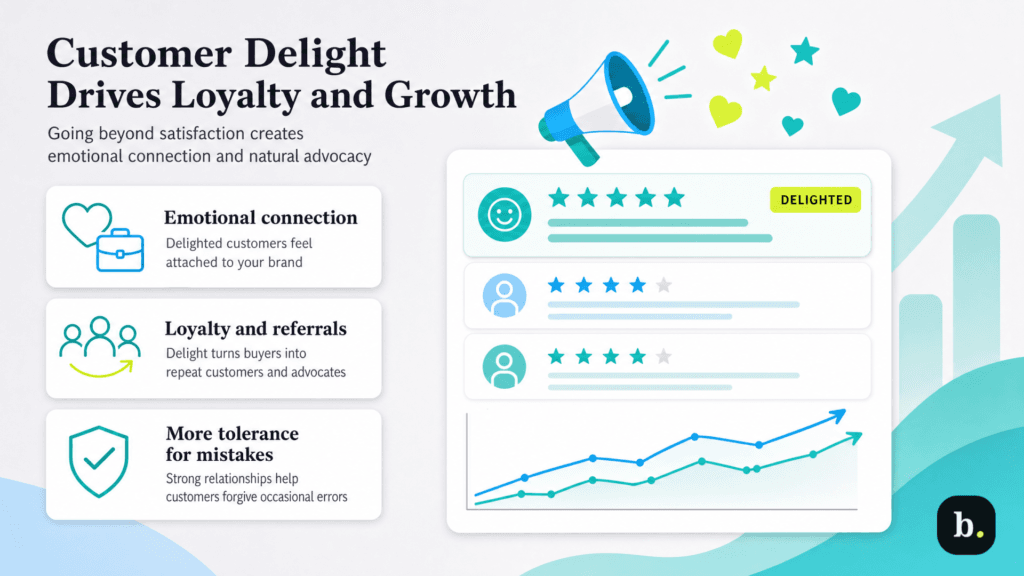
Customer delight is the practice of exceeding customers’ expectations to create an especially positive and memorable experience. Customers want to feel valued throughout the entire journey, not just at the point of sale. One of the most effective ways to delight them is by finding thoughtful, unprompted ways to go above and beyond what they anticipated.
“Customers who are happy and satisfied with your products or services will likely become loyal customers, but customers who are delighted will sing your praises,” said Rohan Nayak, CEO and co-founder of audio series platform Pocket FM. “They post about it, which results in natural expansion as people recommend the company on their own.”
Creating these kinds of experiences can help reduce customer churn while encouraging repeat business and customer referrals. Importantly, according to Nayak, delighted customers become more emotionally connected to your business. That connection can make them more forgiving when something goes wrong and more willing to try new products or services from your company.
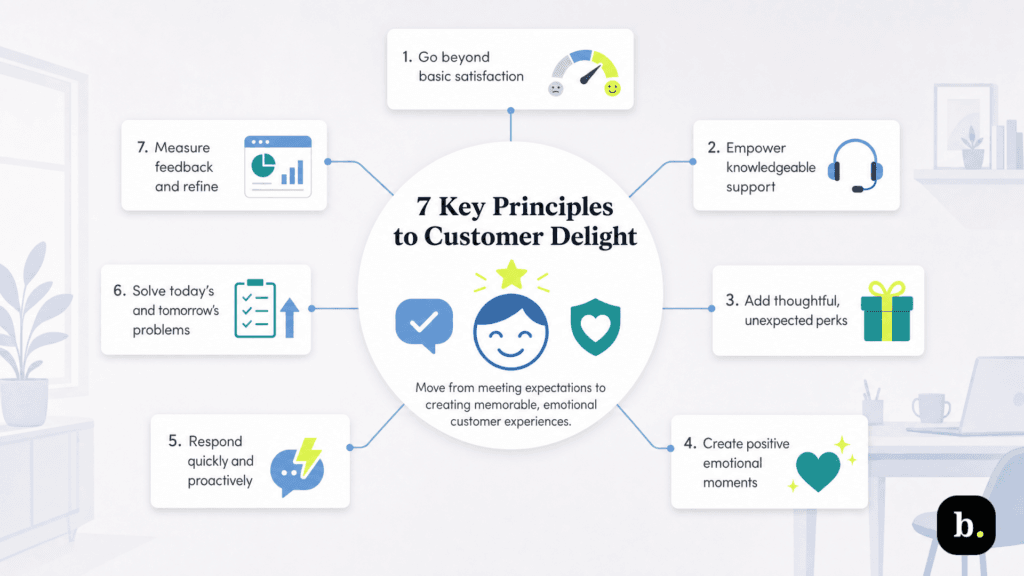
Customer delight doesn’t happen by accident. These seven principles can help you consistently exceed customers’ expectations and give them a reason to keep coming back.
You satisfy your customers when you give them what they expect. You delight them when you give them something even better than they expected.
A classic example is an auto repair shop that washes your car after fixing it. You expect to pick up a car that runs better, but finding it clean too is an unexpected extra. Most people don’t leave an auto repair shop with a smile on their face, but a small gesture can change that.
“Satisfaction is a rational evaluation (‘They did what they promised’), while delight creates an emotional connection (‘Wow, I can’t believe they did that!’),” explained Dev Nag, founder and CEO of customer support AI startup QueryPal.
You can also delight customers when something goes wrong. Say a customer receives a defective product. Replacing it quickly and covering the return shipping takes care of the problem, but offering a $25 credit toward a future purchase goes a step further. That small gesture could leave the customer feeling better about your business despite the initial frustration.
When customers reach out for help, they want to talk to someone who knows what they’re doing and can solve the problem without making the process more frustrating. A well-trained customer service team can answer questions confidently, find solutions quickly and give customers the kind of experience that leaves a lasting impression.
Investing in customer service training can help your team deliver on some of the things customers value most:
“Build a knowledge base of your best customer interactions, and leverage technology to instantly retrieve and personalize those winning responses for each new customer,” Nag suggested. “Look for ways to turn every customer interaction into an opportunity to exceed expectations through speed, thoroughness and personal attention — even if that attention is intelligently automated.”
It can also help to put someone in charge of keeping an eye on the overall customer experience. Teri Williams, president and chief operating officer of OneUnited Bank, recommended assigning someone to monitor whether the experience your company intends to provide is the one customers are actually getting.
Customer delight doesn’t have to involve a grand gesture. If you always pay a bill on time, for example, you probably expect to hear from the company only when a payment is late. Imagine instead receiving an unexpected thank-you email with a coupon for 10 percent off your next order. It’s a small gesture, but it’s likely to get your attention.
That’s the idea behind surprise-and-delight marketing: Give customers something they weren’t expecting without asking for anything in return. You might send a loyal customer a small gift, offer an unexpected upgrade or include a handwritten thank-you note with an order. The best surprises don’t have to cost much. They simply need to feel thoughtful and relevant to the customer.
Customers may appreciate a discount or free product, but those perks aren’t the only way to delight them. Think about how you want customers to feel when they interact with your business. A friendly conversation, an employee who remembers their name or a thoughtful response when something goes wrong can stick with them long after the transaction is over.
“Although lower prices or additional products and services can ‘wow’ customers, long-lasting customer delight comes from how [you and] your employees make customers feel,” Williams said.
Look for opportunities to create those positive feelings throughout the customer experience. You might celebrate an important milestone with a longtime customer, follow up after solving a difficult problem or simply take a little extra time to make an interaction feel personal. The goal isn’t to manufacture an emotional response. It’s to show customers that you value them as people, not just as sales.
When a customer has a question or problem, don’t leave them wondering whether anyone is listening. A quick response shows customers that you’re paying attention and that their concerns matter. In fact, Zendesk’s 2026 CX Trends report found that 88 percent of customers expect faster response times than they did just a year ago. You may not always be able to solve the problem immediately, but you can acknowledge it, explain what happens next and keep the customer updated until it’s resolved.
Make sure you’re paying attention everywhere customers might reach you. Williams recommended monitoring customer reviews on sites such as Google, Yelp, Trustpilot and the Better Business Bureau, as well as comments on social media. That can help you spot both positive feedback and problems that need your attention.
Technology can make it easier to keep up, especially as your customer base grows. The best CRM software can keep emails and other customer communications in one place, remind employees to follow up and give your team a record of previous interactions. Automation can also handle simple requests or acknowledge a message after hours, but customers should still have an easy way to reach a person when they need one.
Solving the problem in front of you is important, but customer delight comes from thinking one step ahead. Once you’ve helped a customer, consider what you can do to prevent the same issue from happening again or make things easier for them next time.
For example, if customers regularly contact you because they’re confused about how to use a product, don’t just answer the same question over and over. Create a short tutorial, FAQ or how-to video they can refer to whenever they need help. If a customer calls because a service isn’t meeting their needs, take the time to understand what they’re trying to accomplish and recommend an option that’s a better fit, even if it isn’t the most expensive one.
Pay attention to recurring questions and complaints, too. If several customers run into the same problem, that’s a good sign that the issue may be with your product, instructions or process rather than the customers themselves. Fixing the underlying problem can improve the experience for everyone and reduce the number of support requests your team has to handle.
You can’t know whether you’re delighting customers unless you ask them and then pay attention to what their behavior tells you. Survey data, interviews, reviews and focus groups can all help you understand what’s working and where the customer experience could use some attention.
Don’t rely on a single metric. Nag recommended tracking measures such as first response time, resolution time and customer satisfaction scores. Nayak’s team also looks at customer behavior, including how much time listeners spend on its platform and whether they finish an audio series. Depending on your business, you might monitor repeat purchases, retention rates, referrals or participation in your loyalty program.
It’s also important to ask for customer feedback directly. Ask about specific parts of the experience, such as product quality, communication and customer support, rather than simply asking whether they were satisfied. Open-ended questions can also uncover problems or opportunities you hadn’t considered.
Most importantly, do something with what you learn. Look for patterns in the feedback, share recurring issues with the employees who can address them and let customers know when their input leads to a change. When customers see that you’re actually listening, asking for feedback becomes part of the experience you’re trying to improve.
There’s no single formula for customer delight. The best approach depends on your customers, what they value and where you have opportunities to make their experience a little better than expected. You don’t necessarily need an elaborate loyalty program or expensive giveaway, either. Small, thoughtful gestures can be just as effective when they’re relevant to the customer.
Here are a few ways to put customer delight into practice:
Whatever approach you take, make sure it fits your customers rather than simply following what another company does.
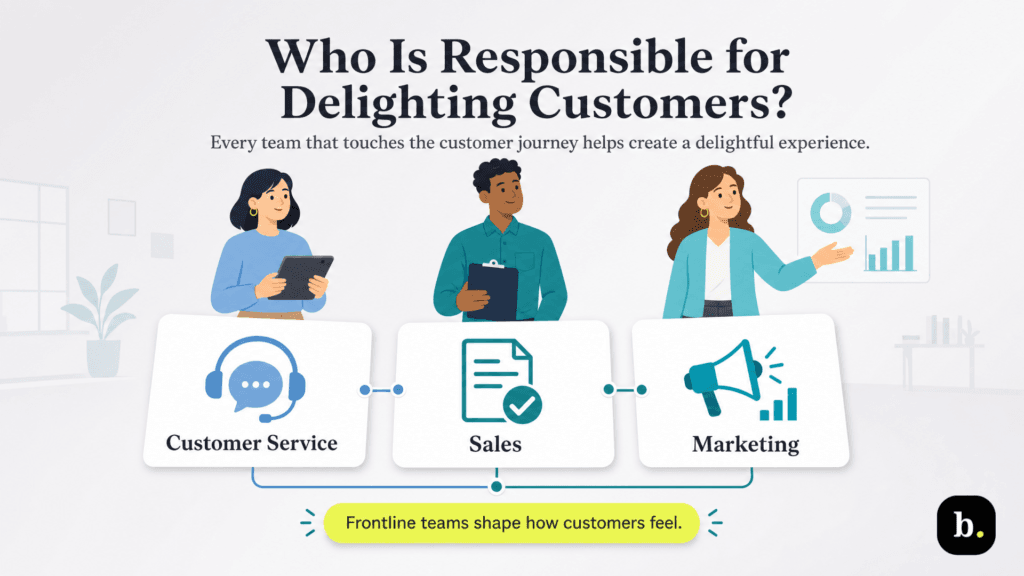
Everyone in your business plays a role in customer delight. Customer service, sales and marketing employees may have the most direct contact with customers, but the experience doesn’t begin and end with those teams. Anyone whose work affects the customer, from product development and order fulfillment to billing and management, can influence how people feel about your business.
Those interactions can have a lasting impact. According to Freshworks’ 2026 Customer Service Benchmark Report, 59.3 percent of support teams said positive support experiences increase customer trust and the likelihood of renewal. (The report analyzed data across more than 33,000 accounts and 1.2 billion support tickets.)
Employees who interact with customers regularly can be especially valuable sources of insight. They hear customers’ questions, complaints and compliments firsthand, so they often know where people are getting frustrated and what your business is doing particularly well. Encourage these employees to share what they’re hearing and give them opportunities to suggest ways to improve the customer experience.