Business.com aims to help business owners make informed decisions to support and grow their companies. We research and recommend products and services suitable for various business types, investing thousands of hours each year in this process.
As a business, we need to generate revenue to sustain our content. We have financial relationships with some companies we cover, earning commissions when readers purchase from our partners or share information about their needs. These relationships do not dictate our advice and recommendations. Our editorial team independently evaluates and recommends products and services based on their research and expertise. Learn more about our process and partners here.
Email blasts can deliver powerful messages and drive conversions quickly — if they're executed well.


Businesses have plenty of ways to reach large audiences, but email marketing remains one of the most effective. It’s a reliable, affordable and efficient way to connect with prospects at every stage of the customer journey.
Email blasts are a common content marketing tactic that can engage email subscribers and prompt action — or frustrate them if handled poorly. We’ll break down what email blasts are and show you how to send effective ones that improve your digital marketing return on investment without overwhelming your audience.
An email blast, also known as a broadcast email, bulk email or mass email, is a stand-alone message sent to all or a large portion of a contact list. The goal is to reach a broad audience with relatively little setup or effort.
Editor’s note: Looking for the right email marketing service for your business? Fill out the below questionnaire to have our vendor partners contact you about your needs.
Email blasts are typically promotional, sharing news about a sale, special offer or upcoming event. They’re designed to prompt a specific action, such as registering for an event or making a purchase. In some cases, businesses also use email blasts to share important updates that need to be communicated quickly.
Ross Soodoosingh, founder and CEO of Marketing Markets, noted that email blasts are often urgent and separate from more targeted email marketing campaigns. “Unlike traditional personalized emails that are tailored for their intended reader, email blasts are seldom personalized to the extent in which it would directly be speaking to you as an individual,” Soodoosingh explained. “Email blasts are also different from emails in an email sequence or email journey, as they’re single messages rather than a series sent over time or triggered by specific actions.”
Thomas Hassett, founder of TH Results, cautioned that email blasts should be used sparingly, since they can feel spammy when handled poorly. “Save them for your big announcements, your can’t-miss sales and your truly newsworthy updates,” Hassett advised. “If you abuse the privilege, you’ll quickly become the digital equivalent of the boy who cried wolf, and your emails will start going straight to the trash.”
Follow these six steps to plan and send email blasts that drive engagement.
A powerful, intuitive email marketing service is key to running effective email blasts. The best email marketing services simplify tasks like managing contact lists, designing emails and scheduling delivery. Many tools also support marketing automation, which can be useful for drip campaigns, personalized customer journeys and transactional emails like order confirmations or appointment reminders.
An email list gives you a direct line to potential and returning customers, making it one of the most valuable tools in your marketing toolkit. When you build an email list, you’re collecting addresses from people who actually want to hear from you. An opt-in email marketing strategy helps strengthen customer relationships and ensures your messages reach engaged prospects and customers.
Email list segmentation divides your contacts into smaller groups (segments) based on related characteristics, such as the following:
Segmenting your list helps you better understand your audience and send more relevant emails. And it can also pay off: HubSpot’s 2025 State of Marketing report found that 96 percent of marketers saw higher sales from personalized experiences, and market segmentation is one of the easiest ways to make that personalization possible at scale.
Even though email blasts are usually sent to a wide audience, segmentation can still make sense in some cases, like when you’re promoting something to a specific group of customers. It helps make your message feel more relevant without giving up the efficiency of a mass email.
Email blasts often go to most or all of your list, but thoughtful targeting can improve results. Depending on your audience, you might tweak messaging or send times for different regions or tailor content for first-time buyers versus returning customers.
Even small adjustments can make your email blasts feel more relevant without losing their wide reach.
Next, it’s time to write and design your message. Your email marketing service may influence layout and design, since many platforms offer templates tailored to different industries. For example, Omnisend focuses on email marketing tools for e-commerce businesses.
Templates can help, but the message itself matters most:
Rebecca Parson, a public relations professional in investing and insurance, noted that other elements may make sense depending on your goal. “Some things I’ve seen work well are including interactive elements like polls or surveys to engage recipients and get their feedback, incorporating user-generated content like customer photos or testimonials to boost credibility and relatability and offering a time-limited deal to encourage immediate action.”
After your message is ready, schedule it for a time when your audience is more likely to open and act on it.
Sending an email blast isn’t the final step. Reviewing how recipients interacted with your message helps you understand what worked and what didn’t. Key email analytics like click-through rate, conversions and deliverability offer useful insight into campaign performance.
Keep in mind that open rates have become less reliable due to privacy changes, such as Apple’s Mail Privacy Protection, which can inflate open numbers. Looking at clicks and conversions often provides a clearer picture. Regularly reviewing performance data helps you refine your strategy and improve future email blasts.
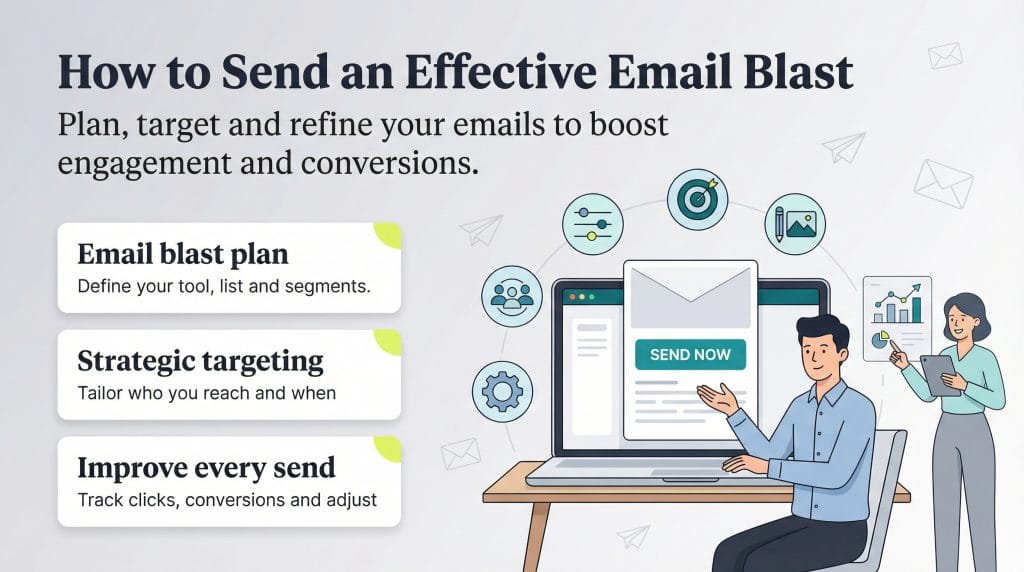
When you’re putting together an email blast, the following tips can help make the difference between a conversion and a quick unsubscribe:
Email marketing requires a bit of balance. Sending too many emails can annoy subscribers, but sending too few can make it easy to be forgotten. Finding the right balance depends on your business and how often your audience wants to hear from you.
For most companies, a good starting point is sending an email blast at least once a month but no more than once a week. That cadence helps you stay visible without overwhelming your list. From there, test different schedules and review past performance to see how often your audience actually wants to hear from you.
When it comes to timing, there’s no single best day or hour for every business. Recent data from MailerLite shows that certain patterns still tend to perform well. Friday and Monday often see higher open rates, while Friday and Tuesday frequently drive stronger click activity. Early morning sends — roughly between 8 and 11 a.m. — can help with opens, while later in the day may work better when clicks are the goal. The best approach is to test different send times and see what resonates most with your own audience.
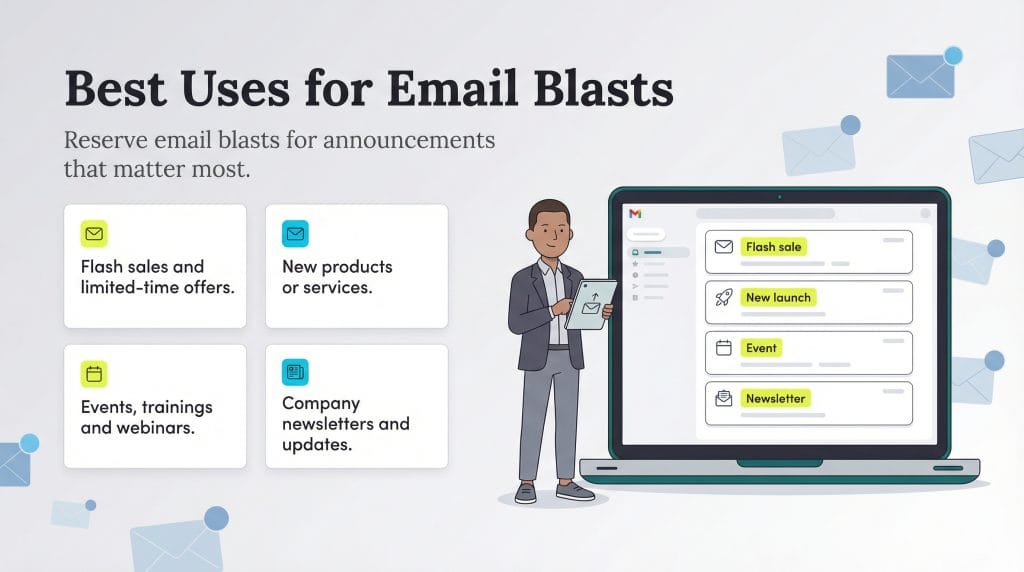
Email blasts work best when you need to share important information with a large audience quickly. Instead of using them as an everyday marketing tool, save email blasts for moments that really matter.
Here are some examples of ideal occasions for e-blasts.
A message letting your entire contact list know about a limited-time offer or flash sale is one of the best uses of the e-blast technique. Including compelling visuals and bold imagery in the email body can encourage clicks and boost engagement.
Here are a couple of sample subject lines that are perfect for a bulk email push advertising a flash sale:
Announcing a new addition to your product line or adding a new service to your agency is another great way to use an email blast. In this case, consider segmenting between prospective customers and existing ones to ensure your messaging resonates with each audience.
Try one of these sample subject lines for your next launch:
If your company offers online training or in-person events, an e-blast is an excellent way to encourage people to save the date or register. You can also follow up with a reminder email blast closer to the event date, including details on how attendees can share their participation on social media. This could help boost engagement and conversions.
Consider these sample subject lines when crafting an e-blast for your next webinar or event:
Email newsletters are a bit different from typical email blasts because they tend to be more structured and aligned with longer-term campaigns. However, they’re technically still e-blasts because they’re usually sent to most contacts on the sender’s list. They typically contain company updates, blog snippets, promotional information or fun content, such as quizzes.
Subject lines should align with the newsletter’s content while encouraging engagement. Asking questions or highlighting a unique value-add can significantly increase open rates and reader interaction.
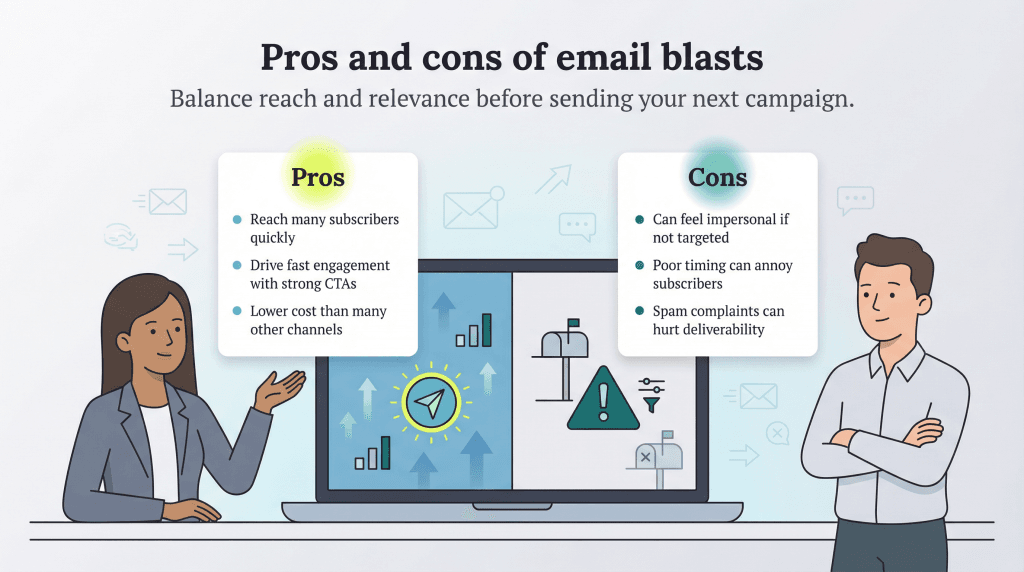
Like any digital marketing strategy, email blasts come with both benefits and trade-offs. Here’s what to consider before sending one.
Jennifer Dublino contributed to this article.