Business.com aims to help business owners make informed decisions to support and grow their companies. We research and recommend products and services suitable for various business types, investing thousands of hours each year in this process.
As a business, we need to generate revenue to sustain our content. We have financial relationships with some companies we cover, earning commissions when readers purchase from our partners or share information about their needs. These relationships do not dictate our advice and recommendations. Our editorial team independently evaluates and recommends products and services based on their research and expertise. Learn more about our process and partners here.
Email marketing is becoming more complicated as digital privacy laws like the GDPR and the CCPA reshape what businesses can and can't do. Here's what to know before launching your next campaign.


We’re operating in an era of heightened data privacy, where governments around the world are putting new limits in place on how organizations collect and use personal data. These laws have sweeping effects on how businesses connect with potential customers online, including everyday practices such as email marketing. In particular, the General Data Protection Regulation (GDPR) is widely considered the world’s strongest data privacy and security law.
Editor’s note: Looking for the right email marketing service for your business? Fill out the below questionnaire to have our vendor partners contact you about your needs.
If you’re thinking about launching an email marketing campaign, you need to understand which data privacy laws apply to your business. Failure to comply can lead to significant financial penalties and damage to your brand’s reputation.
Data privacy laws are regulations designed to protect individuals’ rights to a basic standard of data privacy and security. They typically spell out how companies can collect and use personal data and how businesses must inform users about that collection and use. These rules are often broad, shaping nearly every digital interaction a business has with customers, including common channels like email marketing.
One of the most prominent examples is the European Union’s GDPR, which set a global benchmark for privacy protection. In the United States, the California Consumer Privacy Act (CCPA) introduced similar protections and helped spark a wave of state-level privacy laws.
Understanding these laws — both for staying compliant today and keeping up with future privacy trends — is essential for any business involved in digital marketing strategies or data collection.
The GDPR is the European Union’s overarching data privacy law, designed to create consistent privacy rules across all 27 member countries. If your business collects or uses data from people in the European Union, the GDPR is something you need to pay attention to. What surprises many businesses is that location doesn’t matter; companies based in the United States can still be subject to the GDPR if they interact with EU-based users.
When it comes to email marketing, the GDPR requires businesses to obtain clear, explicit consent before contacting anyone by email. This is known as opt-in consent and results in what’s called opt-in email marketing. In other words, before sending marketing emails, businesses must be sure they have permission from the recipient.
Under the GDPR, businesses need to be able to explain how they received a person’s consent and keep track of who has since opted out or unsubscribed. Companies must also respect requests to delete personal information. On top of that, the regulation expects businesses to collect only the data they actually need, rather than gathering information “just in case.”
Violating the GDPR can lead to significant financial penalties. Under the regulation, less serious infringements can result in GDPR fines of up to €10 million or 2 percent of a company’s worldwide annual revenue, whichever is higher. More serious violations can trigger fines of up to €20 million or 4 percent of global annual revenue, again depending on which amount is greater.
Enforcement has been active and highly visible in recent years. For example, in May 2023, the Irish Data Protection Commission fined Meta €1.2 billion related to user data transfers between the EU and the United States. Cases like this highlight why the risk of large fines and legal action should push businesses to think carefully about how (and how much) user data they collect.
The CCPA is California’s data privacy law. It was modeled largely after the GDPR, though it differs in some important ways. For email marketing purposes, however, many of the core rules are similar.
Like the GDPR, the CCPA treats a user’s email address as personal information. That means users typically must consent to email communications and be able to opt out at any time. Data tied to how someone interacts with your emails, like email open rates and click-through rates, also counts as personal information. If a user asks for their data to be deleted, businesses must remove not just the email address, but any related engagement data as well.
For email marketers, the good news is that CCPA compliance looks largely similar to GDPR compliance. Other parts of the law differ, though, so businesses that collect data beyond email marketing should review both laws with legal counsel to confirm compliance, especially since both laws can apply at the same time.
Violating the CCPA can lead to civil penalties ranging from $2,663 per unintentional violation to $7,988 per intentional violation. In some cases, businesses may have up to 30 days to fix the issue and bring their practices into compliance before penalties apply.
While these fines aren’t as steep as the maximum penalties under the GDPR, they can still add up quickly. Because penalties apply per violation, repeated consent issues — such as emailing thousands of contacts without proper permission — can turn into a costly problem fast.
You can manage GDPR compliance on your own, but it quickly gets complicated. Using one of the best email marketing software platforms takes much of that work off your plate by building privacy and consent rules directly into how campaigns are created, sent and tracked.
The GDPR requires companies to get permission for the specific type of emails they plan to send. In other words, if someone shares their email address, you can’t assume they’re OK with marketing messages; they need to clearly opt in to receive them.
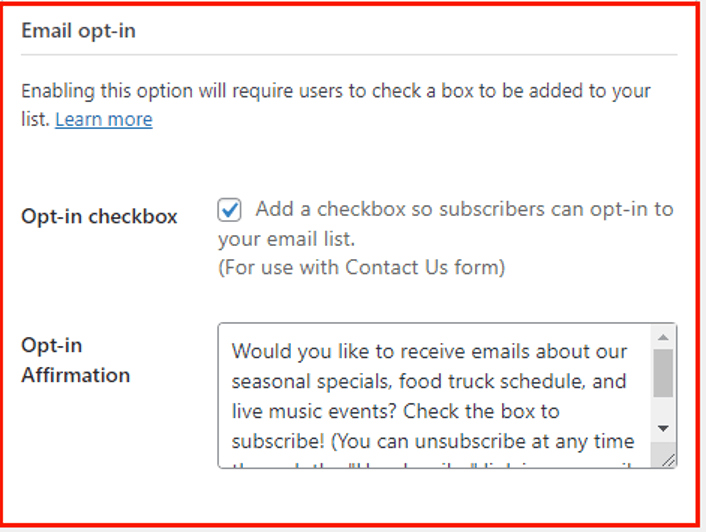
Most email marketing platforms make this easier by offering opt-in forms where subscribers actively check a box to approve certain types of emails, such as news, events or special offers. Note that boxes to receive information can’t be prechecked; the subscriber must actively check the box themselves for consent to be valid.
For example, as seen below, when setting up forms with Constant Contact in WordPress, you can enable email opt-in so subscribers know exactly what they’re signing up for before they give permission. (Check out our Constant Contact review to learn more about this top-rated email marketing platform.)
Many email marketing platforms also make it easy to set up a double opt-in process, which can be especially helpful if you’re working with an email marketing list that may not have given explicit permission to receive certain types of content. In this setup, the subscriber receives a confirmation email that explains what kind of messages you plan to send and includes a link to confirm their opt-in.
The GDPR also requires companies to keep records of consent, including who gave permission, when and how they did so, and what information they were shown at the time. This information is typically stored automatically within each contact record in the email marketing platform.
The GDPR gives EU citizens the right to be forgotten, which means they can ask a company to access, delete or update their personal data. When that happens, businesses are required to comply.
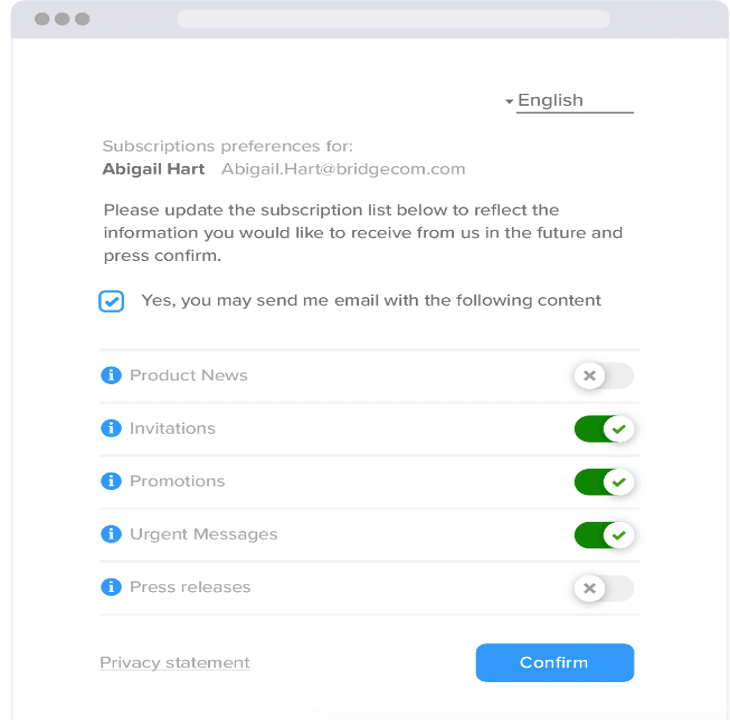
Email marketing platforms help support these rights by automatically including unsubscribe links in email templates and, in many cases, linking subscribers to a profile where they can manage their email preferences directly, as seen below.
Opt-in forms typically also make it clear that subscribers can unsubscribe at any time, and email footers provide a simple way to do so. Once someone unsubscribes, they’re added to a suppression list in your account so they aren’t accidentally emailed again.
Another GDPR requirement is that businesses take “reasonable and appropriate measures” to keep subscriber data safe.
Most established email marketing platforms come with built-in safeguards designed to keep subscriber data secure, including:
Kimberlee Leonard and Jennifer Dublino contributed to this article. Source interviews were conducted for a previous version of this article.