Business.com aims to help business owners make informed decisions to support and grow their companies. We research and recommend products and services suitable for various business types, investing thousands of hours each year in this process.
As a business, we need to generate revenue to sustain our content. We have financial relationships with some companies we cover, earning commissions when readers purchase from our partners or share information about their needs. These relationships do not dictate our advice and recommendations. Our editorial team independently evaluates and recommends products and services based on their research and expertise. Learn more about our process and partners here.
Once employees understand how their efforts contribute to the bigger picture, they become more motivated and engaged in their work.


Once employees understand how their efforts contribute to the bigger picture, they become more motivated and engaged in their work.
Your company culture is the foundation of your business. It reflects your mission, brand story and long-term goals for growth and success. But as the saying goes, “No one succeeds alone.” To reach your goals, you need a culture that empowers your employees to take ownership and thrive.
Building that kind of environment has never been more important. According to Gallup’s 2025 State of the Global Workplace Report, only 21 percent of employees worldwide feel engaged at work, showing just how critical it is for businesses to focus on empowerment. When people feel trusted and supported, they don’t just show up: They take ownership of your company’s success. We’ll look at strategies that can help any business foster a culture of empowered employees and explain how that can benefit everyone.
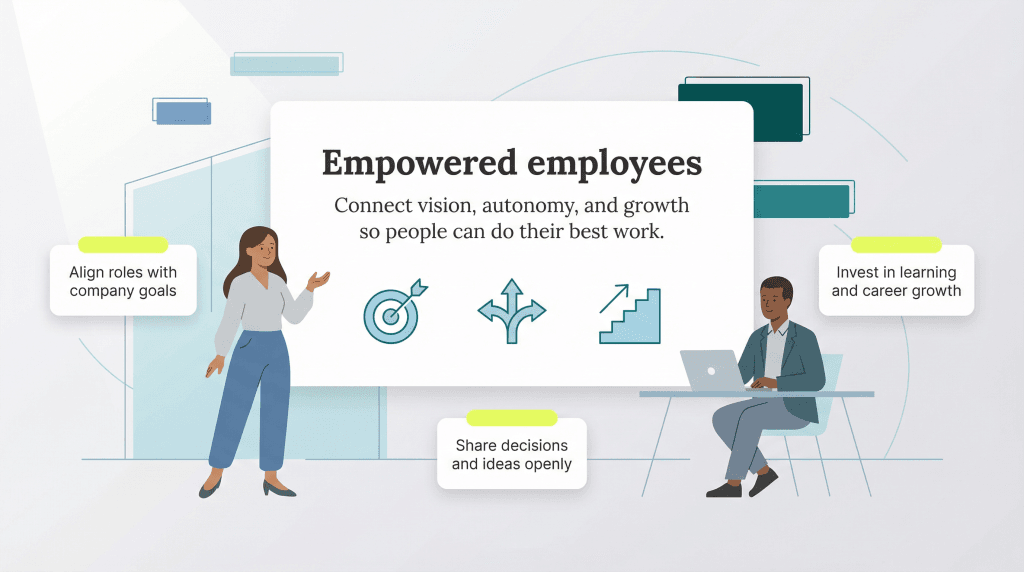
Employee empowerment isn’t just a buzzword; it’s a business advantage. When people feel trusted and supported, they perform better and care more deeply about the company’s success.
Here are eight practical ways to help your team feel more confident, capable and connected, no matter the size of your organization.
Identifying the core tenets and values that define your company culture is essential. Ask yourself: Are you committed to delivering the best product quality? Focused on excellent customer service? What’s at the heart of your business that drives progress?
Once you’ve defined your overarching business goals, break them into smaller objectives and show employees how their work connects to the bigger picture. When people understand how their efforts contribute to company success, they feel more engaged and take greater ownership of their roles.
Encourage that sense of ownership by delegating responsibilities whenever possible. For example, business decision-making can take a great deal of company leaders’ time, but sharing that responsibility empowers employees and brings new perspectives to the table. It also helps lighten the management load while fostering a happy and productive work culture.
Open communication is essential to an empowered workplace. According to ADP’s Employee Motivation and Commitment (EMC) Index, 63 percent of employees say they don’t have the flexibility or autonomy they want at work, and only 12 percent feel they’re given enough freedom to make meaningful decisions.
Make sure employees and leaders alike have a safe space to share ideas and suggest improvements. Feedback isn’t just valuable; it’s a retention tool. Workers are far more likely to stay with a company that listens to them and acts on what they say.
You can encourage open dialogue through “big idea” sessions, town halls or even an online solution box where employees can submit suggestions and constructive feedback. When employees pair a challenge with a potential solution, it fosters shared ownership and keeps everyone invested in the company’s growth.
Every executive or business owner strives to hire top talent. However, many leaders struggle to give employees full autonomy over significant projects, even knowing that micromanaging can hurt productivity, engagement and morale. So, how do you strike the right balance?
The key to successful delegation lies in trust and structure. Research from McKinsey & Company shows that empowered teams — those trusted to make decisions and manage their work independently — consistently outperform tightly controlled groups. When leaders step back and give employees room to lead, creativity and innovation thrive.
That starts with strong training and clear expectations. Businesses need to have the right employee training infrastructure in place so managers can train their teams in the following critical decision-making areas:
When you allow your employees to own their successes and failures, you create a sense of empowerment and engagement. By relinquishing a bit of control, you create an environment where people don’t just complete tasks: They take pride in shaping outcomes.
An empowered workforce thrives when employees see a future for themselves within the company. A big part of that empowerment comes from having clear opportunities for personal and professional growth. Continuous learning doesn’t just build skills; it supports employees’ mental and emotional well-being by fulfilling the basic human need to improve and progress.
The data backs this up. According to iHire’s 2024 Talent Retention Report, 11 percent of workers said they quit because professional development was lacking, and more than 60 percent reported that access to training and growth opportunities would motivate them to stay. Investing in education and career development programs is one of the simplest and most effective ways to build a culture where employees feel empowered, valued and ready to grow with your business.
Employee recognition shouldn’t stop at profits and performance metrics. Acknowledging the effort, creativity and collaboration that drive those results is just as important. Doing so helps prevent burnout and keeps employees motivated, engaged and proud of their work.
Recognition also goes beyond outcomes; it’s about modeling the right behaviors. When leaders consistently celebrate learning, growth and teamwork, employees take notice. They’re more likely to stretch their skills, support one another and invest in their own development.
Outdated tools don’t just slow teams down: They drain motivation and signal that leadership isn’t invested in employee success. When people have to fight against inefficient systems, productivity drops and frustration rises.
As workplace technology continues to evolve, keeping your tools current has never been more important. According to Eagle Hill Consulting’s 2025 Tech Enablement Survey, nearly 80 percent of employees use technology every day, and almost 70 percent say it makes their jobs easier. Still, 41 percent report their organization isn’t prepared to adopt new automation tools, and just 20 percent say improving workflow automation is a company priority.
Investing in up-to-date resources shows your employees that you value their time and trust them with the tools to do their best work. It’s one of the simplest ways to boost efficiency and build a culture of empowerment.
Creativity isn’t a nice-to-have — it’s a growth driver. According to an often-cited Forrester–Adobe study, companies that foster creativity are 3.5 times more likely to outperform their peers in revenue growth. Businesses that invest in creativity are also more likely to innovate, stay competitive, deliver better customer experiences and achieve long-term success.
Encourage employees to bring creative ideas forward, whether that’s improving a workflow, rethinking a process or brainstorming new approaches in meetings. The more space you give your team to experiment, the more likely they’ll uncover smarter solutions and cost-saving ideas. All it takes is a willingness to listen and the freedom to think differently.
There’s room for improvement in any role, from interns to executive leaders. Investing in your workforce and encouraging professional development can lead to greater engagement, and that, in turn, drives retention and productivity. Often-cited research indicates that organizations with comprehensive training programs see 218 percent higher income per employee and 24 percent higher profit margins than those with less focus on learning and development.
Encourage continuous learning through opportunities like mentorship programs and professional development workshops. This helps employees strengthen their business skills and learn from their peers, making them better prepared for their roles and more confident about their future with your company.
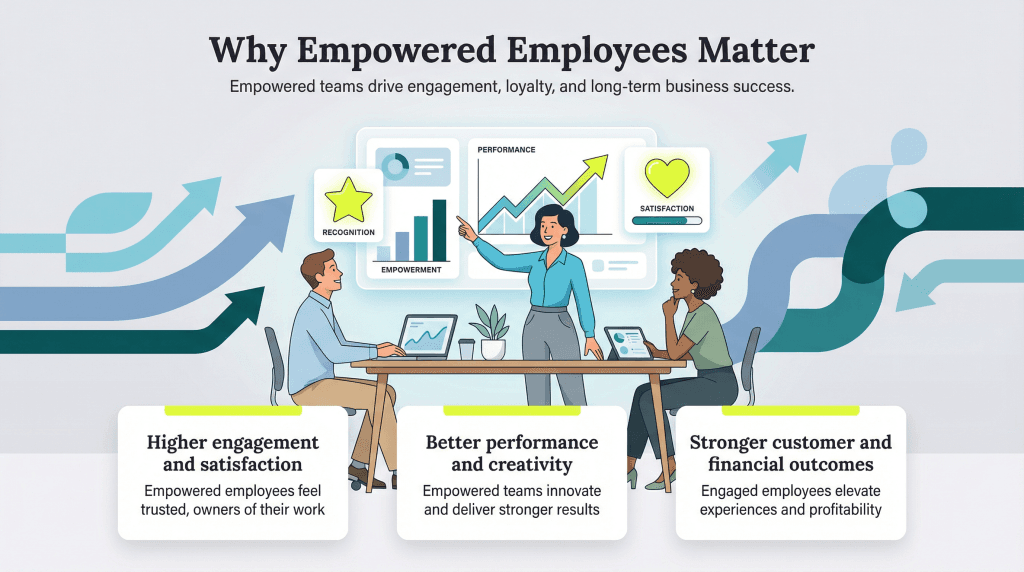
A 2023 Journal of Business Research review on workplace empowerment found consistent evidence that employees who feel trusted, supported and involved in decision-making show higher engagement, stronger commitment and better overall performance. Empowered teams are also more adaptable, collaborative and motivated — qualities that contribute to long-term business success.
Below are some of the key ways empowering your employees can make a measurable difference for your organization.
Empowered employees are generally happier in their roles because they feel supported by their employers and coworkers. This empowerment often leads to increased satisfaction for employees. This reduces stress and isolation while encouraging independence and ownership of their work.
When employees feel they have control over the trajectory of their careers and work, they are more likely to produce high-quality, creative work. They’re also more likely to go above and beyond their job description and stay at your company long-term. Employees are more likely to trust leaders who empower their workforce and act as mentors who support them and celebrate their triumphs.
Employees want to know that their work matters. By developing a culture of empowerment, businesses can boost employee engagement and ensure workers remain motivated in their roles. Creating this kind of environment is crucial to maintaining employee engagement while ensuring goal alignment across the company. This, in turn, helps to prevent turnover and employee burnout.
Empowering your team is a great way to improve productivity. In fact, the productivity gains from employee empowerment are well-documented. A 2024 meta-analysis found that empowerment is significantly associated with stronger job performance and other positive outcomes across dozens of studies. Field research also shows that empowering leadership improves employee performance, in part by increasing work engagement.
That said, empowerment works best when it’s consistent. Teams thrive when everyone has the same level of trust and decision-making freedom; otherwise, uneven empowerment can create confusion or slow collaboration.
Stifling employees’ ideas can hold a business back, preventing it from embracing growth opportunities and new perspectives. In contrast, encouraging creativity can improve employee retention, satisfaction and engagement. Empowered employees are more likely to take initiative, collaborate and think outside the box.
Empowered employees are often happier in their roles. When team members feel supported and trusted to make decisions, that satisfaction carries over to your customers. Empowered employees are more likely to go above and beyond to solve problems, create positive interactions, and build long-term customer loyalty, all of which can help your business stand out from competitors.
Empowering and encouraging your staff can have far-reaching effects across the company, including the bottom line. When employees feel trusted, supported and valued, they’re more engaged in their work and committed to company goals. That engagement pays off: According to Gallup, organizations with highly engaged employees see 23 percent higher profitability. Empowering your employees not only strengthens morale but can also help the financial success of your business.