Business.com aims to help business owners make informed decisions to support and grow their companies. We research and recommend products and services suitable for various business types, investing thousands of hours each year in this process.
As a business, we need to generate revenue to sustain our content. We have financial relationships with some companies we cover, earning commissions when readers purchase from our partners or share information about their needs. These relationships do not dictate our advice and recommendations. Our editorial team independently evaluates and recommends products and services based on their research and expertise. Learn more about our process and partners here.
Here are some recent graphic design trends and predictions your business should know.


The graphic design industry continues to change based on consumer trends, current events and industry predictions. To succeed in the field, one must remain relevant and flexible in the face of change.
Over the past few years and, especially with rapid advancements in technology, the graphic design industry has shifted drastically. Below, we’ll explore recent industry trends and predictions pertaining to the future of graphic design.
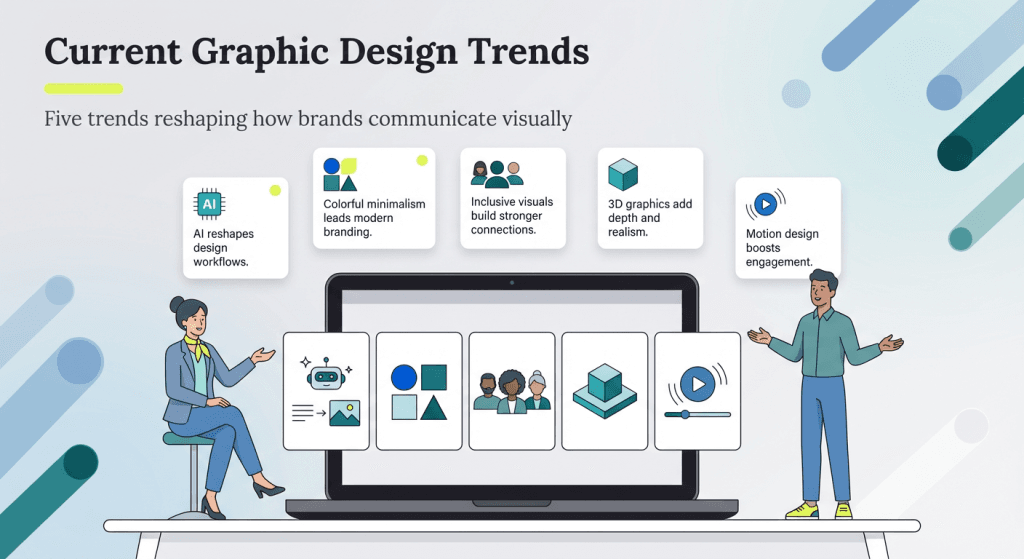
Here are five trends that graphic design is currently experiencing.
AI has revolutionized nearly every industry and graphic design is no exception. AI tools in graphic design range from smart editing, such as removing backgrounds or automatic color adjustments, to text-to-image generative AI platforms like Midjourney, DALL-E 3 and Adobe Firefly.
Generative AI for graphic design has become mainstream: 74 percent of marketers use at least one AI tool for their work, according to HubSpot. The technology has fundamentally changed how marketers approach their craft, with 69 percent reporting that AI helps them personalize customer experiences and 70 percent saying that it allows better collaboration.
Expect to see designers spending less time on artistic endeavors and more time creating prompts and visuals with AI, making it easier to convert website visitors into customers with engaging design. [Related: Read about the best website builders and design services.]
Minimalism, which combines simple elements and limited color palettes to create classic designs, has evolved into a dominant force in modern branding. Consider the logos of major brands like Apple, Mastercard or Nike — these designs achieve instant recognition without being too overwhelming visually.
One especially popular variant is colorful minimalism, which combines the soothing effects of minimalism with playful hues. This design trend is versatile and can apply to business website design. Uniform geometric shapes are paired with bold color palettes to create the perfect blend of simplicity and energy. Experiment with contrasting colors to add extra impact.
Today’s consumers care about diverse, inclusive representation in the brands they patronize. According to a study by Numerator, 63 percent of consumers believe diverse representation in advertising is important and 47 percent are more likely to buy from brands that feature diversity in their ads.
To respond to this trend, graphics designers can actively incorporate diverse and inclusive models and renderings into their imagery. This may include racial and ethnic diversity, age diversity, and disability and LGBTQ+ representation.
Related to this, brands can also lean into accessible graphic design to support a wide range of users, including those with disabilities. Sufficient color contrast and easy-to-read fonts increase readability, while alternative text ensures users with visual impairments can engage with images.
Advancing technology has made 3D design a viable form of creation that combines the power of both the physical and digital worlds. This design style displays rich detail while captivating consumers. Depth and dimension are favored over flat vector illustrations. The potential range of 3D designs is immense. Some brands prefer lifelike 3D designs while others favor a more abstract concept.
The proliferation of 3D design tools has accelerated this trend. Platforms like Spline, Dora and Womp now enable designers without extensive 3D experience to create sophisticated three-dimensional graphics directly in web browsers. The global 3D rendering market is projected to hit 19.82 billion by 2033, growing 19.2 percent, according to Grand View Research.
Static graphics are giving way to dynamic, animated content as businesses recognize the power of motion to engage audiences. Motion design encompasses everything from micro-interactions on websites to complex animated brand stories for social media platforms.
The demand for motion designers has surged, with 95 percent of marketers reporting that video is an important piece of brand strategy, according to Wyzowl. Tools like After Effects, Rive and LottieFiles have made animation easier for designers, while emerging AI-powered animation tools promise to further streamline the process.
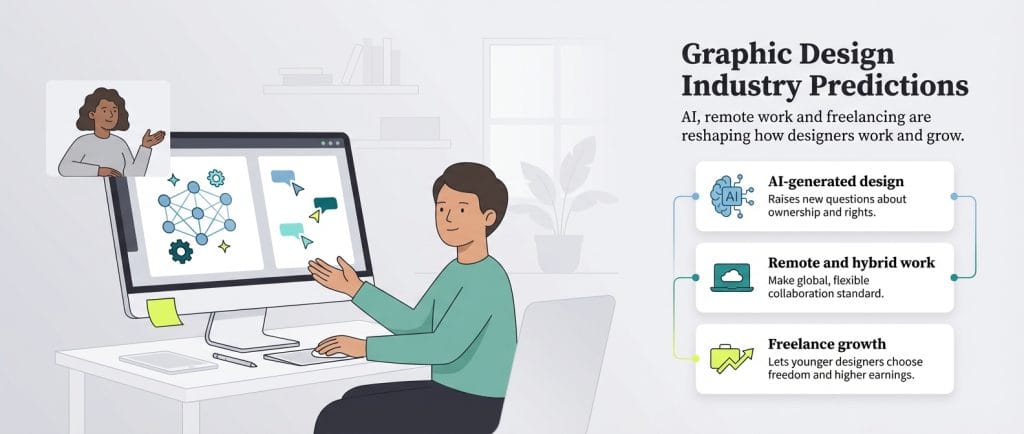
What’s next for the graphic design industry? Nothing is absolute, but some of these predictions are already coming true.
Generative AI models require extensive training on existing creative works, often without permission from original artists. This practice has sparked intense debate about intellectual property rights, fair use and the future of creative ownership in the age of AI.
Multiple high-profile lawsuits are reshaping the landscape, including cases against Stability AI, Midjourney and OpenAI filed by artists and major stock photo companies. These legal developments will establish critical precedents on the use of generative AI in graphic design.
Remote work has become more accepted by companies around the globe. Graphic designers have embraced this flexibility, with cloud-based design tools and collaborative platforms making location-independent work easy. Designers can leverage tools like Figma, Adobe Creative Cloud and Miro to collaborate in real-time with teams across different time zones and continents.
According to FlexJobs’ State of the Workforce Report, 76 percent of employees said that they would look for a new position if remote work wasn’t offered, with 69 percent opting a pay cut in exchange for remote work options.
Remote work isn’t without its challenges, however. According to a USA Today survey, a significant portion of remote workers reported feelings of isolation (34 percent), fewer learning opportunities (25 percent) and reduced access to resources and equipment (21 percent). Do not overlook these disadvantages, especially in a field like graphic design, where employee training, culture and creativity are paramount.
The United States Bureau of Labor Statistics (BLS) reported that the average pay for a graphic designer is about $61,300 as of 2024. Approximately 18 percent of graphic designers are self-employed, according to BLS data. The more you work for yourself, the more attractive freelancing becomes — especially since more experienced designers can command higher rates and more freedom in the projects they take on.
This career path resonates strongly with younger generations who prioritize flexibility and autonomy. Recent data from Upwork’s Freelance Forward Report shows that 52 percent of Gen Z workers and 44 percent of millennials have done freelance work.
Before becoming a freelancer, it’s a good idea to at least intern at a local company and gain some experience in the industry. Basic management skills are another vital part of starting and running your own business. You’ll also need to consider the financial logistics of self-employment, including maintaining a steady (enough) income, securing insurance and setting up a retirement fund.
Businesses are prioritizing consumer loyalty through advertising and marketing. Due to its importance, businesses are relying on industry professionals and outsourcing these efforts. This outsourcing continues to grow the graphic design industry.
According to the BLS, employment of graphic designers is projected to grow 2 percent through 2034 to meet industry demand, with approximately 20,000 job openings anticipated each year over the next decade.
To succeed in this evolving landscape, graphic designers must continuously update their skills and maintain diverse portfolios that showcase both traditional design excellence and proficiency with emerging technologies. A bachelor’s degree in graphic design or related field remains the standard entry requirement, but employers increasingly value demonstrable skills in AI tools, motion design and user experience principles alongside traditional design fundamentals.
Lexie Lu contributed to the reporting and writing in this article.