Business.com aims to help business owners make informed decisions to support and grow their companies. We research and recommend products and services suitable for various business types, investing thousands of hours each year in this process.
As a business, we need to generate revenue to sustain our content. We have financial relationships with some companies we cover, earning commissions when readers purchase from our partners or share information about their needs. These relationships do not dictate our advice and recommendations. Our editorial team independently evaluates and recommends products and services based on their research and expertise. Learn more about our process and partners here.
About Us Page: Why Your Business Needs an ‘About’ Page
Your website's About page wields more marketing muscle than any other content piece.
Business.com earns commissions from some listed providers. Editorial Guidelines.
Table of Contents
The About page — often called the About Us page — is a fundamental element of a business’s website design, but many business owners don’t give it much thought or attention. It’s tempting to fill out your About page quickly with an uninspiring bio and buzzwords like “innovation” and “excellence.” However, if you don’t maximize your About page’s potential, you’re missing out on a valuable opportunity.
Your About Us page is a vital digital asset and one of your website’s most frequently visited pages. Anyone who wants to learn more about your company will head to this resource. We’ll explain why an About page is a crucial content element and explore best practices for creating one that presents your business in the best possible light.
Not sure where to start? Tell us a little more about your business and get customized quotes from qualified providers
The importance of your About page
You may wonder why so many people visit the About page. Shouldn’t they look at the services or pricing sections first, or check out your content and resources? The About Us page’s popularity makes sense for several reasons.
1. The About page fosters familiarity and trust.
When you meet a new person at an event, what’s the first thing you do? You’ll likely check for similarities and ask about their background, hobbies and more. You’ll try to figure out whether their story is similar to yours. When you feel a genuine connection, you may consider investing in the relationship.
Similarly, when a prospect visits your website for the first time, they’ll head to the About Us page to determine if they can trust you. They want to know your brand story and see if you have the experience, knowledge and expertise to solve their problems.
At this stage of the customer journey, your prospects want to understand what you’re doing and why you’re doing it. If your About page includes elements of your mission statement or company vision, readers can determine if your business resonates with them and aligns with their values and needs.
“When done right, it’s the page that builds trust, frames your value and connects with your audience on a human level,” explained Darryl Stevens, CEO and founder of Digitech Web Design. “People don’t just want to know what you do; they want to know who’s behind it, why it exists and what you stand for. That context is often what tips the scale in your favor when a visitor is deciding whether to work with you or keep browsing.”
In addition, Shaun David, senior market analyst at CleaRank, emphasized that your About Us page plays a key role in building trust. “Your About Us page isn’t a dusty corporate brochure — it’s a trust magnet,” David explained. He noted that many users check this page before deciding whether to trust a brand, and it can also support your site’s E-E-A-T signals — Google’s framework for evaluating experience, expertise, authority and trustworthiness — which can influence search visibility.
2. The About Us page helps visitors understand their options.
The About page is also the perfect place for visitors to quickly narrow their options.
For example, say Company A’s About page emphasizes creating the highest-quality product in the industry. However, Company B’s About page highlights its focus on making the product affordable and accessible to all. If a visitor is looking for a higher-cost, higher-quality product, they’ll likely want to learn more about Company A. If cost is a more significant concern than product quality, they’ll be more inclined to choose Company B.
3. The About page humanizes your business.
The About Us page helps humanize your business by telling visitors about you and your team. Put a face to a name and title, and let your photos and bios reassure visitors that they’re dealing with real people who understand their needs.
Tip
Ensure your About Us page follows your existing website design and includes consistent brand elements, like your company logo and website color scheme and fonts. Use specific, verifiable details to demonstrate your credibility.
How to write an About Us page
When you craft your About page, make sure to do the following:
Tell website visitors what you do: Start your About page by clearly explaining your company’s mission and purpose without using jargon. For example, let’s say you’re a healthcare software provider. An About page that starts with “We create software that makes it easier for healthcare providers to manage their practices” is much more compelling and descriptive than “Our solutions protect sensitive data and offer multiple ways to gain insights about the people that you serve.”
Give prospective customers a reason to buy from you: After sharing what you do, explain how your company, products and services are different from — and better than — competitors’. Clearly show how your offerings benefit prospective customers. Include a sentence or two explaining how customers can rely on your company to stand behind its products and services with a great customer experience, both before and after the sale.
Add humanizing elements: For example, include a brief paragraph about your company’s history, founders and values. Consider adding photos of your founders, key employees or product development process. If your company has a storied local history, photos of the original building can be a nice touch. Use a friendly tone throughout to help humanize your brand.
End your About Us page with a call to action (CTA): Don’t leave your prospect hanging. If you’ve effectively introduced your company, a CTA can seal the deal by inviting visitors to take the next step. You might ask them to subscribe to your blog, download a whitepaper or enter their email as part of your lead generation strategy. Here are some examples of strong About page CTAs:
“Check out our [product name]”
“Start your free trial”
“Browse our catalog”
“Schedule an appointment”
“Shop now”
Best practices for creating About Us page content
It may take time to find your company’s unique identity and voice and translate them into well-crafted copy. However, keep the following guidelines in mind as you begin creating a compelling About page.
Focus on the customer.
Your About Us page doesn’t have to be all about you. Website visitors are there because they’re facing a problem or challenge and need your help. If you can show that you understand their problems, they’ll be more inclined to trust you.
Don’t overemphasize big philosophical missions and visions on your About page. Instead, share your company’s mission while making it clear that you’re there to solve your customers’ problems.
FYI
Consider including client testimonials and positive customer reviews to demonstrate the quality of your products and services.
Tell your story.
Storytelling is a compelling way to capture your audience’s attention. An engaging story about your business’s humble beginnings can establish immediate trust in your customers’ minds.
Share how your products or services were developed to improve lives. Discuss the problems or challenges you faced that led you to start the business. If your business is family-owned, let visitors know. Genuine stories humanize your brand, giving your business more context and meaning.
“From analyzing hundreds of websites, I’ve found that visitors spend significantly more time on sites with compelling About Us pages that tell authentic stories about real customer impact,” said Joe Davies, CEO of fatjoe. “I recommend keeping it focused on how you solve customer problems rather than just listing awards or credentials — for example, share a brief story about how your team went above and beyond to help a specific customer overcome a challenge.”
Include contact information.
Many businesses feature key employees, including photos and short bios, on their About pages. Introducing your team helps your business feel more authentic and human.
Include team members’ contact information so visitors can reach out. For example, if someone wants to connect with your sales team, they’ll know exactly whom to contact. Linking this information can also help you build an email marketing list of interested prospects.
Tip
Consider including video content, such as a personal message, on your About Us page. Videos can help build trust and are often more engaging than text.
Make your About Us page memorable.
Whatever you do, don’t make your About Us page boring. Strive to create a lasting impression in your prospects’ minds so they don’t forget you the moment they close the tab.
People are far more likely to do business with people they like, and your About Us page can make all the difference in helping visitors form the right first impression. Additionally, make your About page copy consistent with your brand. And while it should be professional, a bit of humor is always welcome.
Toot your own horn.
Although you don’t want to sound obnoxious, the About Us page is the place to tell prospects about your accomplishments. Showcase anything that builds credibility, including the following:
The number of years you’ve been in business (if it’s a long time)
Your experience in the industry and related fields
Any patents, copyrights and other proprietary intellectual property you own
The owner’s and executive team’s relevant education, training and certifications
Awards your company has received
Honors members of your executive team have received
Company or product certifications, such as ISO or Microsoft Partner, or evidence that you’re OSHA-compliant
Certifications or practices related to sustainability, such as LEED, B Corp or Energy Star
Statistics and survey data that demonstrate your success, such as customer satisfaction results, reviews (number of stars and total reviews), the size of your customer base, the percentage of repeat customers and the share of business from referrals
Share your values.
Tell prospects what’s important to you. When visitors see that you share their values, they’ll feel more comfortable buying from you.
Choose and highlight the three or four values that matter most to your company. If your target audience cares deeply about these values, explain how you put them into action.
Using the About Us page to show your values in action can also be incredibly effective. David shared, “I recently analyzed a firm that added ‘Mission Mondays’ (team volunteering videos) to their About page and the result was an impressive spike in signups within three months. A good About Us page will convert your visitors into believers.”
Did You Know?
Your About Us page should be concise. You can go into more detail about your products' features and benefits on your product pages. The About page should briefly touch on that information so visitors get a clear sense of what you offer.
Examples of effective website About Us pages
Some of the best About Us pages share a few things in common: They lead with purpose, highlight the people behind the brand and make it easy for visitors to take the next step. The following brands can help inspire small businesses building or refreshing their own About page content.
Yeti
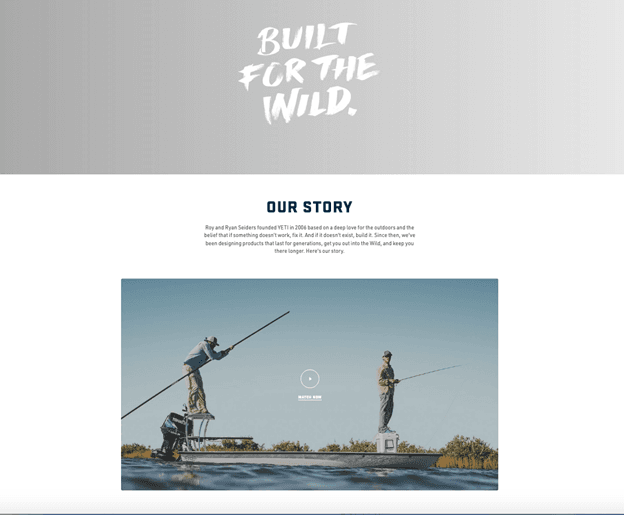
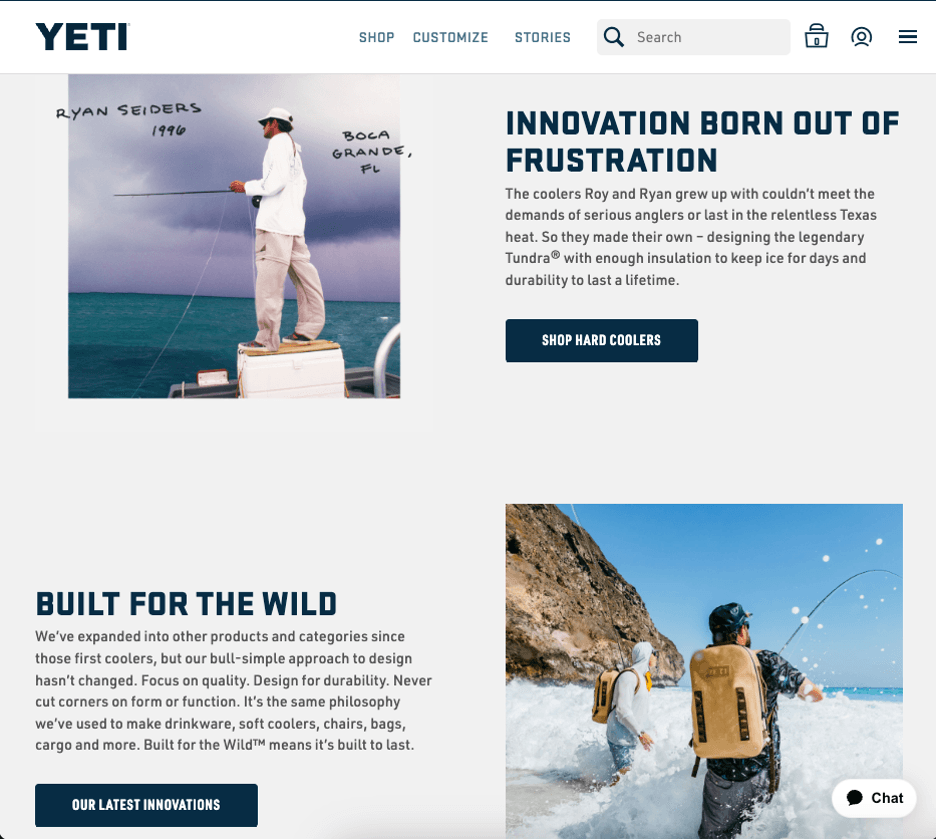
Outdoor products manufacturer Yeti excels at visual storytelling. Its About page features action shots and videos that immerse visitors in outdoor experiences. Its tagline, “Built for the Wild,” immediately identifies its target audience: people who enjoy fishing, hunting, diving and the outdoors. The copy explains how the company’s founders were frustrated with existing coolers and set out to build better-performing products.
The page continues by highlighting the company’s commitment to quality and durability, which carries through to its products. It also provides social proof, noting that the company’s “products have been embraced by communities and outdoor pros across the world.” The page finishes with a statement of the company’s values, including a commitment to protecting wild environments.
Yeti’s About page leads with striking visuals and an instantly recognizable tagline that speaks directly to its core audience.
Yeti’s About page weaves brand values and social proof into a cohesive narrative that resonates with outdoor enthusiasts.
Chime
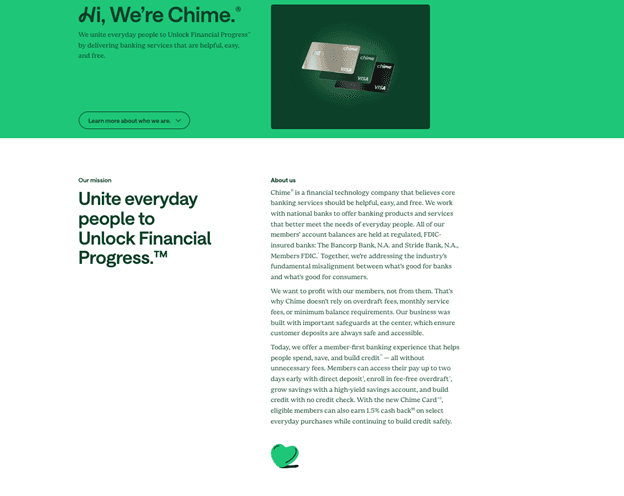
If you’ve never heard of Chime, you would be forgiven for thinking it had something to do with doorbells. However, the fintech company’s About Us page immediately tells you exactly what it does, how it works and who it’s for. The page leads with a clear mission and reinforces its value proposition — banking that’s helpful, easy and free. It also walks visitors through the problem it aims to solve and how its model differs from traditional banks, emphasizing a member-first approach with no hidden fees and tools designed to help everyday people make financial progress.
Chime’s About page clearly communicates its mission and value proposition from the start.
Salesforce
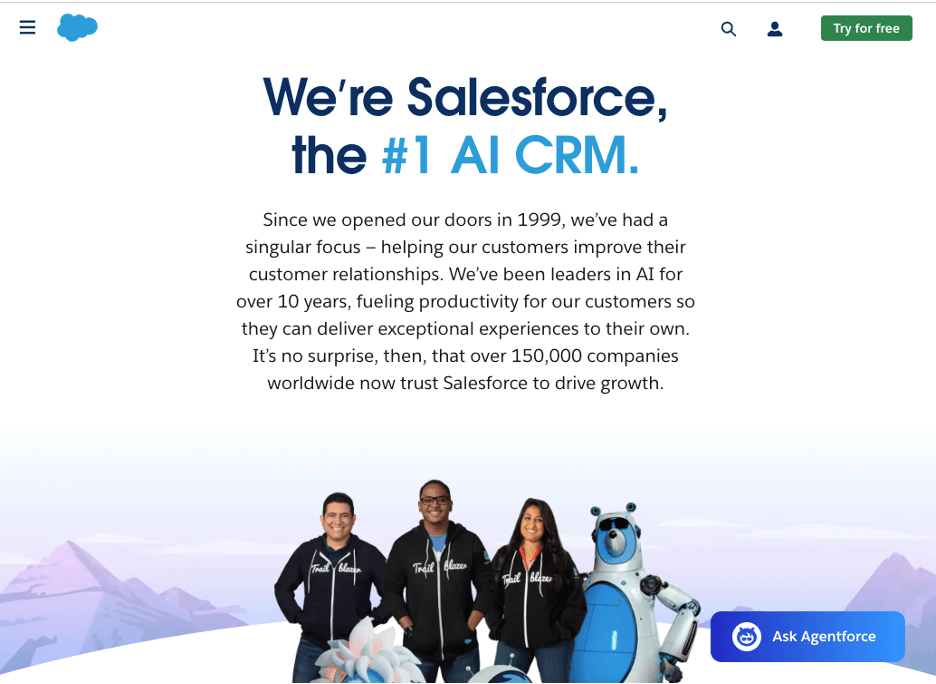
When you think about the giant CRM software company Salesforce, you might expect its About page to be stiff and impersonal. However, the company takes a very different approach. While much of the Salesforce website is straightforward and text-heavy, the About page uses approachable visuals and a friendly, nontechnical tone.
The copy emphasizes its AI capabilities and how they help customers work smarter. It positions Salesforce as a company that helps businesses connect with their customers to drive success and create positive change. Throughout the page, the messaging reinforces the idea that technology isn’t something to fear — it’s a tool for building stronger relationships and trust.
Salesforce’s About page uses friendly visuals and approachable language to make complex AI technology feel accessible to business users.
Get the most from your About page
Your About Us page isn’t just a standard website design requirement. A compelling, thoughtful About page can help generate leads, boost website traffic and present your organization in the best possible light, especially for small businesses without an established brand value. When done well, it gives visitors a clear sense of who you are, what you stand for and why they should choose you — turning casual browsers into confident customers.
Jennifer Dublino is an experienced entrepreneur and astute marketing strategist. With over three decades of industry experience, she has been a guiding force for many businesses, offering invaluable expertise in market research, strategic planning, budget allocation, lead generation and beyond. Earlier in her career, Dublino established, nurtured and successfully sold her own marketing firm.
At business.com, Dublino covers customer retention and relationships, pricing strategies and business growth.
Dublino, who has a bachelor's degree in business administration and an MBA in marketing and finance, also served as the chief operating officer of the Scent Marketing Institute, showcasing her ability to navigate diverse sectors within the marketing landscape. Over the years, Dublino has amassed a comprehensive understanding of business operations across a wide array of areas, ranging from credit card processing to compensation management. Her insights and expertise have earned her recognition, with her contributions quoted in reputable publications such as Reuters, Adweek, AdAge and others.