Business.com aims to help business owners make informed decisions to support and grow their companies. We research and recommend products and services suitable for various business types, investing thousands of hours each year in this process.
As a business, we need to generate revenue to sustain our content. We have financial relationships with some companies we cover, earning commissions when readers purchase from our partners or share information about their needs. These relationships do not dictate our advice and recommendations. Our editorial team independently evaluates and recommends products and services based on their research and expertise. Learn more about our process and partners here.
AI answer engines are a new and important touchpoint for users in your target audience. Here’s how to improve your brand’s AI visibility.


Customers can ask an AI search tool to compare vendors, explain their options or recommend a local service before visiting a business’s website. When those answers leave out your company or describe it incorrectly, it impacts business. That’s why you need to ask yourself: What information can these systems find about my business, and how useful is it?
Improving your visibility starts with understanding customers’ questions, maintaining an accessible website and publishing information that helps people make decisions. Marketers often call this work answer engine optimization (AEO) or generative engine optimization (GEO). The following steps will help you identify practical improvements and evaluate their results.
AI answer engines combine information to draft responses to users’ questions. Examples include ChatGPT’s search features, Google’s AI Overviews and AI Mode, Microsoft Copilot and Perplexity. Their answers may name businesses, recommend options or link to supporting sources.
Start with the following eight actions:
You can control those inputs, although they cannot guarantee a mention or recommendation.
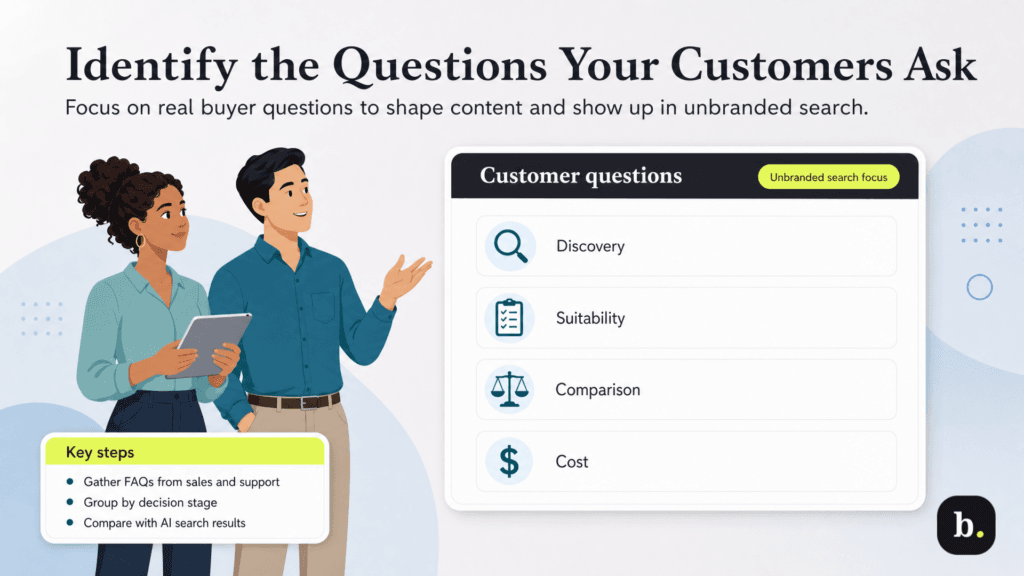
Start with what prospective customers need to know before buying. Ask your sales and customer service teams which questions they answer repeatedly. Review inquiry forms, customer interviews and your website’s search terms, if available.
Group questions around decisions customers make. In the example below, a contractor is looking for a bookkeeping service:
Choose a manageable set of questions tied to services you actually provide. Then check how relevant AI search tools answer them and which sources they cite. Treat this as an initial sample, rather than proof of everything customers see.
Include unbranded questions alongside questions about your company. A tool’s ability to describe your business when prompted with its name tells you something different from whether it suggests your company to someone discovering providers.
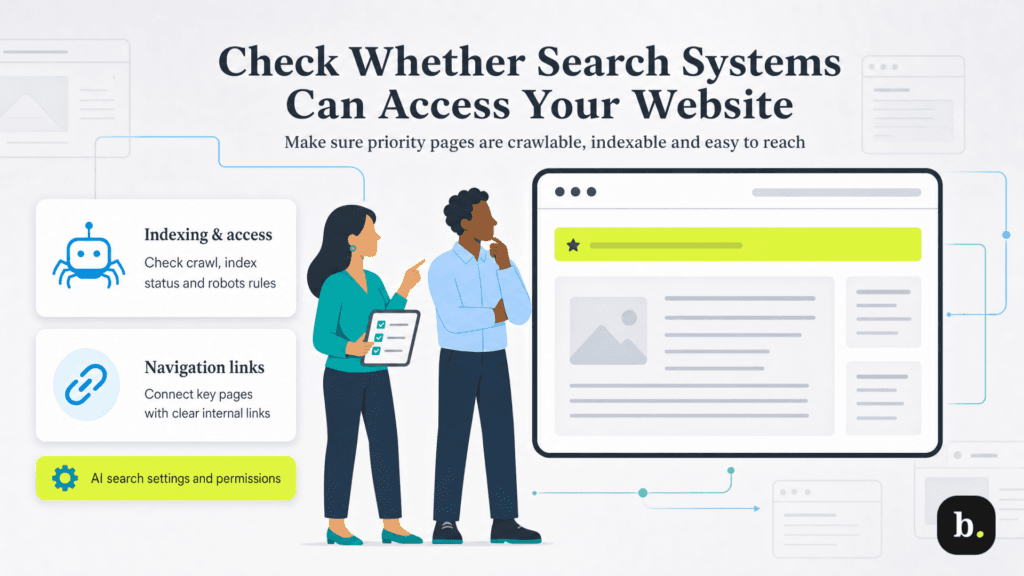
An informative page cannot help customers through search if the relevant system cannot retrieve it. Ask your website manager to review your priority product and service pages, rather than assuming the homepage tells the whole story.
Give them this checklist:
For Google’s AI search features, Google says a supporting page must be indexed and eligible to appear with a search snippet. Also check “Settings” > “Search generative AI” in Google Search Console. Google’s control documentation explains that a property can include or exclude its links and content, or inherit its parent property’s choice. Inclusion is the default for top-level properties.
If your current platform makes routine content and navigation improvements difficult, evaluate those needs when comparing the best website builders.
Read your core pages as if you know nothing about the company. Can you quickly identify what it sells, who it serves, where it operates and how someone can become a customer? Broad claims such as “transforming business through innovative solutions” leave those questions unanswered.
Give each major offering a clear explanation. Include relevant capabilities, eligibility requirements, service areas, limitations and next steps. Where prices depend on a quote, explain the factors that affect cost instead of leaving customers with no context.
Make your business identity equally clear. Use consistent names for the company and its products, and explain any relationship between a trading name and a parent company. Keep contact information and important business details accurate across your website and profiles.
For eligible local businesses, maintain your Google Business Profile. Retailers should also review applicable product feeds and listings. These updates support ordinary customer research as well as AI-assisted discovery.
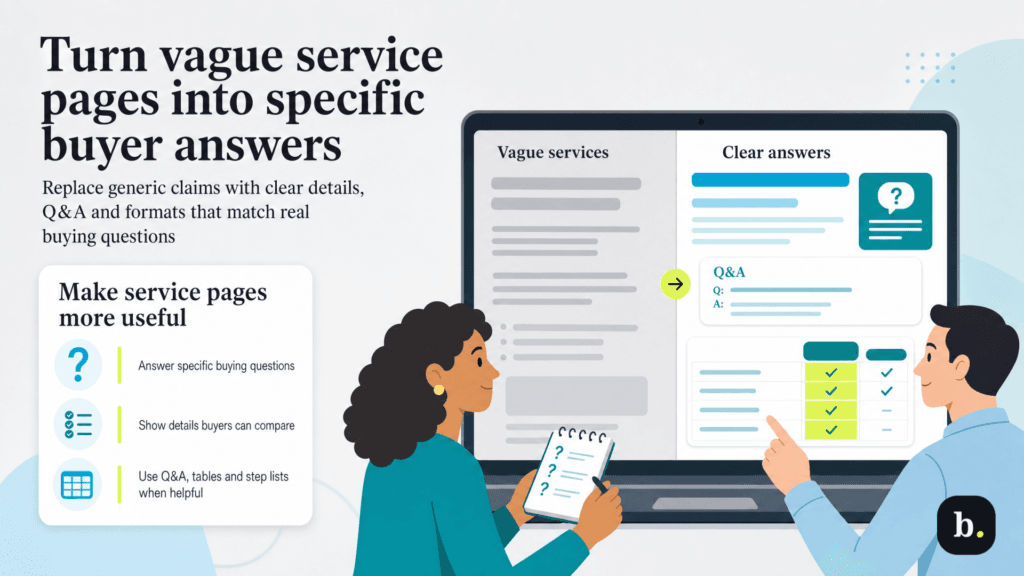
Use your question list to identify gaps in existing pages before commissioning new content. A detailed explanation added to a service page may be more useful than another blog post that repeats the same information.
For a hypothetical bookkeeping firm, a vague service description might say, “We offer comprehensive financial solutions.” A more informative version would explain that the firm handles monthly bookkeeping for small construction companies, specify whether job-cost reporting is included and describe what records customers must provide.
That detail gives customers something to evaluate. Follow it with answers to related questions, such as how onboarding works, which accounting systems the firm supports and whether tax preparation costs extra.
Choose formats that fit the information. A comparison table can clarify service packages; numbered steps can explain implementation. Microsoft recommends clear headings, questions and answers, lists and tables in its AI search content guidance. Use them when they improve understanding, without forcing every page into an identical template.
Show what your business knows from doing the work. A manufacturer might explain a material choice using its own test results. A consultant could describe how a project unfolded, including complications and what the team changed.
Useful evidence can include:
Identify who created or reviewed the content and why their background is relevant. Get permission before publishing customer information, and explain limitations when reporting results. One successful project does not establish an outcome every customer should expect.
In its current AI optimization guidance, Google advises, “Don’t just recycle what others on the internet have already said or could easily be produced by a generative AI model.” Apply that principle by giving readers information your business is qualified to contribute.
Look at the outside sources cited in answers to your priority questions. They may reveal places where customers encounter relevant industry information, such as trade publications, professional directories or review platforms. Evaluate whether those sources genuinely serve your audience before investing time in them.
Pursue opportunities that have value independently of AI visibility. Contribute useful expertise to a trade publication, maintain accurate professional listings and participate in industry discussions where you can answer real questions. Avoid repetitive promotional posts or placements chosen solely to insert your company’s name.
Invite customers to describe their actual experiences through an appropriate customer review process. Give honest feedback room to be specific, and respond constructively to concerns.
This work also belongs within your broader online reputation management strategy. Third-party coverage can shape customer perceptions even when it never produces a measurable AI mention.
Create a short list of facts that would cause problems if repeated incorrectly: your service area, business model, product capabilities, pricing, operating hours or ownership. Review those facts on your website and important third-party profiles whenever they change.
When an AI answer gets something wrong, save the answer and examine any cited sources. Correct your own pages first. If an outdated directory entry or article appears responsible, contact the publisher with a specific correction and supporting evidence.
Use the AI platform’s feedback mechanism where appropriate, too. Neither a submitted correction nor an updated source guarantees an immediate change, so keep a record and revisit the issue. If incorrect information is widespread, assess the scope and likely reputation management costs before outsourcing the work.
Record a baseline before making improvements. Save the questions, platforms, dates, answers and cited sources, then repeat checks under reasonably consistent conditions. Keep a separate log of page updates so you can investigate patterns without relying on memory.
Track different outcomes separately. A brand mention means your company is named; a citation links to a source; a referral brings someone to your website. Leads and sales require additional measurement.
Google’s Generative AI performance report provides impressions for supported Search features, including AI Overviews and AI Mode. The report may not appear if a site lacks sufficient impressions. Bing Webmaster Tools also reports citation activity across supported Microsoft AI experiences. Neither report counts every mention of your company across AI tools.
Use Google Analytics to examine identifiable website traffic and conversions. For a fuller monitoring workflow, see our guide to tracking brand mentions in AI search.
Search engine optimization (SEO) helps people discover your website through search. AI visibility adds questions about how an answer presents your brand and which information it uses. An answer could cite your article without naming your company in the response, or recommend your company using information from another website.
That makes your broader online presence relevant to the analysis. Check whether answers accurately explain your business, identify suitable use cases and link to useful information. A simple presence-or-absence count cannot tell you all of that.
Google describes optimization for its generative search features as part of SEO. Other platforms have their own systems and controls, so avoid assuming that a tactic documented for one engine is a universal requirement. Compare observations across platforms before deciding where to focus.
The biggest mistakes involve shortcuts that try to act as a substitute for useful information and sound website management. Avoid these common mistakes:
Start with a few important customer questions and the pages most closely connected to them. Assign an owner to each task and define an output you can review. This keeps the project focused while you learn which gaps deserve more investment.
Use the following schedule as a planning framework, rather than a promise that AI visibility will improve within a month.
Timing | Priority | Concrete output |
|---|---|---|
Week 1 | Establish a baseline and check access. | Saved answer samples and a list of technical fixes. |
Week 2 | Clarify business information. | Updated priority pages and business profiles. |
Week 3 | Improve answers and evidence. | A few substantive content updates or new resources. |
Week 4 | Review progress and remaining gaps. | An action list with owners and follow-up dates. |
At the end of the month, evaluate what you completed, what your monitoring shows and which issues remain unresolved. Keep the questions and measurement method stable enough to support comparison as the work continues.
The next priority should follow from a specific finding: an inaccessible page, an unanswered buying question or a recurring factual error. Addressing those problems gives customers better information and creates a practical basis for improving your brand’s AI search visibility.
