Business.com aims to help business owners make informed decisions to support and grow their companies. We research and recommend products and services suitable for various business types, investing thousands of hours each year in this process.
As a business, we need to generate revenue to sustain our content. We have financial relationships with some companies we cover, earning commissions when readers purchase from our partners or share information about their needs. These relationships do not dictate our advice and recommendations. Our editorial team independently evaluates and recommends products and services based on their research and expertise. Learn more about our process and partners here.
Cash flow is key for small businesses, and the payment terms and invoice workflows you implement can determine how quickly you get paid.


This article is sponsored by Intuit.
Invoice collections are usually treated as a follow-up problem. When the money comes in, that’s when someone starts chasing the client, and it can take some time before payment finally hits your account.
According to Intuit QuickBooks’ 2026 Small Business Late Payments Report, 59 percent of small businesses are carrying invoices overdue by 30 days or more, up from 47 percent the year before, with an average of $17,700 outstanding.
Although these numbers suggest late payments are simply part of doing business, you can reduce the impact through the terms you offer, the money you collect upfront, and incentives and penalties you attach. The follow up should come as a last resort, with these front-end policies and workflows doing most of the work to get you paid.
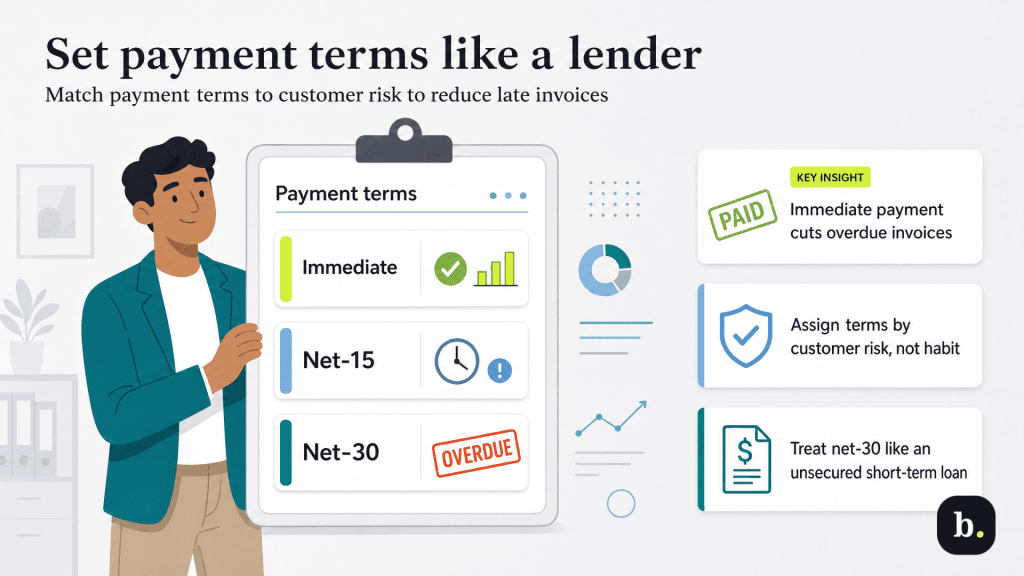
When you invoice a customer on net-30, you are effectively extending them an unsecured, interest-free, 30-day loan. You have already delivered the work, paid your own people and covered your own materials. Covering a 30-day gap between services rendered and collecting payment amounts to providing financing to your client.
The cost of this is your own financing that you have to arrange to cover the gap. In the Federal Reserve’s 2025 Small Business Credit Survey, 56 percent of firms that applied for financing said they were doing so to meet operating expenses, which was the most common reason cited. It’s reasonable to assume at least some portion of that borrowing is covering up an accounts receivable problem.
Intuit’s quarterly survey of roughly 5,000 small business owners and decision-makers found that more than half (55 percent) of businesses on net-30 terms had overdue invoices, compared with 26 percent of those requiring immediate payment. Terms alone don’t explain every late invoice, but the right terms can reduce the size of the problem.
Payment terms shouldn’t be a set default. They should be assigned deliberately, by customer, based on the same things a lender would look at: how long you’ve worked with them, how they’ve paid historically and how much of your monthly revenue is exposed if they stop paying. New customers and small jobs are where shorter terms cost you the least and protect you the most. Longtime customers and trusted relationships deserve the lead time that net-30 terms offer.
Payment terms should be based on a client’s actual history, not an expectation that’s never been met. A customer on net-30 who has paid on day 45 for two years isn’t really a net-30 customer. They’re also not likely to respond to a change in terms. Moving them to a net-15 will just mean the payment is overdue longer.
Instead, change payment terms where it makes sense:
One practical benefit of tracking actual behavior is that it makes cash flow planning far more accurate. Our guide to building a rolling cash flow forecast walks through slotting open invoices by expected payment date rather than due date.
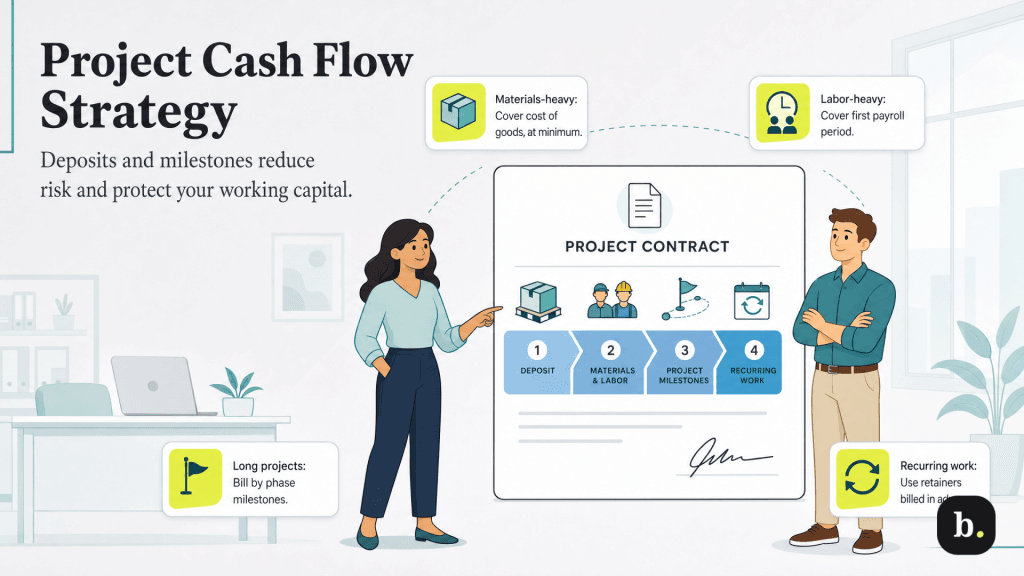
The fastest way to shorten a collection cycle is to collect part of the money before the cycle starts. A deposit changes what you are owed while a customer still needs the work done and has not yet received it. It also functions as a filter for clients that don’t actually have the budget to support your services.
Milestone billing provides built-in checkpoints throughout the project at which you get paid. This can provide additional liquidity for labor and materials as the project continues, preventing you from dipping into your capital reserves.
The right figure for a deposit covers your out-of-pocket exposure. Milestone billing should inject liquidity along the way to help you support the work. Work backward from what the job costs you to figure out the right structure. Consider the following:
When you have a choice, a deposit usually beats an early-payment discount. A deposit costs you nothing and reduces your exposure, while a discount costs you margin on revenue you would probably have collected anyway. Reach for the discount when the customer’s process genuinely can’t accommodate a deposit; many larger companies and public entities can’t issue prepayments, for example. Use a deposit everywhere else.
Most small business late fees are decorative. They appear in the footer of an invoice and are usually never applied. Clients know this, and some take advantage of it. To make sure your late fees have teeth, do the following.
A late fee that appears for the first time on an invoice is the weakest version of the term. Clients never agreed to it beforehand and it comes along after the work has already been completed.
Instead, late fees belong in the signed contract, the accepted proposal or the purchase order terms. If you work from a standard services agreement, make this revision today so it applies to every client you sign in the future.
Any fees you charge should look like a reasonable estimate of what late payment costs you. This includes your carrying cost on the money plus the administrative cost of chasing it. Commonly, late fees are a small percentage of the outstanding balance, charged on a monthly basis. A flat fee that dwarfs the invoice likely wouldn’t stand up in court, where it would be read as a punishment rather than compensation.
Selective enforcement undermines late fees. If you waive the fee for some customers and not others without a documented reason, you create a fairness argument for the customer who got charged. Decide whether you are going to use the fee. If you are, use it every time it applies.
Additionally, a grace period helps. Building in 10 to 15 days after the due date before the fee applies builds goodwill with clients, gives legitimate processing delays room to resolve and reads as reasonable should you later end up in court.
Everything above happens before the invoice goes out. Once it’s with the client, you can still influence things based on your follow up cadence and the available payment methods by which customers can settle their bill.
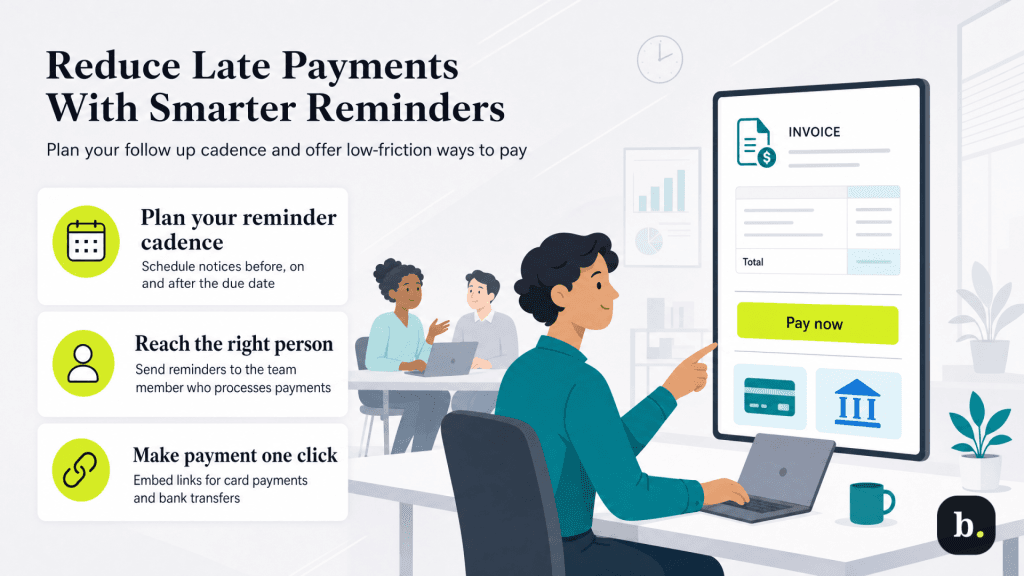
The point of a follow up cadence is that no one has to decide when to chase a client for payment, and no invoice slips through the cracks because someone forgot to follow up. Here’s an example of a strong follow up cadence:
Make sure reminders go to the person who actually processes payments rather than the person who hired you. At larger companies, these are often different people. Additionally, escalate the sender as the cadence advances. A message from the owner is usually taken more seriously than a system notification.
Sometimes a delay in payment isn’t a matter of reluctance but logistics. An invoice that requires a customer to look up your banking details, write a check or route a request through their own approvals will sit longer than one they can pay with the click of a link. An embedded payment link that accepts card payments and bank transfers removes several steps between the decision to pay and the actual payment.
Remember that getting paid and receiving the money are not the same thing. ACH transfers and card payments typically take one to three business days to clear, and Intuit’s report found that 49 percent of owners say standard processing times create critical or moderate cash-flow gaps even after the customer has paid. Nearly 3 in 5 (59 percent) said they paid for instant transfer or fast deposit at some point in 2025. That’s a waste of money if you build the settlement periods into your cash flow forecast.
The above workflow requires a few features: recurring invoice templates so repeat billing goes out without being re-created; scheduled payment reminders to clients that you don’t have to trigger manually; per-customer terms so you can assign different terms to different accounts; an embedded payment method that works inside the invoice; and automatic matching of payments against open invoices so your receivables report reflects reality without manual reconciliation.
QuickBooks Online covers this entire set. Invoice templates carry your payment terms and can be edited per customer for accounts with negotiated arrangements. Recurring invoices go out on a schedule without being rebuilt each cycle. Automatic reminders can be scheduled relative to the due date. Adding a payment option to the invoice lets customers pay by card or bank transfer, and those payments are matched and recorded against the invoice, so the receivables view stays current. See our QuickBooks Online review for a closer look at how the invoicing and payments features perform.
Whichever platform you use, adhering to the sequence above is what matters. Terms and deposits determine most of your collection cycle before an invoice exists. Discounts and late fees shape behavior at the margins. Reminders and payment friction handle what’s left. Owners working on the invoice itself should also review our guidance on how to write an invoice and, for those extending terms as a way of establishing trade references, our guide to building business credit.
