Table of Contents
If you’re looking for a way to generate more sales leads and improve your marketing mix, direct mail marketing should be a serious consideration. Although digital marketing initiatives, like pay-per-click strategies and social media marketing campaigns, have stolen the spotlight, direct mail marketing isn’t a thing of the past. It’s still a versatile and powerful way to expand your business.
Searching for a direct mail service and not sure where to start? Tell us a little more about your business and get customized quotes from qualified providers.
Direct mail options include flyers, postcards, letters and even packages. Postcards and letters are two of the most popular options, but the type of mail you choose will depend on your business and your marketing campaign’s goals. We’ll explain the differences between postcards and letters to help you decide on the right medium, create effective direct mail marketing campaigns, and measure and improve your marketing return on investment (ROI).
What are the benefits of postcards in direct mail marketing?
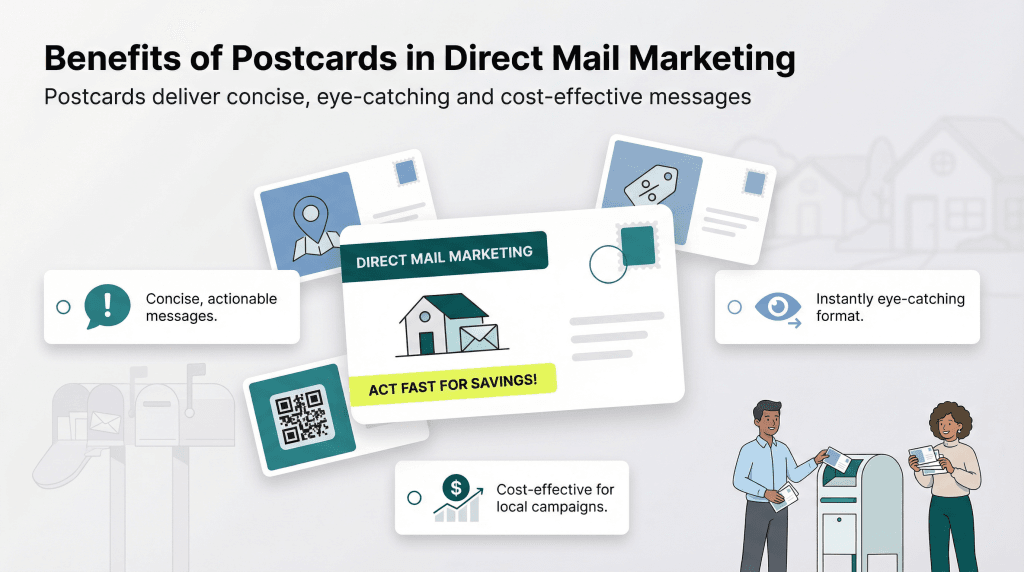
Mailing eye-catching, personalized and straightforward postcards is an effective offline marketing strategy. Here are some top benefits of using postcards in direct mail marketing.
Postcards are concise.
Brevity is a significant advantage of postcards. You can use a postcard to deliver a single, compelling message to a potential customer. Because the postcard has limited space, your copy can focus on a persuasive call to action (CTA). A CTA is a direct prompt for the response you want from your audience in a mailing campaign — the ultimate purpose behind your postcard marketing campaign. For instance, a CTA might ask the customer to sign up for a subscription at a discounted rate, visit your website to check out the latest sales, subscribe to your blog or call a number for a free quote.
If your direct mail campaign aims to drum up interest in or announce something — like a store reopening, a new product or an important annual sale — postcard marketing can be an inexpensive and effective way to do that.
Alec Boye, president of Mail Processing Associates, recommends postcards for time-sensitive offers, like flash sales or limited-time discounts, where you want to catch the recipient’s attention immediately. Because postcards don’t require opening, they’re excellent for delivering quick, impactful messages.
“[They’re] ideal for announcements or driving foot traffic to an event,” Boye said. “Additionally, postcards often produce a better ROI in campaigns targeting local markets or specific demographics where a concise, visually engaging message can be more effective than a lengthy letter.”
Postcards are eye-catching.
Unlike with letters, recipients don’t have to open postcards, allowing you to catch the customer’s eye right when they open their mailbox. In other words, because of their very nature, your postcard will have a 100 percent “open rate.”
Along with their readability, postcards are relatively affordable to print in full color, and it’s easier to get noticed with color-saturated photos and graphics.
Postcards are customizable.
Postcards are incredibly customizable, especially with today’s printing technology. Variable data printing — a digital technique that lets you change text, graphics and images on each individual mailer — makes it easy to tailor your message to different customers. You can personalize postcards to guide someone to your website, highlight a nearby store location or promote an offer that aligns with their past behavior. Many of the best customer relationship management (CRM) software solutions also integrate with mailing lists, making it simple to personalize your postcards at scale.
Personalization isn’t just a nice touch: It meaningfully improves performance. SG360’s 2025 Future of Direct Mail report found that personalization remains a top expectation among recipients, and marketers who personalize across five key areas (offers, geography, imagery, messaging and names) see a 19.4 percent increase in conversions. Similarly, Lob’s 2025 State of Direct Mail report notes that 88 percent of marketing executives say personalization significantly boosts response rates.
Together, these findings reinforce what many small businesses already see firsthand: Customizable postcards feel more relevant, stand out more easily and drive stronger results.
Postcards are cost-effective.
Postcards are one of the most affordable direct mail formats, especially when you use USPS’s Every Door Direct Mail (EDDM) service. EDDM postage is just 24.7 cents per piece, compared with 78 cents for a standard 1-ounce First-Class letter. For a 5,000-piece campaign, that price gap adds up quickly; postcards let you reach the same audience for a fraction of the mailing cost.
Printing costs vary by paper weight, size and vendor, but many small businesses see total postcard costs fall between 45 and 70 cents per piece, including postage. That makes postcards a budget-friendly option for announcements, promotions and short, eye-catching messages.
Letters, by contrast, almost always cost more. Between envelopes, inserts, additional printing and the higher 78-cent First-Class postage rate, a 5,000-piece letter campaign typically lands in the $1 to $1.20 range per piece. (Bulk letter campaigns may qualify for lower USPS Marketing Mail rates, often in the 40- to 60-cent range for postage, which can bring total letter costs closer to 60 to 90 cents per piece. Even then, postcards usually remain the more economical option.)
What are the benefits of letters in direct mail marketing?
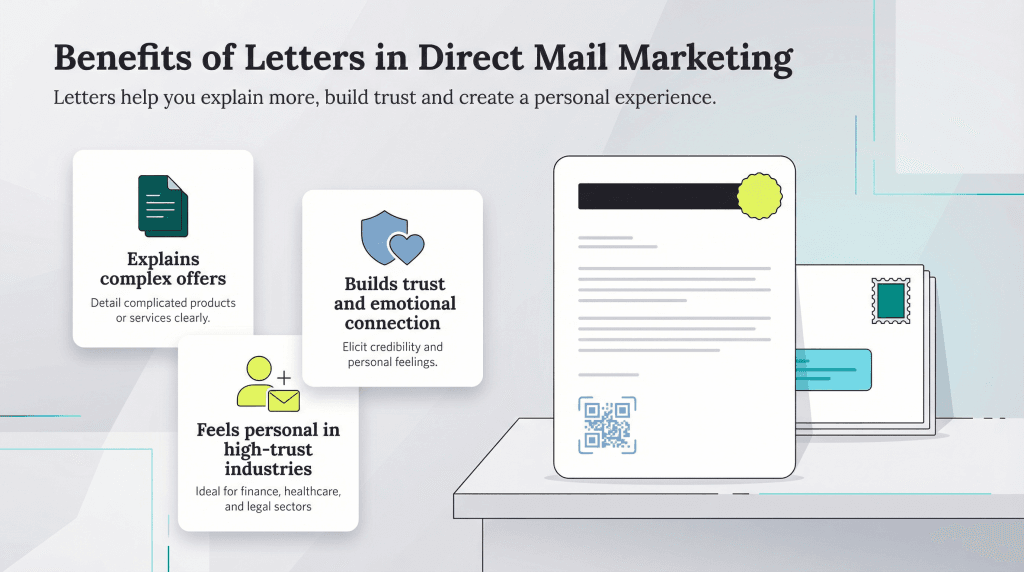
Like postcards, direct-mail letters can be a highly effective marketing tool. Here are some reasons letters may be the better choice for certain campaigns.
Letters provide more room for your direct-mail message.
Because letters offer more space, they’re ideal when your mailing needs a more official or personal tone or requires an in-depth explanation. The larger page area gives you room to:
- Deliver a more comprehensive message
- Demonstrate that you’re invested in the customer
- Incorporate brand storytelling
- Address customer emotions
- Add a personal, human touch
- Incorporate inserts
For services that require explanation — such as financial planning, insurance or nonprofit fundraising — a letter can walk readers through important details or clarify complex offerings.
“In financial services or healthcare, where understanding the nuances of a product or service is critical, a letter provides the necessary space to convey that complexity,” Boye explained.
Letters also make sense when you’re asking for engagement, such as a donation, a signed document or an RSVP. The format gives you room to explain why the request matters and to outline the next steps clearly.
Letters build trust.
Letters help businesses form deeper emotional connections with recipients.
“Letters allow you to build trust and provide thorough information, which is essential when asking recipients to make significant commitments, such as enrolling in a long-term service or making a substantial purchase,” Boye said. “A well-crafted letter not only informs but also reassures, making it an ideal medium for more formal and intricate communications.”
Letters feel personal.
You can customize letters and envelopes with various design elements to make them feel more personal to the recipient. For example, you can hand-address a letter or use a pen-addressing machine.
Additionally, snap-pack mailers’ unique designs can convey important messages. You can even design your direct mail envelope and letter to look like an invitation, making the recipient feel more valued and increasing open rates.
Letters excel in regulated or high-trust industries.
Certain industries rely heavily on letters because they allow for private, compliant and more formal communication. According to Lob’s State of Direct Mail 2025 report (cited above), letters are the most commonly used format for businesses in the financial services arena (72 percent) and in healthcare (80 percent) — two sectors where a one-to-one, trustworthy approach is essential.
Letters give these businesses the ability to share detailed information, meet regulatory expectations and communicate in a format customers take seriously. If your offer involves sensitive data, complex explanations or a need for added credibility, a letter is often the best fit.
Capitalizing on the best direct mail marketing strategy for your business
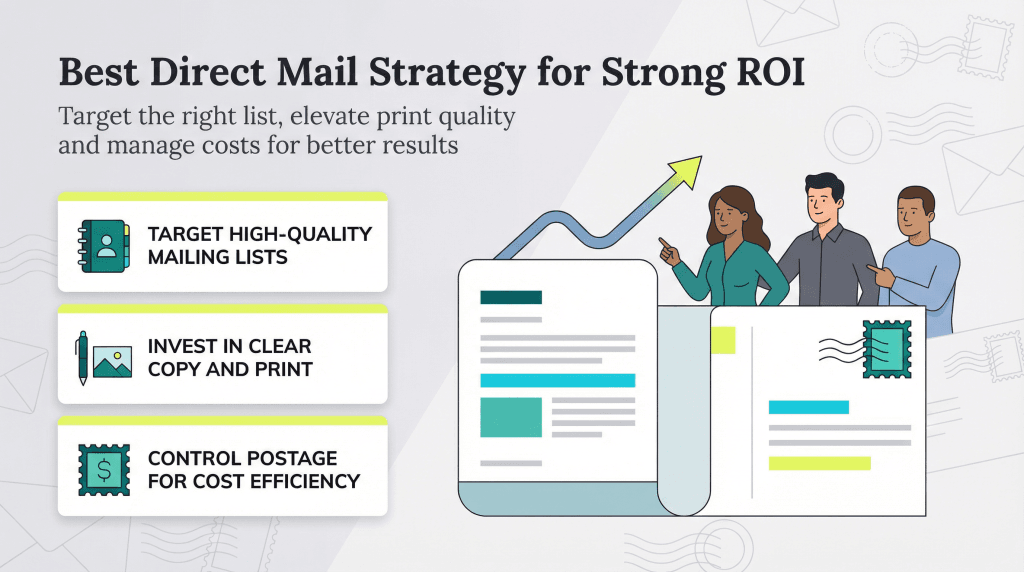
Direct mail remains one of the most versatile marketing channels available, offering formats and tactics for nearly every budget, industry and campaign objective. It’s also backed by strong performance data. The latest research from the Association of National Advertisers shows that direct mail sent to house lists delivers an average ROI of 161 percent, making it one of the highest-return channels in the study.
Still, getting the most out of your direct mail campaigns requires thoughtful strategy and execution.
“List sourcing is crucial,” Boye stressed. “You need to ensure your message reaches the right audience, whether through a purchased list or your own CRM database.” He also emphasized the importance of high-quality materials: “The quality of your collateral — this includes well-crafted copy, compelling graphics and high-quality print — is essential to capture attention and convey your message effectively.”
Controlling costs matters too. “[You must] select the most economical postage method without compromising delivery speed, as this can significantly impact your ROI,” Boye cautioned.
Both letters and postcards can play a significant role in a successful direct mail strategy, offering flexibility, personalization and the kind of tangible brand experience that digital channels alone can’t match. If you want support executing your campaigns or exploring more advanced options, consider partnering with a direct mail marketing service that can help you design stronger pieces and streamline the entire process.
Mark Fairlie contributed to this article. Source interviews were conducted for a previous version of this article.
- The Best CRM Software of 2026

- The Best Text Message Marketing Services of 2026

- The Best Email Marketing Services and Survey Software of 2026

- 15 Retail Marketing Strategies to Better Market Your Store

- Hitting the Books: A Guide to Retail Accounting

- Repeat Business: 8 Ways to Keep Your Customers Coming Back

- Cash Register Buying Guide: POS vs. Cash Registers vs. Tablet mPOS

- Your Guide to Creating a Small Business Marketing Plan

- Financing Your Retail Store

- Guide to Credit Card Processing Fees