Business.com aims to help business owners make informed decisions to support and grow their companies. We research and recommend products and services suitable for various business types, investing thousands of hours each year in this process.
As a business, we need to generate revenue to sustain our content. We have financial relationships with some companies we cover, earning commissions when readers purchase from our partners or share information about their needs. These relationships do not dictate our advice and recommendations. Our editorial team independently evaluates and recommends products and services based on their research and expertise. Learn more about our process and partners here.
Impostor syndrome can leave employees struggling with self-doubt and affect your workplace culture. Here’s what you need to know to support your employees.

At some point, we’ve all had that nagging feeling that we are professionally inadequate. These feelings are completely normal after we start a new job, accept a promotion or take on a challenging task. But for some people, these moments can grow into “impostor syndrome,” or chronic feelings of unworthiness.
It is crucial to identify and address impostor syndrome when it begins to become part of your workplace culture. If ignored, it can cause preventable stress and contribute to a toxic work environment.
The concept of impostor syndrome, introduced by psychologists Pauline Clance and Suzanne Imes, is a person’s lack of confidence in their job performance. They may feel they don’t deserve their job or were given the job by mistake.
People with imposter syndrome tend to doubt their own skills in the workplace, said Bisma Anwar, a Talkspace therapist, licensed mental health counselor and head of Talkspace’s content clinical marketing team.
“They feel like, ‘I’m a fraud,’ even though they might have achieved certain things and had successes,” Anwar said. “There’s an underlying worry that other people will recognize that they’re not good enough and they’ll kind of find them out.”
Impostor feelings can persist even when an individual consistently exceeds performance goals and earns the respect of their peers. These are some signs of impostor syndrome:
Impostor syndrome affects 71 percent of CEOs and 65 percent of senior executives, according to a recent survey by consulting firm Korn Ferry, but it’s prevalent among workers across all stages of their career. An estimated 49 percent of midlevel leaders, 52 percent of first-level supervisors and managers, and 33 percent of non-leader individual contributors struggle with it. Given the prevalence of imposter syndrome, it’s imperative to support employees.
Imposter syndrome is somewhat more prevalent in women than in men, according to research published in the journal Current Research in Behavioral Sciences. However, anyone can be affected, according to Valerie Young, an internationally recognized expert on impostor syndrome and co-founder of the Impostor Syndrome Institute.
“I’ve met many men who painfully experience impostor syndrome, and there are plenty of academic studies that bear that out as well,” Young said.
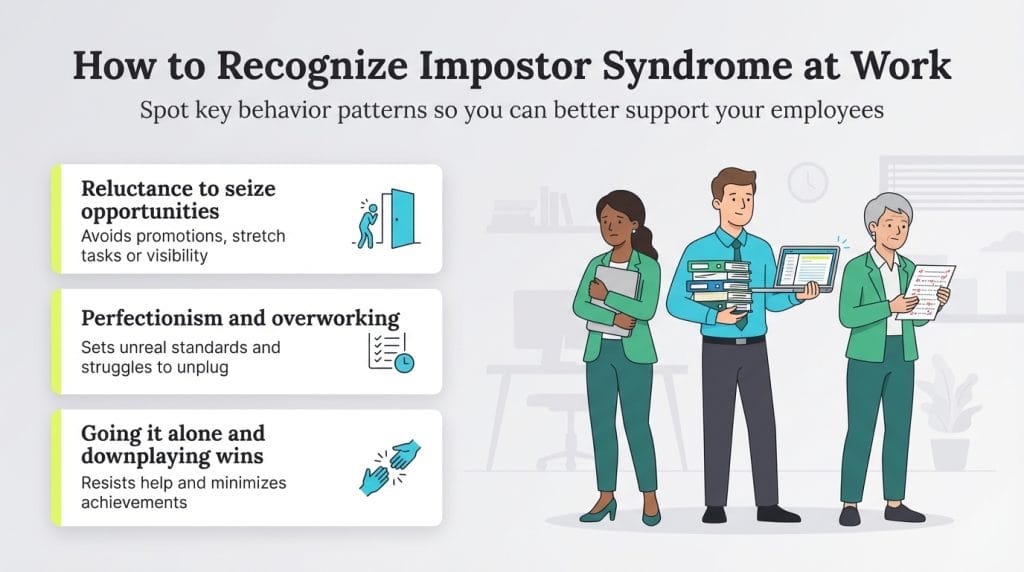
Rather than focusing on gender, employers should be on the lookout for the following ways impostor syndrome can manifest among their employees.
A hesitation to step forward often signals self‐esteem issues. Employees suffering from impostor feelings may reject promotions, decline complex assignments or delay projects claiming they aren’t “ready.” They may also be noticeably reticent when asked to discuss their own successes.
Perfectionism is a giant red flag. When you hear people lightheartedly call themselves perfectionists, pay attention to see if they really embrace the behavior. True perfectionists set unhealthy and unrealistically high performance goals and then criticize themselves harshly when they don’t meet those objectives. The fear of failure can cause severe anxiety or compulsive behavior. They are constantly afraid they won’t measure up to an unachievable ideal and will be exposed as frauds.
These are some signs of perfectionism in employees:
Young cautioned that although there are circumstances when perfectionism and other red flags can indicate impostor syndrome, that’s not always the case. “Perfectionism can be the clue, but sometimes it’s hard to separate [it] from a healthy drive to excel,” Young said.
Employers should be on the lookout for extreme examples of perfectionism and other red flags that show up as part of a pattern of behavior, Young said.
While a dedicated employee is an asset, be cautious of those who seem unable to unplug. Employees who work all the time may be motivated by the belief that they are not skilled enough and need to work harder to measure up to their colleagues.
An employee whose impostor syndrome manifests as workaholism may show these signs:
“Overworking comes from a fear of making mistakes, so it can be linked to perfectionism,” Anwar said. “They never feel like the work is good enough, so they need more time or resources to ‘make it perfect,’” Anwar said.
Employees who don’t accept help from others may feel they need to go it alone to prove their worth. They may believe asking for help will reveal them as impostors who are not up to the task. These are some signs of individualism motivated by impostor syndrome:
People with imposter syndrome might brush off their own accomplishments, Anwar said. “They might put their success onto other factors or other people rather than acknowledging that this was because of their own skill set, because there’s such underlying doubt when it comes to their own capacities and capabilities,” Anwar said.
Recognizing these signs is the first step toward creating a workplace that helps employees overcome their self-doubt.
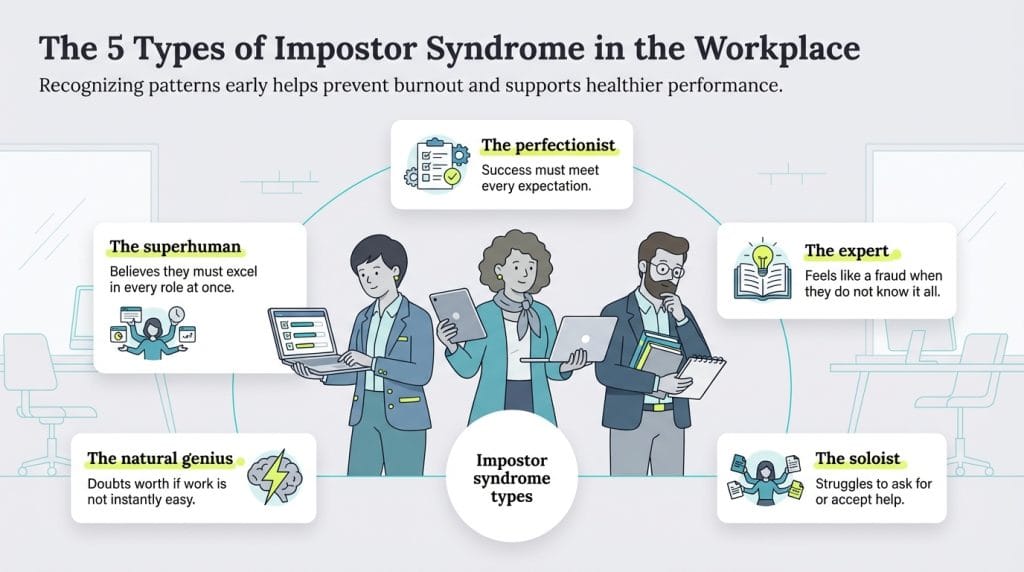
According to Young’s work, there are five types of impostor syndrome. Understanding these five types and how they manifest in the workplace can help employers recognize impostor syndrome.
Recognizing these archetypes allows you to intervene before burnout sets in. If you spot these patterns, it is time to implement organizational changes.
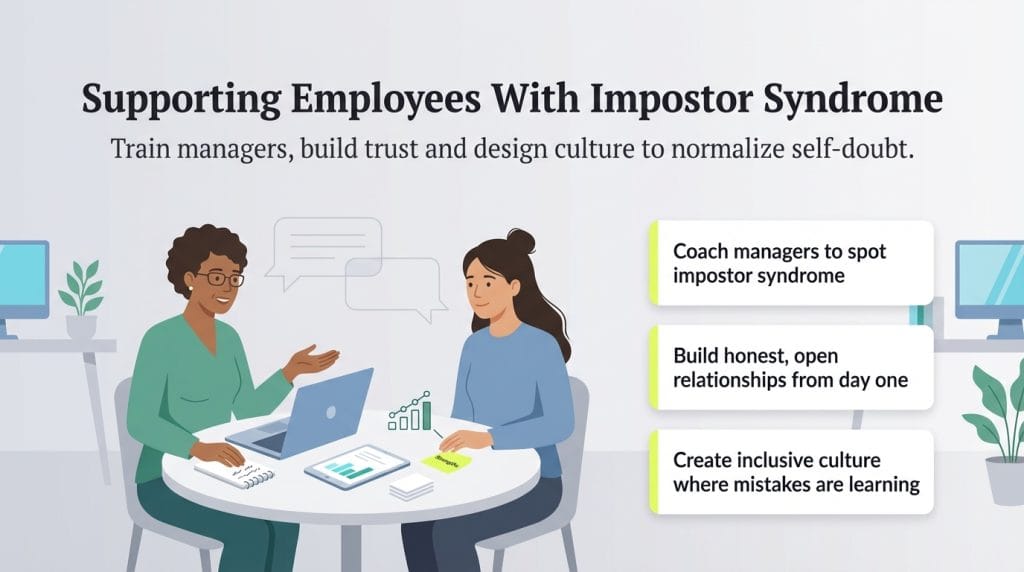
Overcoming impostor syndrome requires a collective effort. The following strategies can help you mobilize your entire organization to create a supportive environment.
Managers should play a prominent role in supporting and encouraging employees, yet few are well equipped to tackle impostor syndrome among their team members.
People with impostor syndrome have an inner critic telling them they are not good enough, they’re frauds and they will be revealed as fakes. It doesn’t work to argue with this inner critic. It can even backfire. Employees who experience impostor syndrome might feel more stressed if they think their managers overlook those feelings.
Instead, managers should engage with employees who experience self-doubt. Educate managers on the various signs of impostor syndrome, and coach them to let their employees know that fears and self-doubt are natural parts of work life. An employee’s goal should not be to strive for supreme self-confidence but rather to handle self-doubt better. Managing these feelings can help them distinguish between realistic and unrealistic concerns.
Naming and explaining impostor syndrome in manager training and during the onboarding process can help managers become aware of its causes and signs, Young said.
“I think if you lead, manage, mentor or train other people, you need to understand imposter syndrome because there are costs and consequences, not just for individuals but also for the organization,” Young said.
Your employees need to have trusted relationships so they can discuss topics such as self-doubt. Social activities and mentoring can help employees feel more comfortable opening up to other team members about how they’re coping with their work.
HR departments should go beyond interviews. Mentoring is an important part of a successful onboarding process and helps to develop relationships with employees from day one. Let them know that the door is always open if they need to talk about anything, including impostor syndrome.
Impostor syndrome often convinces employees they are deceiving their peers, a perception that is typically baseless.
However, impostor syndrome should also be a red flag for the employer. If an employee’s job description doesn’t align with their skills, you could be partially to blame for the impostor syndrome.
Playing to your employees’ strengths can boost their creativity, encourage innovation and improve employee engagement. Plus, your employees will gain confidence and reduce their feelings of inadequacy.
If employees exhibit signs of impostor syndrome or name the condition directly, you should treat them sincerely. If you have struggled with impostor syndrome yourself, consider sharing your story, including what triggered it and how you overcame such feelings.
Have honest conversations about setting better business goals and what you expect from each employee. If an employee feels inadequate, ask them to explain why they think that way. For example, they may have misinterpreted their job requirements, the position may not be a good fit for their skills, or the work environment may not be welcoming.
Maintain an open-door policy to keep communication lines open, Anwar said. “Check in regularly with employees, especially focusing on the newer employees who are still settling into their jobs,” Anwar said. “This is a good time to develop some rapport and make them feel like they have a safe space to be able to discuss whatever is going on.”
A workplace culture with severe repercussions for failure is likely to encourage perfectionism, workaholism and impostor syndrome among its employees. Ask yourself if your company sees failure as a dead end or a learning opportunity. It’s vital to send a clear message to your employees that mistakes happen and they don’t have to be a source of shame.
Encourage your executives, when appropriate, to share their experiences with failure and self-doubt. Set the tone that it’s OK to make mistakes and that leadership is about managing self-doubt rather than constantly feeling confident.
“One thing [managers] can do is share some of their own personal stories of challenges and the mistakes they may have made earlier in their career,” Anwar said. “That gives employees a sense of, ‘OK, this is part of the process; everybody makes mistakes; it’s not just me.’”
By coaching your managers, building relationships that make employees feel safe to open up, and creating a workplace culture that learns from failure, you’ll involve everyone in your organization in stopping impostor syndrome. In addition, deepening the relationship will help your employees do their best and ensure a positive and productive workplace.
The term “impostor syndrome” has been criticized for blaming women and people of color for feeling like impostors, without taking into account societal biases, like racism and sexism, that contribute to those feelings. Recognizing impostor syndrome without acknowledging workplace bias can be a form of gaslighting.
Gaslighting is a form of psychological manipulation that causes us to question reality. It is prevalent in the workplace and our personal lives. Recent research attempts to bridge both the individual experience of feeling like an impostor with the impacts of collective biases, such as systemic racism and sexism, that show up in the workplace.
Listening to and being transparent about hurdles and biases can build trust. Help employees succeed by consistently leveraging your influence for promotions and equal benefits.
Employers and managers should be mindful of the diversity of their workforce, both overall and specifically in leadership positions. White men are disproportionately represented in leadership roles compared with women and people of color, so promoting diversity and inclusion is crucial.
Companies can take these steps to encourage an inclusive workplace:
Beyond race and gender, risk factors for impostor syndrome stem from a sense of not belonging in the workplace. “The more people who look like you or sound like you, the more confident you feel,” Young said.
People who are the sole representatives of their particular group in a workplace — whether it’s related to race, ethnicity, disability, language, gender, age, education level or something else — can sometimes feel underestimated because of that social group membership, Young said.
For example, someone might be more susceptible to impostor syndrome if they work at a law firm where they are the only employee who didn’t attend Harvard Law School, Young said.
“I would make the case that any time you’re on the receiving end of stereotypes, very specifically about competence or intelligence, you’re susceptible,” Young said.
Affirmation is just as vital in the workplace as it is in our personal relationships. Workers with impostor syndrome constantly feel like they are insufficient. By relating to your employees as human beings, you can show them they are valued team members and accept them (and their skills and abilities) for who they are.
Once this relationship is established, you can recognize employees’ professional accomplishments, such as by praising them for meeting performance goals, celebrating their achievements publicly and encouraging them to utilize their strengths.
Erin Donaghue contributed to the reporting and writing in this article. Source interviews were conducted for a previous version of this article.