Whether you need a separate bank account for your business is often one of the first questions new business owners ask. The answer depends largely on how your business is structured. There’s no blanket federal law that requires every business to maintain a dedicated bank account, but for most business owners, operating without one creates real legal, financial and operational risks that far outweigh the minor inconvenience of opening a new account.
In short: you might not be legally required to have one, but you almost certainly should.
If you need a separate bank account for your business, consider our picks for the
best business bank accounts. These services make it easy to get up and running quickly, setting your business up for long-term fiscal success.
What does your business structure require?
The answer to whether you need a separate account starts with how your business is organized. Different entity types carry different levels of legal obligation when it comes to financial separation.
Sole proprietors and freelancers
If you’re operating as a sole proprietor or freelancer without a formal business entity, there’s no legal requirement in most states to maintain a separate bank account. The IRS treats you and your business as one and the same for tax purposes: your business income and expenses are reported on Schedule C of your personal tax return.
However, “not required” and “not recommended” are two very different things. Using a personal account for business transactions makes it significantly harder to track deductible expenses, increases your audit risk and creates headaches at tax time that can cost you real money in missed deductions or accountant fees. The IRS itself recommends that sole proprietors maintain separate accounts to simplify recordkeeping.
For sole proprietors who are just testing the waters with a side project or earning minimal revenue, a personal account may be a workable short-term solution. But it should be treated as a temporary bridge, not a permanent arrangement.
LLCs
For limited liability companies, a separate bank account isn’t just a best practice, it’s functionally essential to preserving the liability protection you formed the LLC to get.
The entire point of an LLC is to create a legal separation between your personal assets and your business obligations. If your business is sued or defaults on a debt, your personal savings, home, and other assets should be protected. But that protection depends on you actually treating the LLC as a separate entity. One of the most fundamental ways to do that is maintaining separate finances.
When an LLC owner routinely deposits business revenue into a personal checking account, pays business expenses from a personal credit card, or otherwise blends business and personal funds, courts can invoke a doctrine called “piercing the corporate veil.” This legal concept allows a court to disregard the LLC’s liability protection entirely, holding the owner personally responsible for the business’s debts and obligations.
Courts examine several factors when deciding whether to pierce the veil, but commingling funds is consistently one of the most common triggers. Other factors include failing to maintain an operating agreement, inadequate capitalization of the business and using the LLC as an alter ego (essentially treating it as an extension of your personal finances rather than a distinct entity.) The more of these factors that are present, the weaker your liability shield becomes.
Single-member LLCs are particularly vulnerable. When one person controls every aspect of the business, courts have an easier time concluding that there’s no real separation between the owner and the entity. Maintaining a dedicated business bank account is one of the simplest and most effective ways to demonstrate that your LLC operates independently.
Corporations (S-Corp and C-Corp)
For corporations, financial separation is non-negotiable. Corporations are subject to stricter governance requirements than LLCs, including maintaining corporate records, holding shareholder meetings and keeping finances clearly distinct from those of the shareholders.
Using corporate funds for personal expenses or running personal funds through the corporate account is one of the fastest ways to lose your corporate liability protection. Courts hold corporations to a higher standard when evaluating whether the corporate veil should be pierced, and the consequences of commingling are more severe.
If you’ve elected S-Corp or C-Corp status, opening a business bank account shouldn’t even be a question — it should be one of the first things you do after incorporating.
Partnerships
Partnerships face similar considerations to LLCs. A dedicated business account simplifies profit-and-loss allocation among partners, provides clear documentation for each partner’s contributions and distributions, and helps protect individual partners from personal liability. Even general partnerships, which don’t offer the same liability protection as LLCs or corporations, benefit from the organizational clarity that a separate account provides.
Risks of using a personal account for business
Even if your business structure doesn’t strictly require a separate account, using a personal account for business transactions creates tangible risks that compound over time.
Legal liability exposure
As discussed above, commingling funds is one of the primary reasons courts pierce the corporate veil. But the risk isn’t limited to dramatic courtroom scenarios. If a vendor sues your LLC for an unpaid invoice and discovers that you’ve been running business revenue through your personal checking account, that fact alone strengthens their argument that your LLC isn’t a truly separate entity. What was supposed to be a claim against your business can quickly become a claim against you personally.
It’s worth emphasizing that courts view veil-piercing as a last resort, not a default outcome. But the case law is clear that owners who fail to maintain basic financial separation are far more likely to lose their liability protection than those who do. Opening a business bank account is one of the easiest ways to stay on the right side of that analysis.
Tax and audit complications
The IRS has historically scrutinized sole proprietors and small business owners more closely than other filers, particularly those reporting income on Schedule C. Commingling business and personal transactions in a single account makes it significantly harder to substantiate your deductions if you’re audited.
When business and personal expenses are mixed together, every transaction becomes a potential question mark. Was that lunch a business meal or a personal one? Was that software subscription for work or personal use? An auditor reviewing a bank statement full of mixed transactions has reason to question everything, including deductions you’re legitimately entitled to.
Separate accounts create a clean paper trail. Business expenses come from the business account; personal expenses come from the personal account. This distinction dramatically simplifies tax preparation, reduces the risk of errors on your return, and gives you a clear defense if the IRS ever comes knocking.
The practical cost is real, too. Accountants typically charge more to prepare returns when they have to sort through commingled transactions, and the extra time spent untangling mixed records can easily exceed what you’d spend on a basic business checking account.
Operational and credibility issues
Beyond legal and tax considerations, using a personal account for business creates day-to-day friction. You can’t accept payments under a business name through a personal account at most banks. Merchant services providers and payment processors typically require a business account. And clients, vendors and partners generally expect to transact with a business, not an individual’s personal checking account.
There’s also the long-term relationship angle. Establishing a business banking relationship early gives you a foundation for future credit lines, small business loans and other financial products. Lenders want to see a track record of business deposits, cash flow management and responsible account usage. That history starts the moment you open a business account.
When a personal account might be a temporary bridge
There’s a narrow window where using a personal account for business is understandable, if not ideal: when you’re in the earliest stages of testing whether a business idea is viable.
If you’re a sole proprietor picking up occasional freelance work, selling products at a local market a few times a month, or exploring a side project that hasn’t generated meaningful revenue, opening a business account on day one may feel premature. In these cases, using your personal account for a short period — a few weeks to a couple of months — while you validate the concept is a reasonable, if imperfect, approach.
The key is recognizing the triggers that signal it’s time to make the switch: your first recurring client, revenue that exceeds a few hundred dollars per month, the decision to formalize with an LLC or the realization that you’re spending real time sorting business from personal transactions at tax time. When any of these occur, the personal account has served its purpose, and it’s time to move on.
A quick note on digital payment platforms: tools like PayPal Business, Venmo for Business and Cash App for Business can be useful for accepting payments, but they are not substitutes for a business bank account. They lack the features, protections and banking relationships that a dedicated account provides, and relying on them exclusively can create the same commingling risks discussed above.
How to open a business bank account
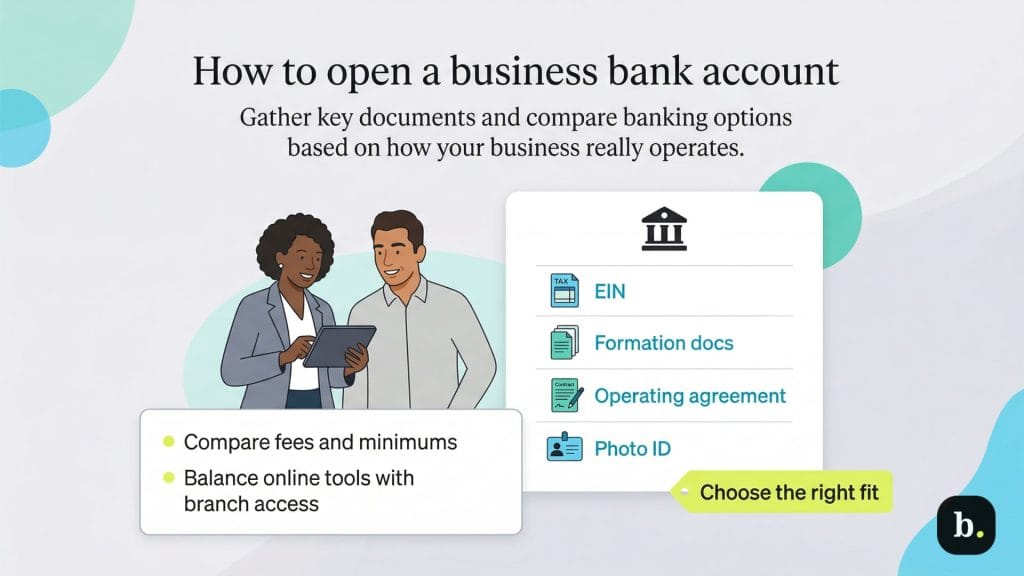
Opening a business bank account is a straightforward process. Here’s what you’ll typically need:
- An Employer Identification Number (EIN). Think of this as your business’s Social Security number. You can apply for one for free through the IRS website and receive it immediately if you apply online. Sole proprietors without employees can technically use their SSN, but an EIN is strongly recommended — it protects your personal information and begins establishing your business’s independent identity.
- Business formation documents. For LLCs, this means your articles of organization. Corporations will need articles of incorporation. Sole proprietors with a DBA (doing business as) will need their DBA registration.
- An operating agreement (for LLCs). Not all banks require this, but many do, especially for multi-member LLCs. It’s good practice to have one regardless.
- A valid government-issued photo ID. A driver’s license or passport for anyone who will be an authorized signer on the account.
When choosing a bank, consider fees (monthly maintenance, transaction limits, cash deposit charges), minimum balance requirements, integration with your accounting software, mobile banking features and whether you need branch access for cash deposits. Online banks tend to offer lower fees and higher savings yields, while traditional banks provide in-person service and stronger lending relationships. Many small business owners find that evaluating these tradeoffs based on how they actually use their account, rather than brand reputation, leads to a better fit.
Transitioning from a personal account
If you’ve been using a personal account for business and you’re ready to make the switch, the transition doesn’t have to be complicated.
Start by opening your new business account and redirecting incoming payments — client invoices, payment platform deposits, recurring revenue — to the new account. Update any automated payments or subscriptions that are billed to your personal account for business purposes. Keep your personal account active and monitor it for any straggling business transactions for 60 to 90 days.
On the recordkeeping side, document the period during which you used your personal account for business. Note which transactions were business-related and ensure your accounting records reflect the separation clearly, even if the bank statements don’t. This documentation will be invaluable if you’re ever audited for the period before you made the switch.
The most important thing is to make the transition cleanly and completely. Once your business account is active, commit to using it exclusively for business transactions. The discipline of maintaining separation is what protects you, the account itself is just the tool.