Business.com aims to help business owners make informed decisions to support and grow their companies. We research and recommend products and services suitable for various business types, investing thousands of hours each year in this process.
As a business, we need to generate revenue to sustain our content. We have financial relationships with some companies we cover, earning commissions when readers purchase from our partners or share information about their needs. These relationships do not dictate our advice and recommendations. Our editorial team independently evaluates and recommends products and services based on their research and expertise. Learn more about our process and partners here.
VR can create immersive ads for brands.


Virtual reality (VR) and augmented reality (AR) have transitioned from novelty concepts to essential business tools. Through immersive technology, users can experience branded narratives, visit digital locations without travel and interact with products as if they were using them in real life.
VR advertising leverages this immersion to create seamless, real-world experiences of a company’s products or services. The market potential is vast; revenue in the global AR and VR market is projected to reach $75.9 billion by 2030, according to Statista. So, there’s no shortage of opportunity to reach new customers in this domain. [Read how technology is changing online advertising.]Learn how advertisers can leverage VR to open new revenue avenues for their brands.
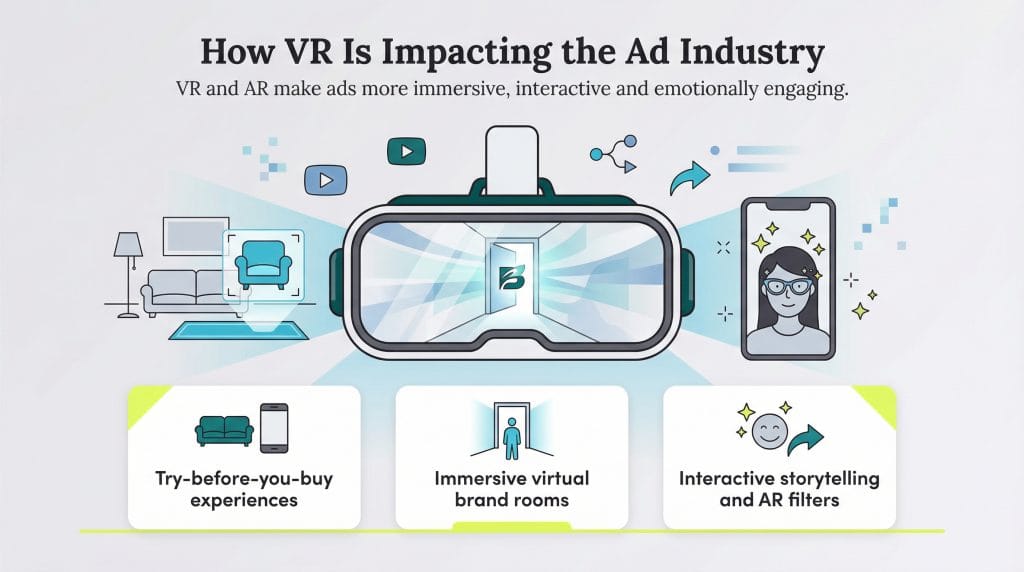
Forward-thinking businesses are integrating VR and AR into their advertising campaigns to drive engagement. Common (and effective) applications include:
With the advent of VR, window shopping is a thing of the past. Customers no longer have to imagine what their dream couch would look like in the living room or how the latest makeup would appear on their face.
Many B2C companies use VR and AR for “virtual try-on” (VTO) campaigns. These campaigns allow customers to use their phones to “place” the company’s products in their life to see what they look like. For example, Amazon Fashion allows users to virtually try on shoes and eyewear, while IKEA Kreativ lets users scan their rooms and erase existing furniture to design new layouts with IKEA products. Similarly, Wayfair’s app offers an AR function called View in Room 3D, which overlays images of its furniture into the customer’s living space.
Custom AR filters are becoming more popular with social media users. Platforms such as Snapchat, TikTok and Instagram have enabled AR filters that any user can make. Companies have also created custom filters to advertise their brand through AR. This creates awareness with minimal effort across mediums. Plus, it does so just by the creation of a simple filter for users to have fun and interact with. For example, in 2025, the National Football League (NFL) used Snapchat Lenses to create buzz for the Chiefs vs. Eagles game, allowing fans to pose with team helmets and jerseys, and then share the images with friends.
VR allows companies to connect with customers on an experiential level. Examples include 360-degree VR videos, immersion-style test drives and brand-related product experiences.
VR advertising has an inherent advantage over traditional advertising: It places users in a distraction-free environment. Thus, companies are incentivized to create high-quality content to engage the viewer for as long as possible. A virtual room differs from other forms of VR advertising, such as a 360-degree immersive video experience. With the former, the user is interacting with the content the entire time they’re inside the room. [Learn more about how to combine traditional and digital marketing approaches.]
More traditional forms of media support linear storytelling: There’s a clear-cut beginning, middle and end of the overall advertisement. With VR, the user has autonomy within the story and can look and go anywhere.
Another way VR is transforming business storytelling is by recreating in-person experiences — evoking an impactful positive emotional response. These marketing techniques are more efficient at captivating audience feelings; they go beyond a person sitting on a couch and watching an ad on television. The more positive emotions captured in the personalized VR advertisement, the better the ad engages and makes an impact on the consumer.
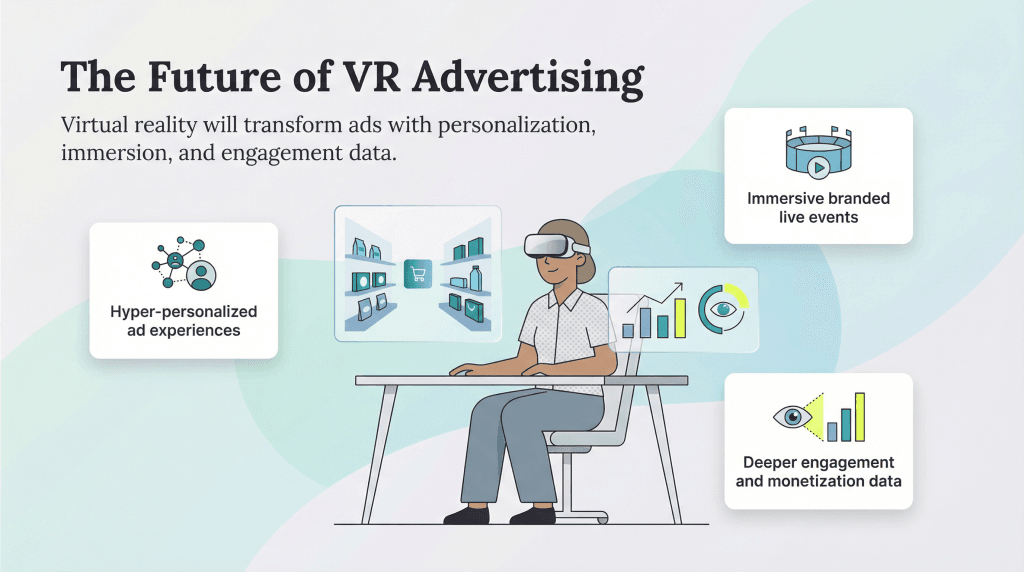
As with any emerging technology, VR’s capabilities — and subsequent impact on the advertising industry — could extend far beyond current applications. Here are just some of the ways VR could shape the future of advertising.
The combination of VR and artificial intelligence (AI) poses immense potential for highly personalized advertisements. AI can already collect and analyze data on a user’s preferences and shopping patterns at scale. In the future, advertising professionals can incorporate this data into their campaigns — potentially in real time as the technology continues to develop.
VR is revolutionizing the concept of “being there.” The NBA, for example, offers VR courtside seats via Meta Quest, allowing subscribers to watch live games as if they were in the arena. For advertisers, this opens new opportunities and revenue in the live event sphere. For instance, if a brand is sponsoring a live festival, the company could overlay virtual ads and digital coupons for its offerings via AR technology. Similarly, businesses hosting live events could augment the experience with various virtual offerings, including compelling visuals and “gamified” activities.
A natural extension of the try-before-you-buy and virtual room phenomena, 3D virtual storefronts are designed to simulate an in-person shopping experience. Customers could interact with a brand’s offerings as if they were in a physical store, including trying on items or viewing product demos. Brands could use their 3D virtual storefronts to experiment with different layouts and offerings. Also, they could provide a wider range of goods without relying on physical inventory.
VR advertising has skyrocketed in popularity and engagement over the past few years. VR advertisements have higher brand recall, quality impressions and other ad display metrics than traditional advertising. One of the key factors of advertisements in the virtual world is immersion; it can create high engagement with many ad types and offers an opportunity for companies looking to expand their marketing horizons. Possible avenues of revenue for advertisements include in-app purchases, as the level of engagement for virtual advertisements further increases. VR has followed the path behind video, social media and mobile applications, and games, with similar patterns of ad acceptance as the platform matures.
VR advertising also provides richer data than clicks and impressions. Advertisers can measure “gaze duration” — how long a user looks at a specific object — and interaction depth. As headset adoption grows, ad monetization will likely shift from cost-per-click to cost-per-engagement or interactivity metrics.
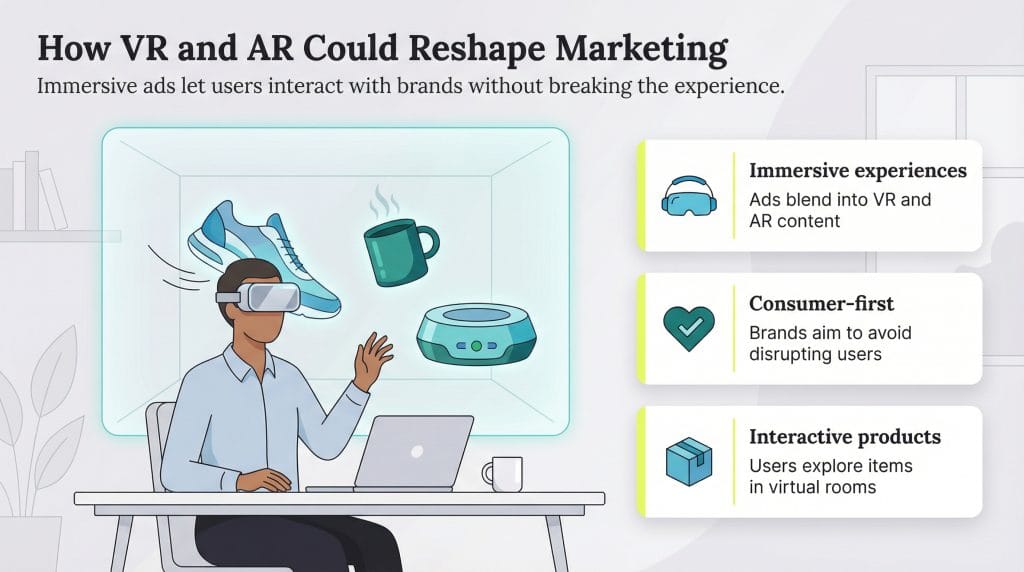
VR and AR are still new forms of technology. Early adopters say that this tech will change the way we consume media. If it does end up becoming a major entertainment medium in America, advertising and marketing will likely follow. If marketers can self-monitor, a user’s experience won’t be ruined by advertisements. Instead, built-in ads and immersive virtual-room-type experiences will allow consumers to interact with products while they’re enjoying content.
“The interest [in VR] is very deep,” said Julie Shumaker, former chief revenue officer, Create at Unity Technologies. “The good news for any of us in the ecosystem is, unlike many ads that tend to be almost completely driven by the agency world, this seems to be a consumer experience driven by the brands themselves.”
Matt D’Angelo contributed to the reporting and writing in this article. Some source interviews were conducted for a previous version of this article.