Written for the leaders, owners and professionals of the 11 million businesses with between $50,000 and $50 million in revenue.
|
It seems like overnight, every company — from social media networks to graphic-design apps, consumer electronics manufacturers, and health care services — became an AI company. This might’ve kept investors excited, but the irony is that customers are less likely to purchase any product marketed as “AI” as opposed to simply “high tech,” according to a new study.
The researchers say consumers are worried about their privacy, believe AI is prone to errors, or even fear it due to sci-fi movies. (So, if your company sells killer drones, just market them as high-tech killer drones!)
At least AI can help you build a business plan. For more, read our experiment on How to Build an Online Business, According to ChatGPT.
|
|
|
Frilliance: Gen Z CEO knows why authenticity is everything
Marvel: Comic book company reassembled after bankruptcy
Game Boy: Old-school platform meets new-school marketing
|
|
|
Frilliance CEO Fiona Frills Knows Why Authenticity Is Everything to Gen Z
|
When Fiona Frills launched her “teen-tested and approved” cosmetics company Frilliance at age 13, it might’ve appeared like simply a fun hobby — but seven years later, her products are distributed in Walmart, CVS, on Amazon, and through the company’s rep program. With over a million YouTube followers, Frills knows Gen Z like few other CEOs (since, y’know, she’s one of them) and shared her unique perspective with us.
b.: How did Frilliance get started?
Frills: I [was] filming YouTube videos, trying out different beauty products, when my skin started to break out really badly. I researched teen beauty brands … that wouldn’t break me out, but I couldn’t find anything. I decided, “OK, let me create one!”
We found a lab that was only an hour and a half away. … Not only did I learn a ton about the ingredients and how they work together, but I got so much more comfortable working with adults [and] learned how to communicate what I needed from a business standpoint…
b.: How does being so close in age to your target demographic give you an advantage?
Frills: You have to understand the language of your target audience. It says so much about your brand. I really strive to make younger creators and customers comfortable by relating to them authentically, which is something that Gen Z and Gen Alpha value.
b.: What are the biggest mistakes you see other youth-focused brands make?
Frills: I see so many companies that make emotionless, vague ads. When you look at successful brands, their ads remind you of their key value — clean design from Apple, reliability from Amazon — but there are a lot of brands that just mimic each other’s content, from the graphics to photography to the copy. I think it’s all about finding a way to keep your … unique brand footprint.
b.: What social media marketing trends are hot and working for you right now?
Frills: I’m a huge fan of Bloom Nutrition’s strategy. They partner with creators to film day-in-the-life content that organically features their powders. In the midst of this video, you’ll see an influencer mix up and drink the Bloom powder, and it doesn’t deter you because it’s not a traditional ad.
When younger generations see a video that’s clearly sponsored, it just doesn’t convert. We make sure to personalize every single partnership and build a connection with our creators; it’s crucial for us to make really authentic content.
|
|
|
Clover is the lucky charm your business has waited for
|
Accepting payments is beyond important, but many first-time business owners are surprised that it’s beyond complicated. Now, though, there’s a unified point-of-sale (POS) system and credit card processor that makes the entire experience a breath of fresh air.
Clover is an all-in-one POS system that provides your business with software, hardware, and processing support all in one place. Get started processing debit and credit card transactions right away, including tap and NFC payments. The built-in software allows you to track sales data and manage inventory with ease, helping you adapt in real-time to customer demand.
From the point-of-sale to the back office, Clover is your lucky charm.
|
|
|
How Marvel Comics Re-“Assembled” After Bankruptcy
|
It’s difficult to fathom now, but Marvel was once more broke than Peter Parker before payday. Despite beloved comic book heroes from Spider-Man to Captain America, Marvel’s stock dropped from $35 in 1993 to $2 by ‘96 when it filed for Chapter 11.
This was largely due to a bursting comic-book bubble. Marvel had banked on a collectors boom carrying them indefinitely … until fans simply couldn’t stomach paying for one more gimmicky holographic cover.
So, Marvel licensed out its IP to Hollywood for cheap. But after the X-Men and Blade films became hits — for 20th Century Fox and Warner Bros. respectively, not for Marvel itself — the comic company’s execs realized they should produce their own movies.
The only problem? They no longer held the film rights to their most popular characters. So, they settled for launching newly minted Marvel Studios with C-list hero Iron Man, who — thanks to a career-defining performance by Robert Downey Jr. — instantly became an A-lister in 2008, bringing in approximately $585 million on an estimated $130 million budget.
It was such a hit that one year later, Disney (which saw the promise of a serialized, interconnected storytelling) acquired Marvel for a Hulk-sized $4 billion. Since then, the Marvel Cinematic Universe has reportedly generated over $13 billion. You could buy a lot of holographic covers with that.
|
|
|
Game Boy Is Back: Why Nike and McDonald’s Both Made New 8-Bit Retro Titles
|
|
|
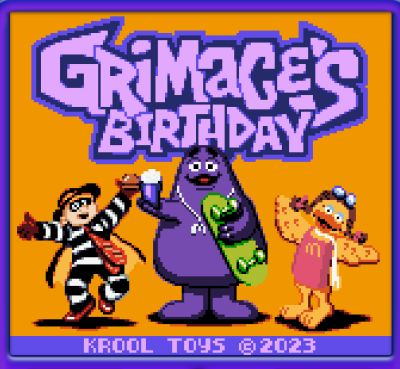
In one of 2023’s weirder marketing moments, McDonald’s put their big purple guy — uh, monster? — Grimace in an officially branded Grimace’s Birthday Game Boy game. No, not a Nintendo Switch game; McD’s actually made a title for the long-discontinued, brick-like early handheld console, originally released in 1989.
Then, in May 2024, Nike dropped Cosmic Climb, another game that you could play on a real Game Boy (or, if you preferred, a modern internet browser). What is going on here?
Both titles were developed by Krool Toys, a two-person team that makes unique designer playthings for niche marketing rollouts. As interest in retro gaming booms, brands know they can get a big reaction from a relatively small spend, generating press — like this article right here — while fostering nostalgic goodwill on YouTube, TikTok, and Reddit. That’s a whole lot of ROI from a couple hundred kilobytes.
|
|
|
Written by Dawn Allcot and Dan Ketchum.
|
|
|
|