Our workdays are filled with never-ending interruptions: emails, Slack notifications, loud side conversations, and meetings that could’ve been emails. It feels difficult to sit down and think about what we’re doing.
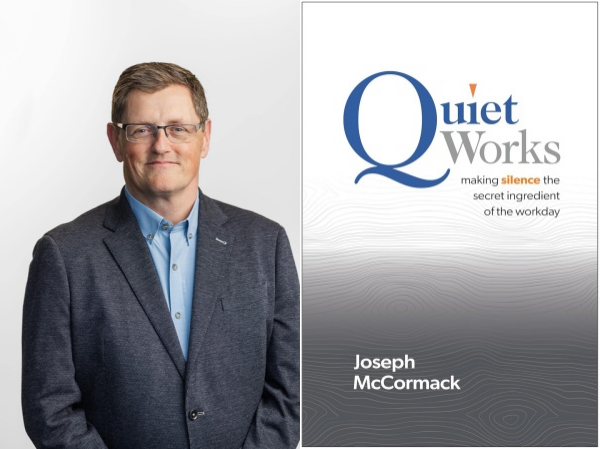
In his recent book Quiet Works: Making Silence the Secret Ingredient of the Workday, Joe McCormack, founder of communications firm The BRIEF Lab, makes the case for why minimizing noise is crucial for leaders. He spoke with b. about how to turn down the volume in your workplace.
b.: How did technology get us to where we are today?
McCormack: It was at times incremental and at times just overnight. … Our attention is completely spoken for. … It’s your bank account, a text alert, information, email, social media; the list goes on and on and on. And it’s right in your hand, right in front of you, and it never leaves.
b.: What are the consequences in the workplace?
McCormack: Rework, confusion, anxiety, unpredictability, chaos at times, frustration… [Leaders] can’t focus on a single thing. They talk about a million things. Well, people don’t like working for people like that. … They’re just running from meeting to meeting … and what’s missing is five minutes of quiet here, 15 minutes of quiet there, alone. … When you’re always on, your ability as a leader is diminished.
b.: Is constant collaboration helpful or a hindrance?
McCormack: If you look at the modern workplace, it’s … an open-floor layout. … It’s very difficult to actually get deep work done … because it’s hard to tell people around you to stop talking; it looks rude.
One of the biggest problems is the entire workplace is designed for only one type of work, which is collaborative work. And my conclusion is that you need to break the workplace into two. You need to entirely reimagine it.
b.: What are ways to become a “quiet leader”?
McCormack: Number one is, don’t treat quiet as a technique; treat it as an appointment. … It’s not about being good or bad at it; it’s about doing it. … I equate quiet to stretching before you work out. … It’s this little thing you do before and after that makes the thing that you want to do — which is working with others — better…
A person once said to me, “Wonder does not look like work, thinking doesn’t look like work, reading doesn’t look like work.” So the second thing people need to do is assign times and places for quiet at work. And most offices aren’t designed for that; most businesses don’t act like that.
Quiet Works is available now.
This interview has been edited for length. Read our full Q&A with Joe McCormack at business.com.