Business.com aims to help business owners make informed decisions to support and grow their companies. We research and recommend products and services suitable for various business types, investing thousands of hours each year in this process.
As a business, we need to generate revenue to sustain our content. We have financial relationships with some companies we cover, earning commissions when readers purchase from our partners or share information about their needs. These relationships do not dictate our advice and recommendations. Our editorial team independently evaluates and recommends products and services based on their research and expertise. Learn more about our process and partners here.
Lifetime Earnings Calculator
Many Americans earn more than $1 million over the course of their working lives. Use our calculator to estimate your lifetime earnings and see how to protect them.
Business.com earns commissions from some listed providers. Editorial Guidelines.
Table of Contents
Over the course of a career, lifetime earnings can add up quickly. Use our calculator to estimate how much you’re likely to earn before retirement — and how to protect it.
Key terms when using the lifetime earnings calculator
Current age
The calculator uses your current age as the starting point for working out how much you’ll earn between now and retirement.
Retirement age
This is the age at which you plan to stop working. For context, the average retirement age in the United States is around 65, though many people work until 67 or even 70, often to maximize Social Security benefits. The calculator uses your current age and retirement age together to estimate the length of your remaining career and your future earnings.
Current annual income
This is your present gross annual income. The calculator uses this figure as the baseline for projecting future earnings over time.
Annual salary increases
This is your estimate of how much your salary will increase each year. To provide context, the Bureau of Labor Statistics’ Employment Cost Index shows that wages and salaries for civilian workers increased by about 3.5 percent over the period ending September 2025. You can use this figure as a general benchmark or adjust it based on your role, industry and career expectations. The calculator compounds this percentage year over year to project future income growth.
FYI
: Investment gains can significantly affect your long-term wealth. Using a capital gains tax calculator can help you estimate how taxes on asset sales may impact your overall financial picture and retirement strategy.
How can I maximize my lifetime earnings?
While there are no guarantees, several strategies can help you maximize your lifetime earnings and make the most of your career:
Invest in your professional development. One of the most effective ways to increase your lifetime earnings is to keep investing in your professional development. Building in-demand technical or business skills, staying flexible as industries evolve and continuing to learn throughout your career can all help support long-term income growth.
Produce the best-quality work possible. Becoming a reliable, high-impact contributor increases your chances of internal promotions and higher employee compensation. Consistently delivering value makes it easier for employers to justify merit pay increases, advancement opportunities and employee bonuses.
Start a business. If you have specialized expertise and an entrepreneurial mindset, starting your own business may offer even greater earning potential. That said, entrepreneurship also carries risk, so it’s important to weigh the financial upside against the uncertainty before making the leap.
Explore the gig economy. A more gradual option is to consider becoming a freelancer or pursuing independent work alongside a traditional job. Freelancing is expected to continue growing in the U.S. workforce. According to Statista projections, 86.5 million people are expected to freelance in the United States by 2027, accounting for about 50.9 percent of the total workforce, reflecting the continued shift toward flexible and independent work.
Pursue consulting work. If you have skills in a high-demand field, independent clients may be willing to pay premium rates for your expertise. As your experience grows and your professional network expands, part-time freelance work can evolve into full-time consulting. In some cases, independent professionals earn more than they would in comparable salaried roles. Success, however, depends on your ability to market yourself, manage client relationships and maintain a steady pipeline of work.
Consider a career change. Another way to increase earning potential is through a strategic career pivot. For example, the technology sector continues to offer strong growth opportunities. According to the U.S. Bureau of Labor Statistics, employment in computer and information technology occupations is projected to grow much faster than the average for all occupations from 2024 to 2034, with about 317,700 job openings expected each year. Many organizations are looking for professionals who can combine industry knowledge with technical or data skills to improve performance and drive growth. Developing expertise in these areas can open the door to higher-paying roles.
No matter which path you choose, creating a clear career plan with measurable goals can help keep your earnings strategy on track.
Tip
Start saving for retirement as early as possible. Even modest contributions in your 20s and 30s can grow substantially over time thanks to compound interest.
What are the best ways to save for retirement?
Saving for retirement is less about one big decision and more about building consistent financial habits over time. While many Americans earn significant income during their careers, far fewer turn those earnings into long-term financial security.
According to the Federal Reserve’s 2022 Survey of Consumer Finances (the most recent data available), 54.3 percent of U.S. families held retirement account assets, such as 401(k) plans or IRAs. Among those families, the median retirement account balance was $86,900. That gap highlights how important it is to plan intentionally throughout your working years.
Here are some of the most effective ways to build retirement savings:
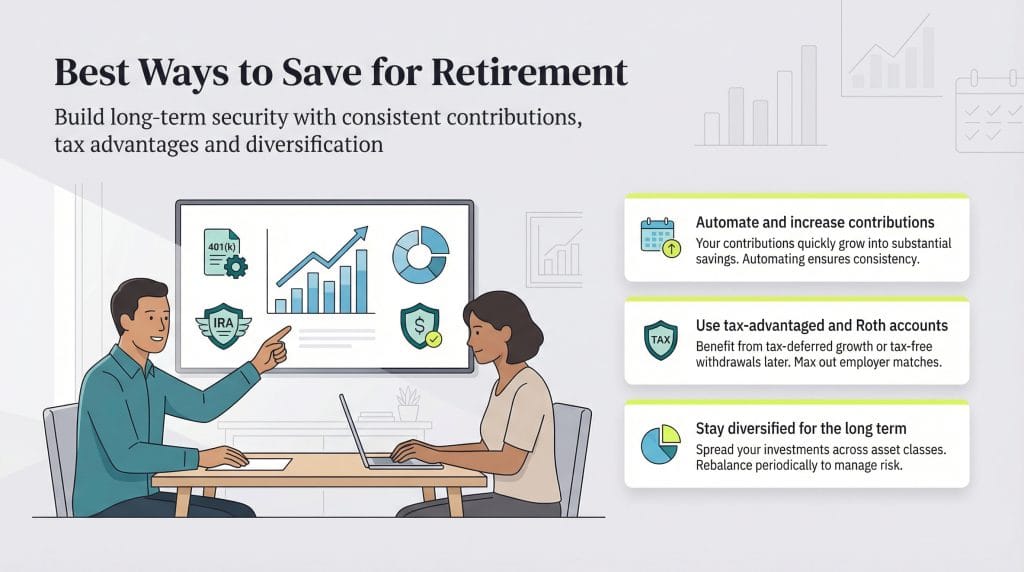
Take advantage of tax-advantaged retirement accounts. The best employee retirement plans, like 401(k)s and IRAs, help protect your savings from inflation while offering valuable tax benefits. Contributing early and consistently allows your money more time to grow.
Maximize traditional retirement contributions when possible. Contributions to traditional 401(k) retirement plans and traditional IRAs are made with pre-tax dollars, reducing your taxable income today. Taxes are paid later, when you withdraw funds in retirement. For 2025, the 401(k) contribution limit is $23,500, with an additional $7,500 catch-up contribution for workers age 50 and older. (This increases to $24,500 for 2026.)
Use Roth accounts to hedge against future taxes. Roth IRAs and Roth 401(k)s are funded with after-tax dollars, but qualified withdrawals in retirement are tax-free. This can be especially valuable if you expect to be in a higher tax bracket later. For 2025, the IRA contribution limit is $7,000, with a $1,000 catch-up contribution for individuals age 50 and older.
Always claim your employer match. If your employer offers matching contributions, aim to contribute at least enough to receive the full match. This is essentially free money and one of the fastest ways to grow your retirement savings.
Invest with a long-term mindset. While past performance doesn’t guarantee future results, diversified retirement investments have historically outpaced inflation over long time horizons. Staying invested through market ups and downs is often more effective than trying to time the market.
Build and maintain a diversified portfolio. A mix of stocks, bonds and other assets helps spread risk and improve long-term stability. As you approach retirement, review your portfolio periodically and adjust your asset allocation to match your time horizon and comfort with risk.
Consider professional financial guidance. A certified financial advisor can help you create a personalized retirement strategy, manage taxes and plan withdrawals. Vanguard research suggests that working with an advisor can add about 3 percent in net returns through better planning and behavioral guidance.
Mark Fairlie brings decades of expertise in telecommunications and telemarketing to the forefront as the former business owner of a direct marketing company. Also well-versed in a variety of other B2B topics, such as taxation, investments and cybersecurity, he now advises fellow entrepreneurs on the best business practices.
At business.com, Fairlie covers a range of technology solutions, including CRM software, email and text message marketing services, fleet management services, call center software and more.
With a background in advertising and sales, Fairlie made his mark as the former co-owner of Meridian Delta, which saw a successful transition of ownership in 2015. Through this journey, Fairlie gained invaluable hands-on experience in everything from founding a business to expanding and selling it. Since then, Fairlie has embarked on new ventures, launching a second marketing company and establishing a thriving sole proprietorship.