Business.com aims to help business owners make informed decisions to support and grow their companies. We research and recommend products and services suitable for various business types, investing thousands of hours each year in this process.
As a business, we need to generate revenue to sustain our content. We have financial relationships with some companies we cover, earning commissions when readers purchase from our partners or share information about their needs. These relationships do not dictate our advice and recommendations. Our editorial team independently evaluates and recommends products and services based on their research and expertise. Learn more about our process and partners here.
When evaluating a human resources information system or auditing your current one, keep these four things in mind.


Your human resources (HR) department is responsible for a large amount of employee data. Managing this information and turning big data into something useful can be difficult to do manually. However, what was once a time-consuming and overwhelming process can now be simplified, streamlined, and automated with the right software and systems in place. In fact, regardless of whether you’re running a new or established business, there’s a good chance that a human resources information system (HRIS) can help you out.
If you’re a first-time HRIS buyer, you’ll want to carefully assess the options on the market to find the right solution for your business — but it doesn’t stop there. As technology changes and your business evolves, you’ll want to conduct regular audits on your HRIS system to ensure it’s meeting your current needs.
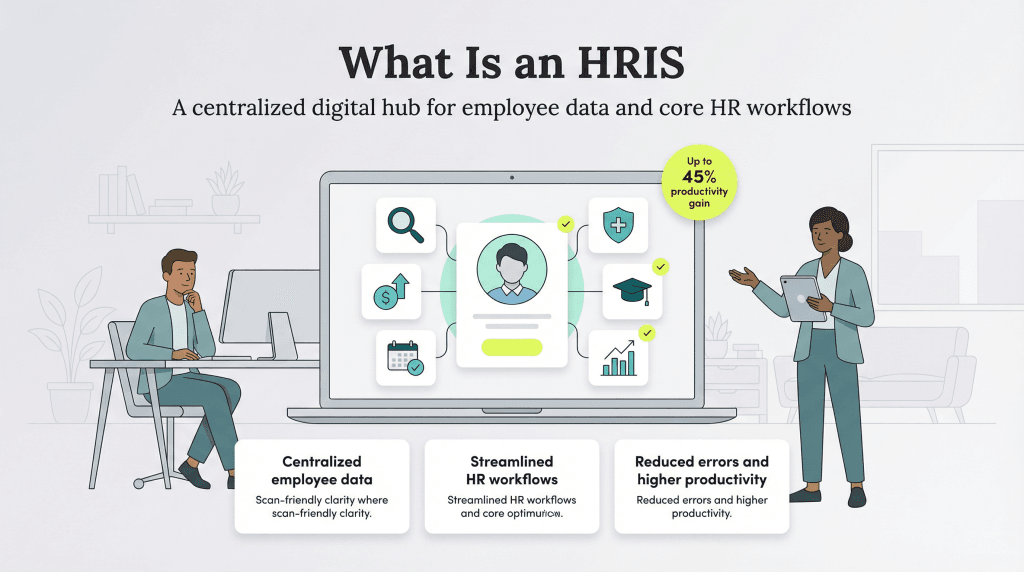
An HRIS is an integrated platform that serves as your organization’s digital HR command center, centralizing employee data while streamlining critical workforce management functions. It serves as a central hub for employee information and aids in common HR functions like: recruitment; applicant tracking; benefits administration; compensation management; employee training and development; absence management; administrative HR services; and HR workflows and workforce reporting. While one specific HRIS may meet your HR needs, some organizations find themselves using multiple HR platforms that integrate seamlessly (e.g., an applicant tracking system and performance management software).
An HRIS can be a powerful tool for workforce management, helping companies increase productivity by more than 45 percent according to recent industry benchmarks. These platforms excel at eliminating repetitive data entry and significantly reducing human error through intelligent automation features.
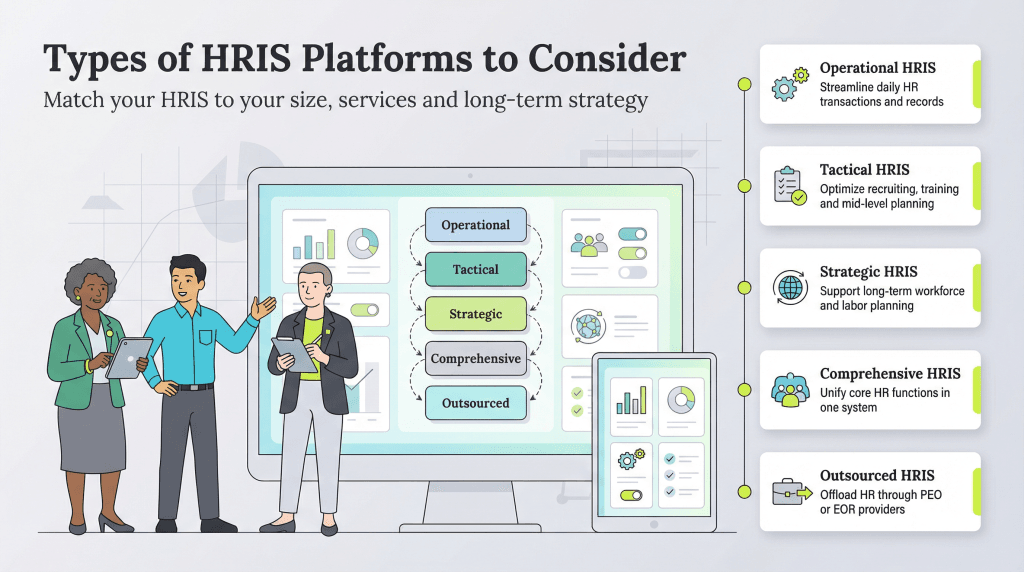
Understanding the different HRIS platform types helps you match the right solution to your organization’s specific needs and growth stage. Here are five primary categories to evaluate:
“Operational HRIS platforms are best for small to medium-sized businesses that need to streamline their HR processes and improve efficiency,” Wende Smith, head of people operations at BambooHR, told us.
“Tactical HRIS platforms are best for mid-sized to large organizations that want to leverage data to drive HR strategies and decision-making,” said Smith.
“For long-term strategic planning, Strategic HRIS platforms offer advanced analytics and insights, which are crucial for larger organizations with complex HR needs,” said Melissa Vadasserril, director at Audible.
“Integrated HRIS platforms are suitable for organizations of all sizes that want a unified HR system to streamline processes and improve employee experience,” said Smith.
“Small businesses, in particular, benefit from using a PEO to manage back-office operations, stay compliant, and manage and grow their teams,” said Vadasserril. “For companies with global workforces, another option is an employer-of-record.”
The wide range of HRIS types can make it tricky to know which system (or combination of systems) is right for you. As such, you’ll likely want to conduct a recurring audit on the HRIS you choose to ensure it continues meeting all of your needs. If it’s not, it might be time to evaluate new HRIS solutions to replace or supplement your system.
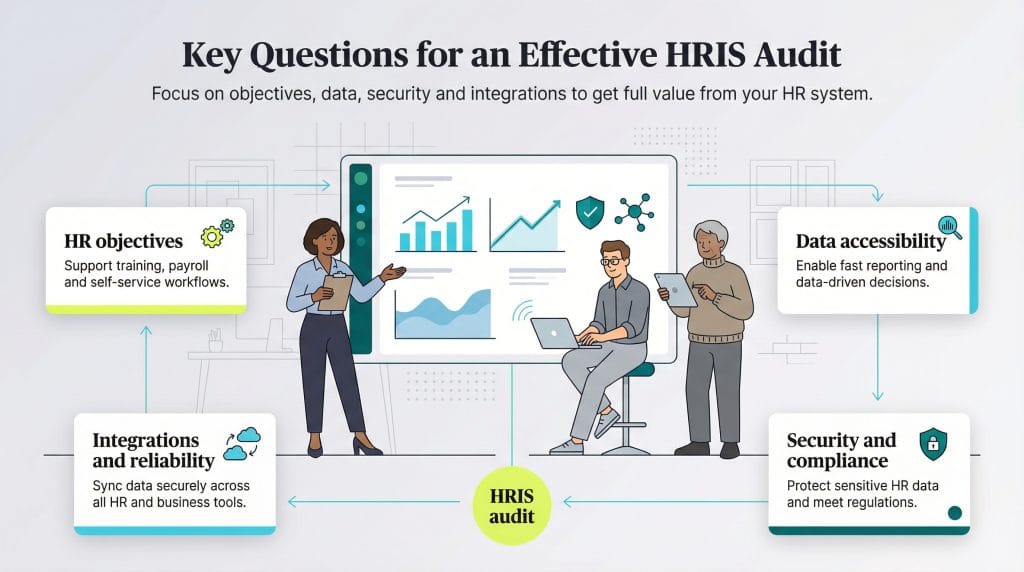
When evaluating an HRIS for purchase or auditing your current system, focus on four critical areas: operational efficiency, data accessibility, security compliance and system integration. These elements form the foundation of an effective HRIS audit framework.
To determine whether your HRIS is meeting HR objectives, evaluate whether the technology provided by your system supports your goals and streamlines your operations. Objectives often include training and employee development, benefits administration or self-service, and payroll and benefits administration. Does your HRIS help facilitate these things? It should.
If your HR team spends 25 percent of its time on record-keeping and auditing, your HRIS isn’t doing its job and is costing your business in terms of employee productivity. The information provided by your HRIS should reduce the time it takes to complete HR processes. The system should allow for easy report creation and management, data-driven decision-making, and employee performance tracking. Look for features like customizable dashboards, predictive analytics, and automated compliance reporting that transform raw data into actionable insights.
Human resources departments are responsible for a large amount of confidential data: employee Social Security numbers, direct deposit information, benefits administration details and so on. Your HRIS must protect this information — from the time it’s entered into the system to what would happen should a breach occur. Clear documentation is necessary; plus, protocols, policies and controls should be built into your HRIS so that only those who need access to sensitive information can get it. This is especially true when it comes to complying with regulatory requirements.
“Many industries are subject to stringent regulations regarding data protection, such as GDPR in Europe or HIPAA in the United States,” said Vadasserril. “A secure HRIS helps ensure compliance with these regulations — minimizing legal risks and potential fines associated with data breaches.”
Consider implementing zero-trust security models and conducting bi-annual penetration testing to identify vulnerabilities before they become breaches.
If you have seamless system integration with confidential information protection throughout, your HR data flow is on the right track in terms of security and reliability. From policies to protocols for data management, a robust HRIS should allow your business to integrate multiple software solutions as needed. Also, it should do so without the risk of data loss or information vulnerability.
“HRIS platforms store sensitive employee information such as personal details, payroll data, performance evaluations and more,” said Smith. “Ensuring platform security helps protect this confidential data from unauthorized access, breaches or cyberattacks.”
Evaluate your HRIS’s API security, data validation rules and integration monitoring capabilities. Modern systems should offer webhook notifications for failed integrations and automatic data reconciliation features to maintain accuracy across platforms.
As you audit an HRIS, make sure you have policies and processes that allow for effective identification, communication, capture and validation of HR data. Document your audit findings using a standardized scorecard that tracks system performance against key metrics like uptime, data accuracy rates and user satisfaction scores.
By asking these types of questions during an HRIS system audit, business owners can gain valuable insights into the system’s security, compliance, functionality and alignment with organizational objectives. Regular audits help identify optimization opportunities, ensure regulatory compliance and maximize the strategic value of your HR technology investment.
Skye Schooley contributed to the writing and reporting in this article. Source interviews were conducted for a previous version.