Email is an effective and affordable digital marketing strategy that many businesses rely on to reach customers. Implementing email marketing is straightforward, thanks to templates and platforms that allow you to segment your lists and track results. Notably, email helps you deliver personalized content based on customer purchase history and prospect engagement, and customers can respond directly to offers.
However, like all marketing channels, email marketing has its share of obstacles. We’ll examine the most significant issues plaguing marketers and how to use email marketing best practices to address them.
Email marketing challenges and solutions
The biggest email marketing challenges include earning new subscribers, increasing open rates, retaining subscribers, improving deliverability, boosting click-through rates and achieving a measurable return on investment (ROI). Here’s a look at these top obstacles and their solutions.
1. Earning new subscribers
While email marketing has enormous benefits, it won’t be of much use unless you have a quality list of prospects and customers to send your messages to. Building that list takes time. Because of opt-in email marketing legalities and best practices, subscribers must willingly join your email list. This can make list building slow, especially now that inboxes are crowded and people are increasingly cautious about sharing their email addresses. But if you buy an email list and try to use it in a campaign, you’ll likely get kicked off the email platform and flagged as a spammer. It’s critical to build a quality email list organically, even if it takes time.
Solution: The best way to earn new subscribers is to show clear value right away and make signing up feel effortless. Keep your message simple and honest about what people can expect. Maybe you share helpful product updates or offer deals they can’t get anywhere else — whatever it is, make sure it feels worth their time.
Let people know exactly why they should subscribe and how your emails will benefit them. Here are some ways to promote your list and boost subscriptions:
- Showcase your subscriber count: If your list is large enough to build trust, mention it. A quick line like “Join over 12,000 subscribers!” can help people feel confident about signing up.
- Make sign-ups easy on your website: Add a sidebar form or an email pop-up box so visitors can join your list without hunting for it.
- Add a sign-up button to your blog posts: Let readers subscribe right after they finish a post and are already interested in what you offer.
- Encourage subscribers to share your emails: A simple forward or share can help you reach new people through your existing audience.
- Offer an incentive for joining: A free trial, sample or another small perk on a dedicated landing page can give visitors a reason to opt in.
Additional ways to
grow your email list include adding a link to employee signatures, displaying gated offers on your site and requiring an email address for visitors who want access to quotes and certain resources.
2. Increasing email open rates
According to GetResponse’s email marketing benchmarks, the average email open rate across industries is 39.6 percent. That means most emails never get read, even when people have opted in. Standing out in crowded inboxes — and convincing subscribers to actually open your messages — is one of the biggest ongoing challenges in email marketing.
Solution: Work to boost your marketing emails’ open rates by using the following best practices:
- Use compelling subject lines: Since they’re the first thing recipients notice, focus on writing subject lines that spark interest right away. Keep them concise and test different versions to see what resonates with your audience.
- Personalize your subject lines: Recipients like when subject lines are personalized, but you don’t have to overthink the strategy. Mailjet’s 2025 survey shows that 61 percent of people notice when the subject line contains their name, while over 80 percent pay attention when it aligns with their needs and interests. So focus on relevance first; the name is optional.
- Use trigger events to send emails: Triggered emails often perform better because they arrive when someone is already engaged with your business. Welcome emails are one of the strongest examples. GetResponse reports an average open rate of about 83 percent, far higher than typical email newsletter campaigns. If someone abandons their online shopping cart, follow-up emails can also help recover potential sales. According to Moosend’s 2025 database analysis, more than 40 percent of cart-abandonment emails are opened.
3. Low deliverability rates
A compelling email with an interesting subject line won’t matter if your messages never reach the inbox. Clearing today’s increasingly strict spam filters has become a persistent challenge for marketers. Full inboxes, outdated or nonexistent email addresses and poor sender reputations can all drag down your deliverability rates.
When your deliverability rate stays low, inbox providers may start blocking your messages altogether. It’s a costly problem because every email that fails to land represents wasted time, money and effort.
Solution: You can take several steps to improve your email deliverability rates, including the following:
- Avoid spammy words: Steer clear of common spam triggers in your subject lines. Spam filters vary by industry, but many look for terms and phrases like “buy,” “cash,” “earn $,” “save $,” “sale,” “subscribe,” “make $,” “click,” “free,” “trial,” “cost,” “cheap,” “prize,” “as seen on,” “be your own boss” and “unlimited.”
- Clean up your contact list: While you can’t control full inboxes, you can improve deliverability by regularly cleaning your email list. Remove inactive or unengaged contacts and use email analytics to identify subscribers who never open your emails.
- Implement double opt-in: Double opt-in helps confirm that subscribers are using accurate email addresses and want to hear from you. This can protect your sender reputation and improve compliance with regulations like CAN-SPAM, the General Data Protection Regulation (GDPR) and other consumer-consent laws.
- Help users update their contact information: Subscribers may change an email address or lose access to an old one. Make it easy for them to update their information through your website.
4. Retaining email subscribers
It’s great to add subscribers, but keep a close eye on your unsubscribes. The average email unsubscribe rate is about 0.22 percent, according to Mailchimp, but this can vary quite a bit by sector and email frequency. If you have a strong base of active subscribers, it pays to make every effort to keep them.
Solution: The best way to keep your current subscribers is by sending relevant emails to the right audience. Try these tips to keep subscribers engaged:
- Segment your email list: Develop customer personas and use segmentation to group subscribers by customer type and address the unique needs of each audience. For example, you might have one list for loyalty program members, another for occasional buyers and another for prospects. You can also segment by purchase history or spending levels.
- Target emails to various segments: After organizing subscribers into market segment lists, send each group emails that speak directly to their interests. For example, a prospect might receive a one-time discount to encourage a first purchase, while a long-time customer might get an invitation to an in-store event.
- Reengage inactive customers: Bring dormant subscribers back with a reengagement email marketing strategy. If they still don’t respond, consider removing them. Their email addresses may be obsolete, or they may no longer be interested in your content.
- Follow the 80/20 rule: Aim for about 80 percent of your email content to be informative and valuable, with no more than 20 percent focused on promotions. If you overwhelm subscribers with hard-sell messaging, you risk losing them quickly.
- Optimize your email timing: Send enough emails to stay in touch but not so many that you clog up subscribers’ inboxes. While there’s no set rule, many marketers start with one to two emails per week, and then adjust based on how recipients engage. You can also allow subscribers to choose how often they’d like to hear from you when they opt in, or prompt them to reduce frequency instead of unsubscribing.
5. Low click-through rates
Another top email marketing challenge is improving email click-through rates (CTRs) and maintaining them over time. Even if recipients open your emails, it doesn’t mean they’ll read your content or click the links inside. According to the Mailchimp data cited above, the average email CTR across all industries is 2.62 percent, though top-performing email marketing campaigns can achieve rates above 4 percent.
Solution: Your low CTRs may be the result of disengaged or mismatched subscribers. Try these methods to capture their attention and encourage more clicks:
- Use interactive elements: Adding features like GIFs, countdown timers or product carousels can make your emails more engaging and guide readers toward your call to action. The impact varies by audience and email client support, but interactive elements can help highlight key offers and keep subscribers interested.
- Boost subscriber engagement: Use compelling visuals and include polls, social share links or exclusive bonuses to encourage interaction.
- Optimize your emails for mobile: Your emails need to work well on mobile. Roughly 41.6 percent of emails are opened on a phone, so if your message isn’t easy to read there, your CTR will take a hit. Slow load times, tiny fonts or anything that forces people to zoom in can turn readers off before they ever get to your links.
6. Measurable ROI
Measuring digital marketing ROI can be tricky. You may see more clicks and opens, but that doesn’t automatically mean you’re getting new leads or sales. Without proper tracking, it’s hard to tell which emails are working. The stakes are high because email marketing can be effective. According to the State of Email 2025 report from Litmus and Validity, 35 percent of marketing leaders report returns between $10 and $36 for every dollar spent, 30 percent earn between $36 and $50 and 5 percent exceed $50.
Solution: Implement comprehensive tracking using UTM parameters, conversion pixels and your email platform’s analytics to connect engagement metrics directly to revenue. Closed-loop reporting lets you follow a subscriber’s journey from their first click to their final conversion, giving you a clearer picture of how your emails drive business results.
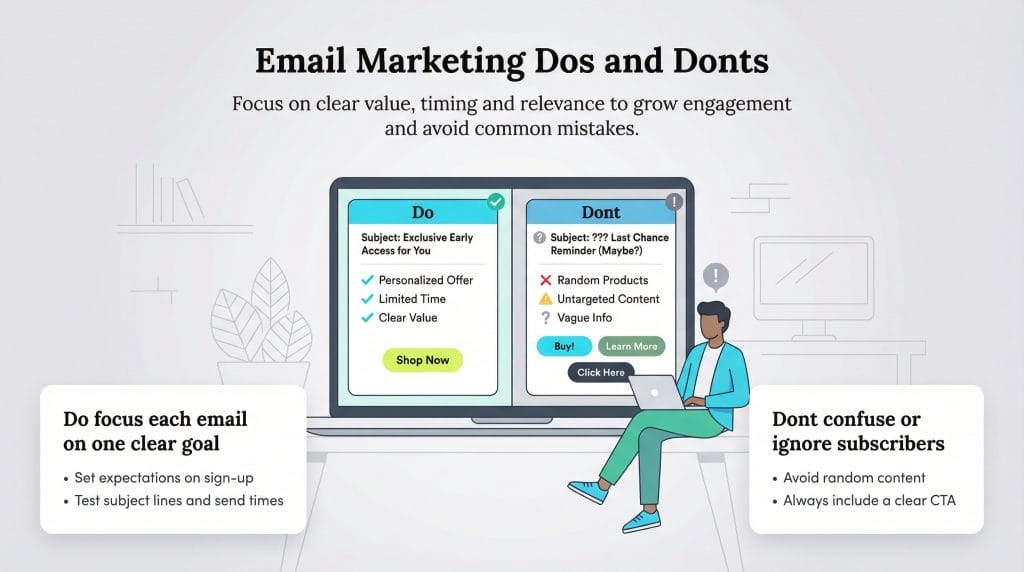
Email marketing do’s and don’ts
Do take these actions when planning and launching an email marketing campaign:
- Include sign-up links: Add subscription links to your email signature, social media channels, website pop-ups and even the end of videos. Make it easy for people to join your list wherever they interact with your brand.
- Offer subscription bonuses: Give new subscribers a compelling incentive, such as a one-time discount or a free e-book, to encourage sign-ups.
- Be clear about what you’re sending: On your sign-up form, set expectations upfront. Let subscribers know what type of content you send and how often.
- Test subject lines: A/B test your subject lines to learn what resonates most with your audience.
- Test send times: Engagement varies by industry, but many campaigns perform best when sent Tuesday through Thursday between 9 a.m. and 11 a.m. Use this as a starting point and refine based on your own analytics.
- Resend campaigns: If a recipient didn’t open your message the first time, try sending it again with a new subject line or at a different time.
Here’s what not to do in email marketing:
- Neglect to send new subscribers a welcome email: A welcome message sets the tone, reminds people why they subscribed and reduces the odds of an immediate unsubscribe.
- Forget to include a CTA: Every promotional email should link to a shopping page or form. Even informational emails should point readers to a helpful blog post or additional resource.
- Have multiple goals for one email: Stick to a single, clear action you want subscribers to take. Too many competing messages can overwhelm readers.
- Send random content: Don’t send irrelevant or unexpected content that doesn’t match what subscribers signed up for.
- Ignore accessibility: Ensure your emails are accessible to all recipients by using proper alt text for images, maintaining strong color contrast and structuring content with clear headings.
Maximizing your email campaign’s potential for success
Email marketing keeps changing as new tools come out and people’s expectations shift, but the core idea hasn’t moved much. Give people something useful, don’t waste their time or crowd their inbox, and keep testing what works. If you stay flexible and pay attention to how your emails perform, you’ll be able to work through the biggest challenges. The tips in this guide can help you fine-tune your approach and, over time, turn that effort into better engagement and stronger results.