Business.com aims to help business owners make informed decisions to support and grow their companies. We research and recommend products and services suitable for various business types, investing thousands of hours each year in this process.
As a business, we need to generate revenue to sustain our content. We have financial relationships with some companies we cover, earning commissions when readers purchase from our partners or share information about their needs. These relationships do not dictate our advice and recommendations. Our editorial team independently evaluates and recommends products and services based on their research and expertise. Learn more about our process and partners here.
While questions around remote vs. in-office work persist, recent data suggests that well-managed remote employees often match or exceed on-site productivity levels.

Flexible work arrangements are no longer viewed as temporary fixes; many organizations now treat them as a core part of how work gets done. According to the Pew Research Center, about 75 percent of workers with jobs that can be done offsite work remotely at least some of the time. Long-term work-from-home setups now play a bigger role in how businesses operate, shaping both efficiency and employee satisfaction.
The question is no longer whether remote work is possible; it’s how teams make hybrid arrangements work day to day. While some large companies are pulling employees back into the office, many small and midsize businesses say flexible policies help with hiring, operations and maintaining steady productivity. Here’s a closer look at what the data says about remote productivity — and what it means for business owners.
Productivity in a remote setting isn’t automatic, which is why the answer to this question depends on the work environment and how teams are managed. Remote employees experience clear advantages as well as challenges that can shape their output day to day. Below, we look at the factors that tend to influence performance and where leadership decisions can make the biggest difference.
Remote productivity isn’t automatic. When expectations aren’t clear, some employees lose momentum or find it harder to separate work from home life. At the same time, flexible scheduling and modern management tools can help teams stay focused while adapting to different work styles.
Several factors tend to shape how productive remote employees feel day to day:
Bremec noted that Game Lounge experimented with alternative scheduling models to support remote productivity. “Our four-day workweek experiment showed how much employees value autonomy,” she said. “Well-being and productivity improved significantly during the trial.”
Maintaining a strong company culture can be challenging when teams are dispersed. Remote employees may also feel left out of key conversations due to proximity bias, where leaders — intentionally or unintentionally — give more visibility or opportunities to those working in the office. Over time, this imbalance can reduce employee engagement and leave remote staff feeling disconnected, which may affect workplace collaboration and productivity across a hybrid team.
Addressing these challenges often requires more intentional communication and structured opportunities for connection, rather than assuming engagement will happen naturally.
“Remote employees are more likely to struggle with feelings of isolation and disconnect from their company, which makes managers partly responsible for their sense of connection to the team,” said Dovile Gelcinskaite, senior talent manager at Omnisend. “It can be fostered through regular check-ins, virtual and, where possible, in-person team-building activities.”
Without clear boundaries around messages and meetings, remote employees may find the workday creeping past normal hours, which can make work-life balance harder to maintain. While longer hours may create the appearance of higher productivity, constant notifications and back-to-back virtual interactions can lead to digital fatigue, productivity-killing stress and declining engagement over time.
“Remote employees’ engagement also depends on a healthy work-life balance, which is especially hard to sustain remotely, making such workers prone to burnout,” Gelcinskaite cautioned.
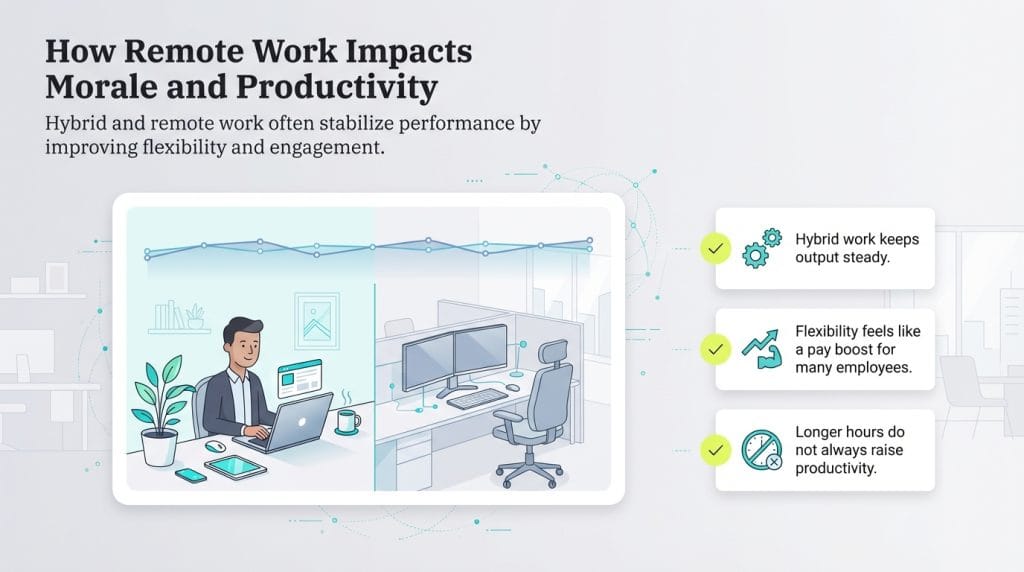
Remote work plans and hybrid work arrangements don’t always increase output directly, but they can change how employees experience the workday — and that shift often influences long-term performance. Research increasingly shows that morale, expectations and workplace policies all shape how productivity plays out in remote environments.
Here are a few patterns that stand out when it comes to remote work, employee morale and productivity:
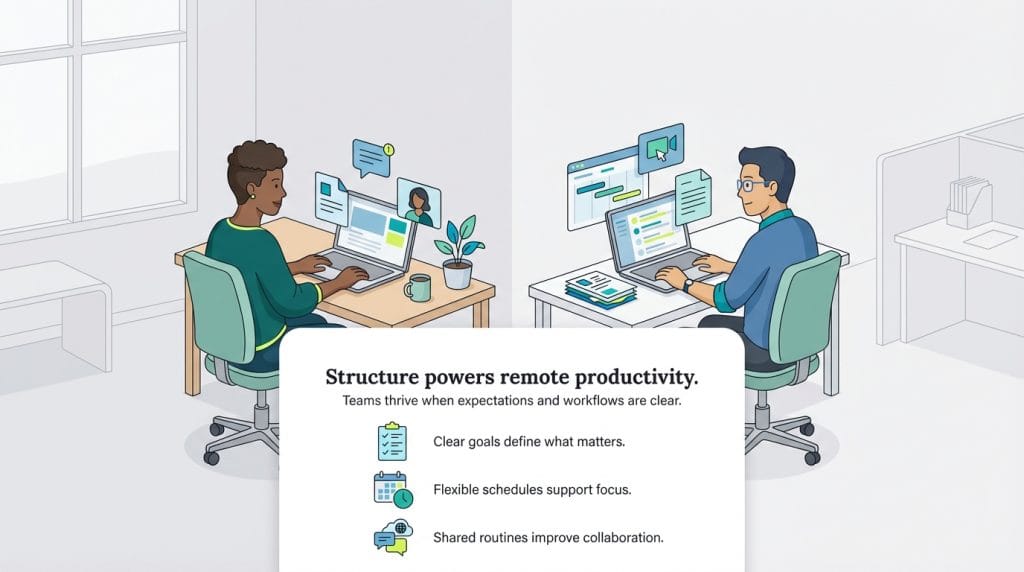
Remote work can support strong productivity, but it works best when teams have a clear structure. The good news is that small adjustments to daily routines and expectations can help employees stay focused without sacrificing work-life balance.
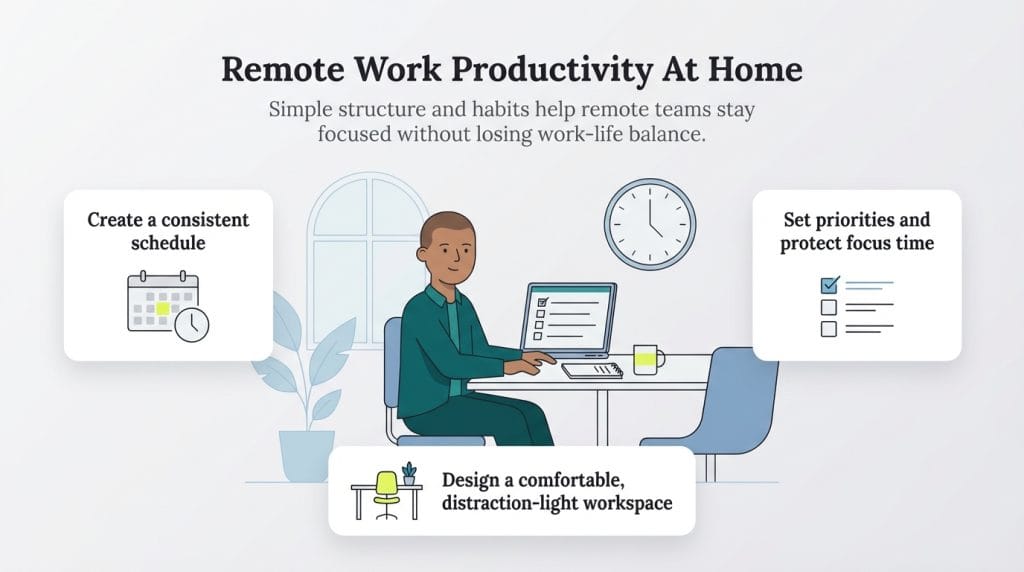
Here are some tips for improving work productivity at home, whether you’re a team member looking to improve your remote work skills or a manager setting up a distributed team for success.
Flexibility is one of remote work’s biggest advantages, but too much unpredictability can make collaboration harder. Establishing a consistent schedule helps teams stay on the same page and ensures employees are available when it matters most.
“We have people who work in different time zones and people who can take their children to school. We have others with children with specific illnesses that need regular hospital visits; they can do all that and still do their job and do their best,” said Bremec.
As you build a remote work plan, encourage employees to develop routines that support their individual schedules. A simple morning routine — similar to what they might follow before heading into the office — can help signal the start of the workday and make it easier to transition into focused work.
Remote employees often need to manage their own workflow more independently than in-office teams. Without constant oversight, clear priorities help employees stay focused and avoid letting work spill into personal time.
“We’ve invested heavily in tools and policies to support hybrid and remote work. From task tracking to hot-desking systems, we’re creating an environment where flexibility is a given, not an exception,” Bremec said.
Many remote workers rely on simple prioritization systems, such as daily to-do lists or frameworks that separate urgent tasks from less important ones. These approaches help employees focus on meaningful work instead of reacting to every new request. Whatever method your team uses, encourage employees to complete key tasks during regular work hours to reduce burnout risk.
“Employees are most engaged when they feel part of a team that’s working toward shared goals,” said Jon Penland, chief operational officer at Kinsta. “The key is that they need to be an expression of the company’s DNA such that leadership can champion those goals without reservation and something that the team works together to achieve.”
Staying productive at home often comes down to reducing everyday interruptions. During regular check-ins, invite team members to share which tasks or home-based distractions make it hardest to focus. Talking through those challenges together can help teams identify small adjustments that make the workday feel more manageable.
Tools like white noise machines or apps that limit social media use may help some employees stay on track, but the most effective solutions usually come from understanding how each person works best.
“Make sure you have clear expectations about what is required of you, and if you don’t have clarity, ask for it. Once you have clarity, structure your day to support the work that matters to the outcomes you want to achieve,” said Penland, offering advice to remote workers on how to maximize their own productivity. “This will mean effectively managing distractions such as Slack and email notifications, scheduling blocks of time for focused work, and finding ways to keep track of the deliverables you’re responsible for.”
A comfortable setup makes it easier for remote employees to stay focused throughout the day. Whenever possible, encourage team members to work from a quiet area of their home where distractions are limited. Ergonomics also play an important role; screens positioned at eye level and chairs with proper back support can help reduce strain during long work sessions.
During weekly check-ins, ask employees how their home workspace is functioning and whether small adjustments could improve it. Some organizations offer equipment stipends or reimbursements to help employees create a more supportive work environment with ergonomic workstations and other helpful add-ons.
When employees work from home, the line between work and personal time can blur, which may lead to mental fatigue over time. Clear boundaries help teams maintain a healthier, more sustainable work-life balance.
Along with creating a comfortable physical space, encourage employees to set routines that signal the start and end of the workday. Simple “clocking in” and “clocking out” habits can make it easier to step away and take meaningful breaks. Research consistently shows that regular breaks support focus and long-term productivity. Some organizations also rely on the best time and attendance software to help employees track hours and maintain clearer boundaries.
Physical movement can help employees stay energized throughout the day, yet it’s easy to overlook when working from home. Without a commute or quick walks to meetings or lunch spots, many remote employees move less than they would in an office setting. Encouraging simple habits — stretching during breaks, taking a short walk or using a stationary bike — can help reset energy levels and support focus.
Regular movement gives employees a chance to step away from their screens, which may improve concentration when they return to work.
If your team is new to remote work, it may help to keep a version of the daily commute (just without the traffic). Some employees use that time to ease into the day with a short walk, light stretching or a few quiet minutes before logging on. Building a simple transition at the start and end of the workday can help employees mentally switch between personal time and focused work, much like a traditional commute once did.
Remote work isn’t the enemy of productivity. When supported by clear expectations and thoughtful routines, it can help businesses tap into talent beyond geographic boundaries while giving employees the flexibility they value. Finding the right balance takes intention; teams need to understand how they work best and build habits that support focus and collaboration.
In practice, many organizations discover that flexible schedules don’t just maintain productivity; they can also reduce stress and help employees stay consistent over time. With the right structure in place, remote work becomes less about where people sit and more about how they work.
Tejas Vemparala and Miranda Fraraccio contributed to this article. Source interviews were conducted for a previous version of this article.