Business.com aims to help business owners make informed decisions to support and grow their companies. We research and recommend products and services suitable for various business types, investing thousands of hours each year in this process.
As a business, we need to generate revenue to sustain our content. We have financial relationships with some companies we cover, earning commissions when readers purchase from our partners or share information about their needs. These relationships do not dictate our advice and recommendations. Our editorial team independently evaluates and recommends products and services based on their research and expertise. Learn more about our process and partners here.
Follow these tips to create cohesive branding that appeals to Generation Z and millennial consumers.


Consumers’ buying practices are evolving, largely due to the rise of e-commerce and social media. Consider the shopping habits of different generations: Whereas baby boomers typically prefer traditional marketing such as word of mouth, television commercials and radio ads, millennials rely on the internet for most of their purchasing decisions.
Generation Z consumers, who were born and raised in the social media era, are following their immediate predecessors with an even bigger emphasis on online purchases and social platforms. As more and more Gen Z and millennials make up the addressable market, companies need to ensure their brands attract these customers’ attention and spending money.
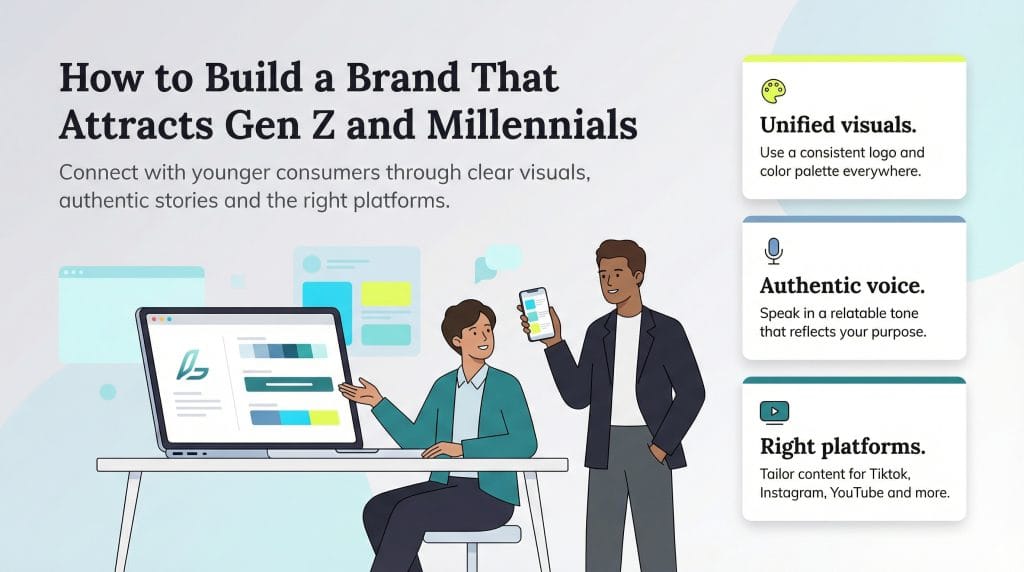
It’s more important than ever for small businesses to build a brand that stands out to millennial and Gen Z consumers. These generations are open to trying small businesses, but it’s up to you to ensure your brand quickly and effectively communicates who you are and why these consumers should learn more about your company. Business owners must prioritize these goals to acquire new customers and support the next level of growth.
Here are some important tips for connecting with this combined younger-consumer cohort through a solid, cohesive brand.
Creating a logo is the first step in presenting a unified, professional look that attracts younger consumers. Start by listening to your brand voice. What do you sell? What do you stand for? What feeling or message do you want people to get from your logo? An effective brand image is simple and visually appealing. Your design doesn’t have to say everything about your business, but it should offer a strong first impression. It also needs to be flexible enough to span all of your marketing.
To achieve a unified look and feel, you must create your own style guide, which will make all your materials, including your business cards and product packaging, feel cohesive.
That said, not every piece should look identical. Stick to the same general or complementary color palette as your logo. If you introduce new elements, make sure they convey the same feeling as your logo so your brand expression stays consistent and customers can immediately tell everything is coming from the same business.
Your brand’s look and feel are not just visual; they have a voice, too. To identify your brand voice, consider your personality as well as your company’s, and then get a sense of your customers. Figure out who you’re selling to, what these millennials and Gen Zers care about, and how they’d like to be spoken to. A relatable tone of voice will make your business feel trustworthy and encourage customers to continue their relationship with you. Once you find your brand voice, make sure it’s consistent across all parts of your business.
Lindzi Shanks, co-founder of gourmet marshmallow brand XO Marshmallow, suggests taking a more indirect, human approach with your audience.
“Both demographics do not want to be directly marketed to,” Shanks explained. “They don’t want targeted ads. They want the people, the behind-the-scenes process, the rawer details of the business side of things. The more transparent we are, the less we try to sell them, the more our sales increase.”
Your brand voice shapes the “what” and “how” of your business, while your brand story provides the “why.” A clear, well-articulated purpose builds an emotional connection with customers. This higher-level purpose doesn’t just give people something to buy; it gives them something to believe in, which is especially important to younger consumers.
Chances are, you already know your business’s story and purpose. Look back on what motivated you to get started. Was there a problem you wanted to solve?
A brand story doesn’t have to be complex or emotionally intense to resonate with your audience. A bakery’s purpose might be to make customers’ days a little sweeter. A landscaper’s mission might be to help neighborhoods bloom. What matters is telling your story in a unique, authentic way — the foundation of becoming a strong business storyteller. This story becomes an authentic part of your branding and plays a crucial role in showing your desired customers who you are and what you stand for.
Just as marketing to the wrong people won’t yield the right results, marketing to the right people on the wrong platform can be just as fruitless. According to the 2025 Sprout Social Index, there’s a clear split in where these generations actually spend time. Gen Z is most active on Instagram (89 percent), TikTok (82 percent) and YouTube (84 percent). Sprout’s broader platform data also shows that millennials are likely to show up on Facebook (87 percent) and LinkedIn (45 percent).
Those differences matter when you’re deciding where to focus your efforts. A channel that resonates with Gen Z may fall flat with millennials, and vice versa.
To avoid misalignment, L Parker Barnum, managing director at creative agency Mythology, recommends maintaining a strong presence across multiple digital platforms.
“While both generations are digital natives, Gen Z prefers newer platforms like TikTok for short-form video content, while millennials may engage more with Instagram and YouTube,” said Barnum, whose agency works with clients such as Target, Warby Parker and Mattel.
Take the time to understand the nuances of each platform, including which types of content perform best.
“Our TikTok focuses more on raw, behind-the-scenes content or ASMR [autonomous sensory meridian response],” Shanks said. “Our [Instagram] focuses more on aesthetics and now on ways to use our product.”
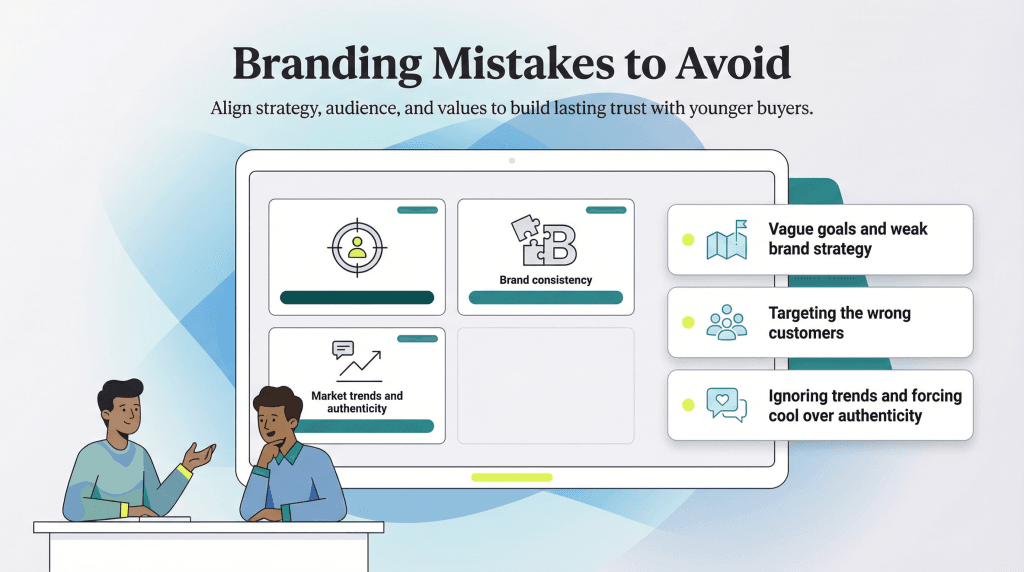
Knowing what not to do when you’re building a brand to attract Gen Z and millennial customers can be just as helpful as knowing exactly what will work. If you can identify weaknesses in your growing brand, you can strengthen its impact. Be aware of these common missteps.
When you’re building a brand geared toward consumers of any generation, you need clear goals for both your brand and the customer journey. If you’re struggling to hit the mark, start by evaluating your ideal customers. Who are they? What problem do they have that your business solves?
Identify your audience’s needs, then provide a solution and use it as your core message. For example, Canva identifies four parts in its brand strategy: personality, voice, identity and values.
Use that framework as the basis of your own strategy, and adjust the components within each category over time as you learn what makes the most sense for your brand and what can be thrown out.
Through it all, make sure you’re demonstrating the authenticity that Gen Z and millennial buyers crave. A genuine vision and clear, consistent branding are essential for connecting with a younger audience.
Even a standout product with great potential will go unnoticed if it’s not marketed to the right people. Pinpointing your target audience is crucial to your brand’s success. If you fail to do so, you risk wasting valuable time and effort.
An easy way to identify your target audience is to look at what your competitors are doing. Does their tone of voice reflect a younger demographic? What ages are the models in their photos and advertising? These choices can give you an indication that the brand is targeting Gen Z and millennial consumers. You should also review the customer data for your own products to determine which buyers show the most interest.
It’s also important to remember that millennials and Gen Z aren’t in the same stage of life, so what they need and how they make decisions can differ widely. Millennials now fall anywhere from their late 20s to mid-40s, while Gen Z spans early teens through late 20s. With such a wide age range, the two groups often approach purchases differently and prioritize different things.
“You can adjust your product offerings and marketing messages to address each group’s specific needs and interests,” Barnum advised.
Have you ever come across a great product that doesn’t match the company’s branding? If the packaging design is off or the tone and voice on the website don’t complement what’s on the company’s social media pages, consumers can tell the business is being inconsistent. For many shoppers, this creates a negative association with the brand because inconsistency breaks trust.
Companies need to establish consistency before they can speak from a place of authority. A well-known example is Coca-Cola. The company’s red color and white typeface are instantly recognizable, and the brand rarely strays from that aesthetic. While most businesses don’t have this level of history with consumers, a lack of long-term consistency can still weaken your brand reputation.
When you ignore market trends, you slowly erode your business’s long-term viability. It can be hard to keep up with the rapid shifts in the digital age, but the potential for growth is worth the effort, especially when it comes to understanding what Gen Z and millennials care about.
For example, the 2025 Gallup/Bentley University Business in Society report shows that 60 percent of adults ages 18 to 29 and 55 percent of those ages 30 to 44 — groups that closely align with Gen Z and millennials — believe businesses should take a public stance on major social issues. Support in both age groups has climbed over the past year, showing that younger consumers want companies to speak to issues they care about, including climate concerns, mental health, economic fairness and privacy.
These expectations are echoed in Deloitte’s 2025 Gen Z and Millennial Survey, where mental health, cost of living and protecting the environment rank among the top concerns for both generations. When brands stay tuned in to these values-driven trends, they’re better positioned to stay relevant, build trust and earn long-term customer loyalty from younger buyers.
Because authenticity is the key to appealing to Gen Z and millennials, content designed to be “cool” or “trendy” — without taking the time to genuinely understand younger generations — can easily come off as disingenuous.
“For example, brands often get it wrong when they hire a celebrity to endorse their product but fail to portray it as an authentic use by the celebrity, making it read as a paid endorsement,” Barnum said. “While the exposure might reach millions of eyeballs, they’ve missed an opportunity for a more meaningful engagement with their customers.”
If millennials and Gen Z are your target audience but you’re not part of those demographics yourself, Shanks suggests bringing in voices that are. Partnering with micro-influencers who have real connections with their followers is often far more effective than chasing big-name endorsements that may feel inauthentic.
Branding a business for millennials and Gen Z takes more than a good look or a trendy color palette. Younger buyers want to feel a real connection, and that only happens when your brand shows up with honesty and consistency. They’ve grown up online, so spotting anything that feels forced or inauthentic is second nature to them.
Try to look beyond the immediate sale and focus on the relationship you’re building. A strong brand story makes customers feel understood and gives them a reason to come back. If your values stay steady and your message doesn’t shift with every trend, people notice — and they’re more likely to stay with you over time.
Erin Shea contributed to this article. Source interviews were conducted for a previous version of this article.